
Teaching Bullying Prevention: 5 Reasons Instruction Matters

Teaching bullying prevention effectively matters to the success of any program a school adopts. Relatable content, active student participation, deliberate lesson design, real-world application, and honest assessment all shape whether a curriculum reaches students. Requirements for prevention policies, staff training, and curricula vary by state and district, so follow applicable law and local policy.


Back to the main Bully Prevention Guide.
STRONG INSTRUCTION…that's the ticket! No one will argue that having the most effective bully prevention program and strong school policies are intricate pieces to stopping bullying, but effective instruction matters just as much! After listening to Principal Kafele recently, I now understand more than ever that administrators must focus on good instruction.
Good administrators spend time in classrooms. They know their teachers well, and they know the content in which they teach. They understand that curriculum can only be taught to students who trust them and are engaged. Likewise, good instructors know their content well and know their students even better. They understand that bully prevention is shared work across administrators, staff, students, and families, and that their classroom is one piece of it.
Administrators and teachers must work together to determine the best way information should be taught to students. Educators know that teaching a stand-alone lesson on bullying isn't as effective as also connecting the content to real-world situations and what is happening currently in the school.
What evidence do administrators and teachers have to prove that their bully prevention program is being taught effectively and students are using the information? Here are five reasons why strong instruction affects bully prevention.
PU #104 - Strong Content and Relatable Examples
Bully prevention curriculum needs to contain strong content that is based on examples that students can relate to and understand. Using real-life situations and scenarios to teach what adults would do is one thing, but using these situations with students in the school can be difficult. The scenarios must be flexible and moldable to each individual school. Teachers must understand and actually deal with bully situations in order for the content to be relevant. Teachers who are not in touch with the pulse of the school and their classroom will find that these lessons may not improve bullying whatsoever. Again, I stress the fact that strong instruction starts with strong teachers.
One of the most popular curriculums, the Olweus Bullying Prevention Program, includes the following types of information in the lessons or "class meetings" at the elementary, middle, and high school levels:
- building a positive classroom climate
- identifying feelings
- communication
- hot spots
- peer relationships
- respecting differences and promoting acceptance
- serving the community/reaching outward
- using current events
Teachers not only connect lessons to what is going on in the school, but they must also introduce topics and strategies that students will encounter. This symbiosis makes bully prevention quite intricate. Whether our students are ready for certain information depends on the adopted curriculum, district policy, any applicable state requirements, and what is developmentally appropriate for that group. Teachers make judgment calls inside those boundaries, and some of this material is sensitive enough that the boundaries matter. Grade level teams can be powerful. Grade levels can discuss the topics they feel should be taught, discussed, and worked on by students and adults. Teacher mentors, administration, and instructional coaches can play a part in these discussions as they can team together to provide the best instruction possible for given bullying topics.
PU #105 - Engagement, Active Participation, and Classroom Relationships
The ability to engage students in bully prevention curriculum can be difficult. Teachers must understand how to get students talking, interacting, and be given several opportunities to communicate with other students and the teacher. Learning structures that get students up and talking can work well for discussion-based and opinion-based questions. Learning structures can increase opportunities for participation, and giving students more chances to talk with each other may support classroom community.
Learning structures such as Kagan Cooperative Learning can be taught school-wide, and most of the structures can be used K-12. Structures as simple as Think-Pair-Share can get students to participate in deeper discussions rather than a teacher posing one question and having one student answer! For example, a teacher poses the question, "What words can a defender use to stop a bully from making mean comments?" First, the teacher says, "Think in your mind of some words that a defender can use. In 30 seconds you will be sharing." The teacher makes sure to give 30 seconds for students to think. This covert active participation technique is not used enough in education, especially with bully prevention lessons. Then the teacher says, "Turning to your elbow partner, Partner A will tell Partner B some words they can use. When done, then Partner B will, in turn, tell Partner A. Ready, go."
Active participation techniques should be used during instruction to make sure students are engaging with the content. Whether students are repeating whole group responses for some questions, or are turning to a partner to give a "thumbs up," questions posed should include a good mix of individual, partner, small group, and whole group responses. Students may even use pinch cards that fold into A, B, C, or D responses, and the student pinches the card according to the specific answer. You can access a great resource for active participation techniques by clicking on the Shasta County Office of Education, based out of Redding, CA.
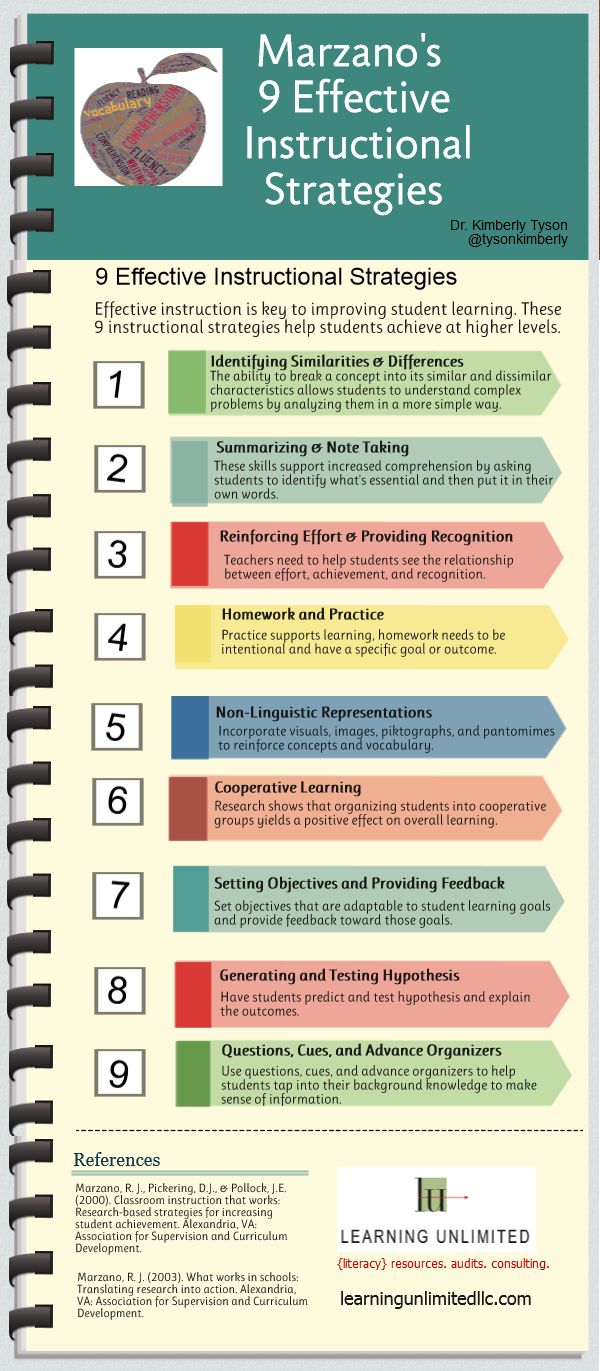
In order for bully prevention lessons to be effective, research-based instructional strategies should be in every lesson. Two names come up constantly here, Robert Marzano and John Hattie, both of whom have spent careers studying which classroom practices move student learning. Here are Marzano's nine effective instructional strategies, drawn from Classroom Instruction That Works (Marzano, Pickering, and Pollock, 2001) and What Works in Schools (Marzano, 2003), in an infographic by Dr. Kimberly Tyson of Learning Unlimited (@TysonKimberly):
Here are ten strategies that rank high in John Hattie's Visible Learning synthesis, one influential effort to compare effect sizes across a large body of studies. The strategy names are Hattie's. The parentheticals are my own classroom shorthand rather than his definitions, and a few of them stretch the original term, so check his descriptions before treating any of these as equivalent:
- Providing Formative Assessment (my example: assessing along the way with touchpoints)
- Micro Teaching (my example: Daily Five Mini Lesson)
- Comprehensive Interventions (my example: Response to Intervention)
- Teacher Clarity (my example: organization + explanation + examples + guided practice + assessment)
- Reciprocal Teaching (my example: student-led small group book discussions)
- Feedback (my example: teacher gives immediate feedback towards goals)
- Student-Teacher Relationships (my example: programs and philosophies implemented that build relationships between student and teacher, High Trust Philosophy)
- Space vs. Mass Practice (my example: chunked instruction using Daily 5 mini Lessons)
- Metacognitive Strategies (my example: teaching students how they can learn best, Art Costa's Habits of Mind)
- Self-Verbalization / Self-Questioning (my example: using the SQ3R technique)
Classrooms that model and practice learning structures can build a stronger culture of togetherness when kindness is a priority. Students get practice listening to and respecting each other's opinions, which may support empathy toward classmates. Stronger peer relationships are not a guarantee that bullying stops, but they make it harder for bullying behavior to go unchallenged.
Students who live with anxiety or have experienced trauma need individualized support, not one set of classroom accommodations applied to everyone. Where a student has an Individualized Education Program or a Section 504 plan, follow it, and work through your school or district procedures. Mental health and health care services are delivered by the qualified staff and outside providers responsible for them, not by teachers. Trauma-informed classrooms still need teachers who know how to build strong relationships with their kids. Research summarized by Iowa ACEs 360 points to the following:
- building resiliency and coping strategies
- making resources more readily available (mental health services, health care, parenting classes, etc.)
- building in protective factors (parental resilience, social connections, nurturing and attachment, knowledge of parenting and child development)
- building and cultivating communities that take care of each other
PU #106 - Strong Lesson Design for Bullying Prevention
Strong lesson design can follow many formats, but the progression should start with getting students engaged in the topic, communicating an objective and rationale, guiding students to explore more, and then practicing the skills they garner in a safe environment. Lastly, teachers should have a way of determining their success by assessing the objective. That assessment data should guide the next bully prevention lessons taught by the teacher.
Check out our teacher lesson plans.
Many of us grew up with the Madeline Hunter lesson design. Many teachers use this format today in their classrooms, and it can still be a useful structure. Here are the common steps in her lesson design (note: these can be in a different order, some may not be present in every lesson, and some portions can be repeated):
- Anticipatory Set (In what way will you activate their prior knowledge and experience to help them relate to today's lesson?) Focus attention, brief practice on previous/related learning.
- Objective/Purpose (The object is what students will be able to know/do by the end of this lesson. The overarching purpose/understanding is the broad goal/curriculum standard related to the discipline).
- Instructional Input (What knowledge will you communicate to the student--tell, lecture, stand up and deliver so that the student will understand the objective?) Disseminates new information and activities to achieve the stated objectives.
- Modeling (How will you show/demonstrate the skill or competence so the student will also be able to do it?) Demonstration and/or example of the acceptable finished product or process.
- Checking for Understanding (How will you check that the students have understood/learned the objectives?) Activities that examine the student's possession of central and essential information to achieve the stated objective.
- Guided Practice (What activities will the students perform under your supervision to ensure that they are able to practice the material? If they make mistakes, you are able to show them how to do it correctly.) Close monitoring and direction of the students by the instructor as they practice the whole task for the first time independently of each other.
- Independent Practice (List homework or seatwork assignments the students are given to successfully practice the material/skill without teacher supervision.) Only after you know the students can proceed, the continued practice of the whole task by the students without the instructor's monitoring and guidance.
Similarly to Madeline Hunter, many teachers use the age-old "I do, we do, you do" model. It is still a powerful design to get students involved. A teacher uses direct instruction to teach a concept. The students then practice together the skill or concept. Lastly, when the students are ready, they practice the skill or concept on their own.
The inquiry model is another powerful lesson design. Students pose questions that they would like answered. They then delve into researching, exploring, and even experimenting to determine the best possible answer to the questions posed. Students then explain the evidence collected and connect it to knowledge gained in the exploring process. Lastly, they create an argument and justification for the explanation.
Here is how the three designs compare when the subject is bully prevention:
| Lesson design | How it is structured | Where it fits a bully prevention lesson | Teacher's role |
|---|---|---|---|
| Madeline Hunter | Seven named stages, from anticipatory set through independent practice, with a checking-for-understanding stop built in | Introducing a new concept students have no vocabulary for yet, such as the difference between conflict and bullying | Directs the sequence and decides when students are ready to move on |
| I do, we do, you do | Three passes at the same skill: teacher models, class practices together, students practice alone | Teaching a specific script or behavior, such as what a defender says to interrupt name-calling | Models first, then steps back in stages as students take over |
| Inquiry | Students pose the questions, research and test, then explain the evidence and justify a conclusion | Older students examining why bullying persists in a specific hot spot in their own building | Frames the problem and pushes on the reasoning rather than supplying answers |
Gone are the days of simply lecturing to students and hoping they are listening, taking notes, and are able to regurgitate the information later. Students who discuss, practice, and teach a concept tend to retain more than students who only sit and listen, and that general direction is well supported by research on active learning. You will often see this argument made with the Learning Pyramid, which assigns a specific retention percentage to each method. Treat those percentages as illustration rather than evidence: the figures are usually credited to the NTL Institute, which has acknowledged that the original study was never published and that the underlying data no longer exists.
PU #107 - Students Putting Bullying Prevention Into Action
A great bully prevention lesson should put students into action. Students should be able to use the information in any setting, and even outside of school. Adults in the school will be able to see and catch students using the content, strategies, and words in different scenarios. That can provide evidence that students are applying what they learned, though on its own it does not show that bullying went down.
Too many times you hear teachers say, "Well, I taught them that," when the student is unable to come up with the correct answer or action. My question to these teachers is, "How well did you teach it?" Good teachers understand that some content needs more than a one-time lesson, and many students need multiple opportunities to grasp the concept or strategy.
Educators should celebrate the actions of these students when they display the words and actions from the bully prevention lessons. What we place value on is what we will get out of in the end. The more we focus on the positive, the more likely positive behaviors will occur. It can change the culture of a school, and it becomes who we are as a school and a learning community.
PU #108 - Assessing Whether the Lesson Worked
Assessment and evaluations are powerful tools when teachers use the data to guide their instruction. This is the same for bully prevention lessons. Teachers must create ways to track the effectiveness of their lessons. Without this data, teacher effectiveness and bully incidents may not see improvements.
Quick assessments and evaluations help determine whether students met the lesson's objective. Unfortunately, many teachers teach the bully prevention lesson without adding in this last piece. They teach the lesson because administration and the district require it. Adding some type of formative or summative assessment can help a teacher work out what students actually understood and plan the follow-up instruction.
Quick assessments such as quick writes, short multiple-choice quizzes, even cloze activities can give teachers strong data that can determine a teacher's next steps. Quick write assessments give teachers good information about the minds of the students as they use their own words to tackle bullying topics.
Self-assessment is another tool that educators can use with bully prevention lessons. In these lessons, students can reflect in two different ways: 1) self-assess how well they are learning the content, or 2) self-assess how well they are using or have used the content. Adding this component to every lesson helps ensure students are making emotional connections to the content. That kind of reflection can make it more likely students reach for the strategies in a future bullying situation.
MORE BULLYING PREVENTION GUIDE RELATED READINGS:
- 3 Types of Bullying in School + 1 Immense Social Challenge
- 5 Reasons Why Schools Have a Difficult Time Stopping Bully Behaviors
- 5 Reasons Why We Need to Define Bully Behavior and Stop Generalizing Events as "Bullying"
- 6+ Steps to Addressing Bullying When It Occurs
- 9 Strategies We Can Teach Students to Problem Solve
- 7 Ways How to Raise a Defender of Bully Prevention
- Provocative Victims and 7+ Practices for Victory
- One School Wide Philosophy: High-Trusting Relationships
- 13 Ideas to Combat Bullying at the Community Level
- 6 of the Most Hideous Cyber Bullying Tactics Used By Students
- 11 Communication Strategies to Combat Bullying
- 20 Ideas To Successfully Use Bully Data
- 5 Reasons Why Strong Instruction Affects Bully Prevention (Currently here)
- #1 Instructional Lesson for All Students on Bully Prevention
- Power of Buddy Classrooms: 19 Ideas
- 8 Ways to Teach Empathy
- 10 Ways to Empower Defenders
- 9 Reasons Culture Trumps Strategy
- One School-Wide Strategy: Kindness Campaign
Frequently Asked Questions
What is bullying prevention instruction?
It is the teaching side of a bully prevention program: the lessons, discussions, and practice that actually carry a curriculum's content to students. A school can adopt a program without teaching it well. Bullying prevention instruction is what happens between the binder on the shelf and the behavior in the hallway.
Do teachers need training before teaching bullying prevention?
Guidance from StopBullying.gov and the Center on PBIS treats adult training as a step separate from student lessons. Staff need a shared working definition of bullying, knowledge of the school's policies, and clarity on how the rules get enforced before any of that reaches students. Training requirements themselves vary by state and district. Formats range from staff meetings to full-day sessions, and schools usually pick based on funding and available time.
How does bullying prevention instruction change by grade level?
The delivery changes more than the content. Younger students respond to concrete, visual work and scripted practice. Middle and high school students engage better with role-play, discussion of incidents they recognize, and digital citizenship. Programs like Olweus hold class meetings at elementary, middle, and high school levels but shift the topics and language at each one.
Does a school need a formal bullying prevention program?
Requirements vary by state and district, so schools should follow applicable law and local policy. Some states and districts mandate particular bullying-prevention policies, staff training, or curricula. Where there is room to choose, StopBullying.gov notes that schools can build bullying prevention into existing lessons and activities rather than buying a packaged curriculum. A research-based program gives you scope and sequence, which helps a lot, and a purchased program still depends on how carefully it gets delivered.
How do you know if a bully prevention lesson worked?
Assess it the way you would any other lesson. Quick writes, short multiple-choice checks, and cloze activities tell you whether students met the objective. A further signal comes later, when adults in the building catch students using the words and strategies on their own. That is evidence students are applying the lesson, not proof that bullying has dropped.
- Implementation matters - A purchased curriculum works better when the teachers delivering it know the content and know the students in the room.
- Relatable scenarios help - Lessons built on situations students recognize from their own building can land harder than generic case studies.
- Active participation helps - Structures like Think-Pair-Share can increase how many students respond, which may support the classroom relationships that make bullying harder to sustain.
- Adult training comes first - Staff need a shared definition, shared policy knowledge, and shared enforcement before any of it reaches students, and the requirements vary by state and district.
- Assess the lesson, not just the program - A quick formative check gives you evidence about what students understood and a basis for the next lesson.
Teacher training in bullying prevention varies by state, district, and school, and for a lot of educators it amounts to less classroom-ready preparation than the topic asks for. Graduate coursework in school climate, behavior, and instructional design goes considerably deeper, and several of the sponsored programs on this page are built for working educators who need evening or online scheduling.
As a 5th grade teacher, in 2010 Jon won the Presidential Award for Elementary Math and Science Teaching (PAEMST). As a principal, his school won the 2012 Blue Ribbon Award. In 2018, he won the National Distinguished Principal Award (NDP). In 2019 he won the National No Kid Hungry Breakfast Hero Award.
Jon is the author of three guides published on teacher.org: An Educator's Guide to Combat Bullying & Bully Prevention; Teacher Evaluation: A Transition Guide to Exemplary Performance; and You are the Wild Card: Infusing Fun Back into Curriculum. He has authored a children's picture book that was released January 2019 titled Benjamin’s Visit to Principal Reads Office…again! (available at www.archwaypublishing.com)
- Learning How to Say No and Set Boundaries with Parents - November 21, 2022
- How to Implement a Check-In, Check-Out (CICO) Behavior System - September 26, 2022
- Teacher Core Values: 7 Strategies for Living Your Code - August 15, 2022