
#1 Instructional Lesson for All Students on Bully Prevention
5/8/2017



Back to the main Bully Prevention Guide.
What is the most impactful Bully Prevention Lesson you have ever taught? What made it effective? What evidence do you have that proves your opinion?
If there were one lesson that I would recommend be taught to all students, it is a Bully Circle Lesson. We will delve into the power of this lesson and build rationale why it should be taught to all students (every year at every grade level).
First, before you read further, you must agree to these three underlying assumptions and rationale in order for this lesson:
- Great instruction from effective teachers can reduce bullying incidents in the school.
- Empathy, kindness, and tolerance should be taught every day.
- Problem solving by students and staff members should always focus on "going to solution."
What makes an instructional lesson so effective? I believe a strong lesson must have…
- strong content that connects to the learner's world outside of the lesson,
- engage the learner and have a strong emotional connection,
- encourage discussion and mind shifts,
- and be useful in the future.
PU #109 - Teacher Strategy: Teach with Strong Content
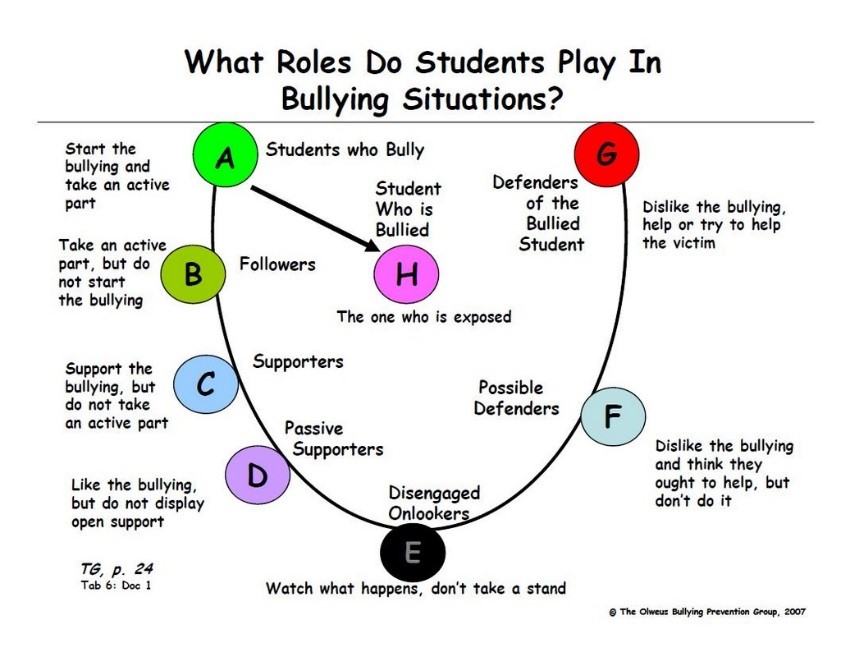
Many web sites have modified the idea of a Bully Circle, but the most used diagram and description of the Bully Circle comes from Hazelton's Olweus Bully Circle. Dr. Dan Olweus uses the visual for students, parents, and teachers to understand the different roles everyone plays when a bully incident occurs.
The basic concepts of the Bully Circle show a person in the middle of the circle whom is being bullied. Then starting on one side of the circle is a defender, or someone who is willing to stop the bully behavior. On the opposite side is the person(s) exhibiting the bully behavior. All the people in between the defender and the person(s) doing the bullying have various levels of connection (or non-connection) to the bullying incident. Here are all the players on the Bully Circle according to Olweus:
- Person Bullying - a person(s) that bully
- Followers - people who take part in the bullying, but don't usually initiate it
- Supporters - people who not be taking part in the bullying, but support it
- Passive Supports - people who support it, but don't openly show it
- Disengaged Onlookers - people that watch, but do not act
- Possible Defenders - people who dislike the bullying, but do not act
- Defenders - people who actively try to stop the bullying
This is the basic premise of the content for the lesson. The Bully Circle is a structure that is easily modified throughout the year, and be can be pertinent in all grades. The actual content of the lesson can change each year that connects specifically to each age level of students. As students get older, the complexity and social ramifications increase. The concepts of the basic understanding of the bully circle can be taught in the primary with basic social contexts, depending on the level of maturity of the students. At the high school level, complex social situations can be discussed with ramifications on each person in the bully circle. Teachers and students can discuss and practice how students can stop future occurrences, as well as showing students how they can change a school's a culture and climate.
Here is a diagram that discusses the roles of each person in the bully circle:
PU #110 - Teacher Strategy: Engage the Learners
Connecting with students can be difficult, but choosing a social context that is relevant to their lives is the number one engagement strategy for a teacher. As students get older, the content in which the teacher chooses to put into the lesson structure changes. Obviously, students' ability to understand roles within in the bully circle becomes more complex.
Pulling situations from the school, as long anonymity is maintained, can be one strategy a teacher uses in order to find engaging content. Students working on social situations that happen in the school are a powerful way to combat the specific bully behavior occurring in the learning environment.
Many times teachers chose social situations that are not relevant, nor age appropriate, and the power of this lesson is nullified. In addition, teachers will need to choose lessons that are age appropriate and combine these relevant social context lessons with lessons that connect to what they will encounter in the future. The idea behind this is giving students tools to be proactive before they encounter such social situations.
This intricate lesson planning (fixing bully behaviors that have already occurred + teaching students' skills for future bully incidents) also affects the engagement of the learners. Making the situations real world is a great strategy for powerful instruction with this bully circle lesson.
PU #111 - Teacher Strategy: Encourage Discussion
Gone are the days where a teacher's main mode of instruction is to stand in front of a class and lecture students on what they should and should not be doing. We know the highest level of learning occurs with students are able to teach others. The best instructional strategies to do this is through discussion-based instruction. This strategy encourages students to discuss the social implications of each person on the bully circle, as well as solutions to the problem.
Students must discuss the roles, actions, and verbiage that can be used in each social context that the teacher introduces. At the primary level, the ideas will be more basic; at the middle and high school level, students will learn strategies they can employ to solve the problem and even change the culture of the school. Students need time to discuss these bully situations with adults on how to solve the problems, as well as with other students.
Empowering students to solve their own problems is one goal we (teachers and adults) have for our students. Adults are not always around to support students when bully behavior occurs. Creating a learning community full of defenders is the ultimate goal. Combining adult support and empowering students a school staff can combat bully behaviors.
PU #112 - Teacher Strategy: How the Content Is Used in the Future
What makes the Bully Circle lesson so powerful is the ability for the information to be used repetitively in future grades and for students to actually use the strategies immediately. Many bully prevention lessons give students skills to be proactive when they encounter bully situations. This bully circle lesson is even more powerful as teachers use it in every grade level. Teachers can connect to prior learning and decide on how the social contexts of the bully circle play out in future bully behavior situations.
Here is a simple lesson plan for using this bully circle. It can modified for any grade level:
Title: 5th Grade Bully Circle Lesson
Objective: The students will be able to identify the roles of each person on the bully circle, and be able to solve the problem.
Rationale: Students need this information in order to be proactive, and to stop bully behavior before it starts.
Materials: Diagram of the Bully Circle (big enough for students to see), Current bullying behavior stories from the school
Steps in Lesson:
- Introduce Bully Circle Diagram. Find out what students already know about bullying.
- Define and discuss roles of each person on the bully circle. Make sure students are able to discuss with one and another the definition and roles. Teacher will need to address any misconceptions.
- Introduce social story or a recent bully behavior incident that occurred on campus.
- Have students discuss and define the roles of each person in the social contexts of the bully circle. Teacher will need to address any misconceptions discussed.
- Have students discuss how they will solve the problem. Discuss what words and actions that defenders can do in this specific situation. Teacher will need to discuss and brainstorm ideas with students. Teacher will need to make sure the solutions students come up with follow school rules and protocols for combatting bully behavior.
- Teacher will discuss the future implications if the bully behavior is not stopped and reported, as well as ending with what positive outcomes will occur when the bully behavior is stopped.
- Students again discuss what they can do in the future when bully behavior occurs.
- Students will then do a 5-minute quick write about how they would solve the given bully situation. Teacher can set up a writing rubric for the response. Students follow the rubric requirements.
Assessment:
Teacher, with student support, can create a writing rubric for a 5-minute quick write. Teacher can determine effectiveness of the bully prevention lesson, as well as the next teaching points.
Here is a sample 5-point rubric:
5 = 30-50 Words in Length (1pt), an opinion with at least 2 details that supports (2pts), sentence content fully answers the question (1pt), neatness and grammar (1pt).
4 = 30-50 Words in Length (1pt), an opinion with one detail that supports (1pt), sentence content fully answers the question (1pt), neatness and grammar (1pt).
3 = 20-30 Words in Length (0.5pts), an opinion with one detail that supports (1pt), sentence content partially answers the question (0.5pt), neatness and grammar (1pt).
2 = 20-30 Words in Length (0.5pts), an opinion with no supporting details (0.5pts), sentence content does not connect to the question, neatness and grammar (1pt).
1 = 5-20 words in Length (0.5pts), no opinion or details, sentence does not connect to question, hard to read and grammar is an issue (0.5pts).
Make sure to visit our other subject specific lesson plans.
MORE BULLYING PREVENTION GUIDE RELATED READINGS:
- 3 Types of Bullying in School + 1 Immense Social Challenge
- 5 Reasons Why Schools Have a Difficult Time Stopping Bully Behaviors
- 5 Reasons Why We Need to Define Bully Behavior and Stop Generalizing Events as "Bullying"
- 6+ Steps to Addressing Bullying When It Occurs
- 9 Strategies We Can Teach Students to Problem Solve
- 7 Ways How to Raise a Defender of Bully Prevention
- Provocative Victims and 7+ Practices for Victory
- One School Wide Philosophy: High-Trusting Relationships
- 13 Ideas to Combat Bullying at the Community Level
- 6 of the Most Hideous Cyber Bullying Tactics Used By Students
- 11 Communication Strategies to Combat Bullying
- 20 Ideas To Successfully Use Bully Data
- 5 Reasons Why Strong Instruction Affects Bully Prevention
- #1 Instructional Lesson for All Students on Bully Prevention (Currently here)
- Power of Buddy Classrooms: 19 Ideas
- 8 Ways to Teach Empathy
- 10 Ways to Empower Defenders
- 9 Reasons Culture Trumps Strategy
- One School Wide Strategy: Kindness Campaign

As a 5th grade teacher, in 2010 Jon won the Presidential Award for Elementary Math and Science Teaching (PAEMST). As a principal, his school won the 2012 Blue Ribbon Award. In 2018, he won the National Distinguished Principal Award (NDP). In 2019 he won the National No Kid Hungry Breakfast Hero Award.
Jon is the author of three guides published on teacher.org: An Educator's Guide to Combat Bullying & Bully Prevention; Teacher Evaluation: A Transition Guide to Exemplary Performance; and You are the Wild Card: Infusing Fun Back into Curriculum. He has authored a children's picture book that was released January 2019 titled Benjamin’s Visit to Principal Reads Office…again! (available at www.archwaypublishing.com)
- Learning How to Say No and Set Boundaries with Parents - November 21, 2022
- If You Had Only One Behavior Strategy to Use in Your Classroom, What Would It Be? - September 26, 2022
- Live Your Code: 7 Strategies That Will Help You Be the Most Effective Educator You Can Be - August 15, 2022