
9 Conflict Resolution Strategies to Teach Students


Conflict resolution strategies for students are the scripts a child can use when an ordinary disagreement starts: telling someone to stop, using an I message, taking a break, or walking away. Calming down is often a useful first step when it is safe to do so. Safety concerns and suspected bullying go straight to an adult.


Back to the main Bully Prevention Guide.
In the school setting and in life in general, a parent or teacher cannot be with a student 24 hours a day for 365 days a year. We have to equip our students to deal with conflict and solve problems on their own. Students can settle a lot of things at the lowest level, and there will always be problems they cannot settle without adult support. The skill is knowing which is which.
That judgment is what most conflict advice skips. A student who has never been taught the difference will either bring every scraped feeling to an adult or sit on something that needed reporting an hour ago. Without conflict-resolution skills, some disagreements may escalate or persist.
One distinction runs through everything below. These nine strategies are for ordinary peer disagreements: disputes over turns and equipment, hurt feelings, friendships that have gone quiet, the friction that comes with sharing a room with twenty-five other people. They are not a first response to bullying. A student who is being targeted is not responsible for making it stop, and suspected bullying should be reported and handled under school and district policy. Reporting requirements vary by state and district, so the specifics of what staff must do next depend on where you teach.
Some situations skip the strategies entirely. Physical threats or harm, weapons, sexual harassment, any threat of self-harm, and serious intimidation go to an adult immediately. A student should never work through a script first in those cases, and should never be told they should have.
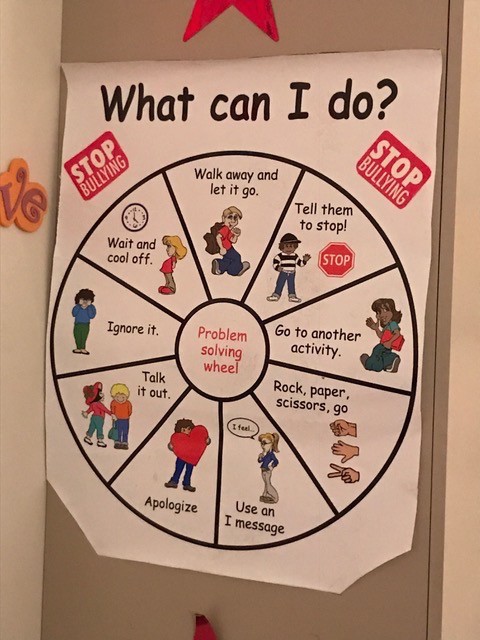
Here are nine strategies we can teach at school and at home that will support students "going to solution."
Conflict Resolution Strategies for Students: Size the Problem First
Before a student picks a strategy, they need two questions answered. Am I calm enough to do this? And is this a problem I can handle myself?
The first one comes first for a reason. A student may have difficulty effectively using these strategies while highly upset, so calming down is often a useful first step when it is safe to do so. Delivering an I message, listening through a talk-it-out, and accepting the result of a coin-flip decision all get harder the more worked up a student is. That is why "wait and cool off" sits low in the numbering here but tends to come first in practice. Teach it early, practice it often, and expect to prompt it out loud for younger students.
The second question is one students can learn to answer for themselves, with one rule sitting above it. Safety concerns go to an adult right away, full stop. Physical threats or harm, weapons, sexual harassment, any threat of self-harm, and serious intimidation are reported first and discussed later. So is anything the student thinks might be bullying. A student never has to try a script before reporting, and nobody should ask them what they tried before taking the report seriously.
Below that line sits ordinary disagreement, and that is where the nine strategies live. A dispute over turns, a friend who has stopped talking, a comment that stung, a game that got heated: these are the ones a student can often work through, and the ones worth practicing. If a strategy does not work, or the student would rather not use one, telling an adult is a fine next move rather than a fallback. Reporting is a strategy, not an admission that problem solving failed.
Age may shape how this gets taught more than it changes the strategies themselves, though needs vary widely within any grade level. Younger students often benefit from having the words handed to them and rehearsed line by line. Some older students already have the vocabulary and get stuck somewhere else, on the social cost of using it in front of people, in which case practice time is better spent on when and where to use a strategy than on the wording. Plenty of students in both groups will need the opposite of what their grade would suggest.
The table below covers ordinary peer disagreements only. Nothing in it applies to a safety concern or to suspected bullying, both of which get reported rather than worked through.
| Strategy | Best for | If it doesn't work |
|---|---|---|
| Wait and cool off | Any disagreement where either student is too upset to talk | Separate them, then come back to it with an adult present |
| Tell them to stop | Name-calling or teasing the other student may not realize is landing | Tell an adult. The student does not need to try again first |
| Use "I messages" | Hurt feelings and exclusion, where the other student may not know the impact | Move to talking it out with an adult, prepping both sides |
| Rock, paper, scissors | Two fair options and no way to choose: turns, equipment, who goes first | Pick a different strategy. A student who cannot accept the result should not use this one |
| Talk it out | Former friends who have stopped speaking, and longer-running disagreements | Adult mediation, with each student prepped separately first |
| Apologize | A student who recognizes they caused harm | Re-teach what a real apology contains, then try again |
| Go to another activity | Games turning competitive, or a student who can feel themselves escalating | Adult support to help the student regulate |
| Ignore it | Minor attention-seeking behavior in an ordinary disagreement | Report it. Persistent, threatening, or harmful behavior is not a student's to manage |
| Walk away and let it go | A disagreement the student would rather not continue | Tell an adult. Walking away is a coping move, not a resolution |
PU #22 - Student Strategy: Tell Them To Stop
This strategy may sound obvious, but when I talk with students, many of them start a conversation such as this: "Jimmy keeps calling me frog face." I then ask Billy, "Did you tell Jimmy to stop?" A student such as Billy routinely tells me, "No!"
This is a reasonable first move for ordinary teasing. I give them the words to tell Jimmy. They practice with me, and then they can go and use the strategy. This settles quite a few problems. It is an option, not a requirement: a student who does not want to say anything, or who thinks the behavior might be bullying, should come to an adult instead, and I would rather hear about something early than find out about it in week six.
If Jimmy persists, the student may come back to me and say, "Mr. Konen, I used the words we practiced to tell Jimmy to stop, but he did not." Then an adult will need to support. My conversations with Jimmy start by asking, "Tell me what's going on between you and Billy." I do this to see if Jimmy is going to own any of his behavior, or if he is going to blame Billy for some other situation. Sometimes this leads me to do some re-teaching with Billy.
Many times I continue my verbiage: "Billy came to me and said you were calling him frog face. Billy and I also worked on words to say to make sure it stopped, but it sounds like it is still going on. Can you tell me more about this?" At this point, a student has two routes to decide: own their behavior or deny it. Many times a student will own their behavior, come up with a plan with me to fix it with Billy, and vow to stop. If it continues, we can then take it to the next level much faster.
I write down these interactions in my notebook. Keeping track of behavioral patterns and which students were involved is what turns scattered complaints into something the school can act on, and it is how a repeat pattern gets identified as bullying and handled under district policy rather than as a string of unrelated incidents. I may write a Level 1 discipline referral if I decide it is important enough to track. When a student chooses to deny it, I spend more time with Billy finding out if there were any witnesses, then investigate further with those witnesses. My whole goal is to get enough information to make my case to Jimmy and for him to own his behavior.
Speaking up is sometimes hard for a student, especially a student who avoids conflict. Practicing it in low-stakes moments gives them language they may draw on later. It is worth saying plainly to students that this is for everyday disagreements. When something feels unsafe or is happening over and over, the right move is to tell an adult, not to find better words.
PU #23 - Student Strategy: Go To Another Activity
A student, "Jimmy," sometimes gets so involved in a game that the competitive nature of it becomes confrontational. Students want to play and want it to be fair for everyone involved. Asking Jimmy to go to another activity can be difficult as an adult, because we know we may be in for an argument. To Jimmy, it seems unfair that he should go to another activity when Billy is not being fair in the game.
The goal of this strategy is for a student to self-reflect and choose another game. When the student can choose another game, they are able to see that their current participation is leading to bigger problems. Whether the problems started with them or with other students, they know that if they keep playing, they are not going to be able to regulate themselves.
Adults have to reinforce this as a real option, and when a student chooses to use it, we need to name the smart choice out loud.
PU #24 - Student Strategy: Rock, Paper, Scissors, Go!
Fairness and justice are qualities we all want in life. Unfortunately, we know that life is not always fair. When students have a disagreement or believe there are two separate workable solutions, a simple game of rock, paper, scissors may be an easy tool for them to use.
Students must agree to the outcome of the game before they play. If they cannot accept the outcome, this strategy is not going to work. That sounds simple, and sometimes it is not. Sometimes a student will risk the outcome of the problem on 50/50 odds and lose. Negative behavior from losing may come to the forefront, and another strategy may be needed.
The idea behind the game is to solve a problem in a game format, requiring less stress than arguing. It works well for games outside, and for classroom decisions where either solution would do.
PU #25 - Student Strategy: Use "I messages…"
The ability for a student to use their words to work through a disagreement is a real skill, and it takes teaching. Some students reach for physical aggression or hurtful language instead. We have to give our students words that are productive and proactive and that let others know how you feel.
An I message is a good strategy for students to learn when they are working through an ordinary disagreement. An example states, "Jimmy, I feel sad when Billy is made fun of." Starting with the word "I" communicates the speaker's own feelings and the impact of the behavior, without framing it as a direct accusation. That is the whole point of the structure: it describes what happened and how it landed, rather than assigning blame.
A teacher can practice I messages with students before they need them. That practice and modeling will help them go to a solution much faster when conflict arises. This is a strategy many adults have difficulty using, because shifting blame tends to be easier and going to a solution with the other person takes more time and work. Some people avoid it because they think using words about their own emotions will be read as weak. If we can teach this skill, it is a useful tool for the rest of a student's life.
PU #26 - Student Strategy: Apologize
These days, an apology can be difficult. Many people do not want to be viewed as weak, or to admit they are guilty, or even to consider that an apology can be a workable solution. We teach students that an apology is part of the culture of our school when we make a mistake or hurt someone. We teach the words for how to give one. We do not give out forced apologies. An apology has to be sincere, has to tell the person specifically what it is for, and has to include that it is not going to happen again.
Teaching a student when to use an apology can be tricky. Deciding that a situation calls for one is a powerful piece of self-reflection. A student has to step outside the situation and assess whether what they were doing or saying warrants an apology. Doing that on their own has to be practiced, modeled, and praised.
We also teach students how to accept an apology. We never say "It's okay" afterward. It is not okay. We can teach students to accept the apology, and we go further and tell them to make sure the behavior does not happen again.
PU #27 - Student Strategy: Talk It Out
Two students in a disagreement sometimes need more time to talk it out. Students, like many adults, want to avoid conflict and want a problem solved immediately. If it is not solved immediately, they tend to hold grudges, spread rumors, and create more drama.
This strategy often needs adult support. I like to bring together students who were previously friends but are not talking. One student, and many times both, want the problem fixed so they can rekindle the friendship. I spend time prepping both students on what it will look like in my office, the words they can use, and how the other student is likely reading the situation. That gives them the tools, some power, and some choice in how they handle it.
For students who have matured enough to spend time talking a problem through, having them do it on their own is a tool they will use for the rest of their lives.
PU #28 - Student Strategy: Ignore It
Ignoring minor attention-seeking behavior can sometimes prevent escalation. The saying goes, "What we pay attention to is what we get more of." A student who is being needled over something small will occasionally find that not reacting takes the fuel out of it. That makes this a useful tool for everyday friction.
It has a hard limit, and the limit matters more than the strategy. Persistent, threatening, or harmful behavior should be reported to an adult. A student who is being targeted has not caused the behavior and cannot be expected to end it by managing their own reaction. If ignoring it does not work, that is information about the person doing it, not about the student who tried.
So the conversation I have with students is short. Try it if the thing is small and you want to. Tell me if it keeps happening, if it gets worse, or if it ever makes you feel unsafe, and tell me whether or not you tried anything first.
PU #29 - Student Strategy: Wait and Cool Off
In the heat of an argument, taking a break to cool off can be a strategy students use to solve a problem. It requires self-reflection. A student has to understand their own emotions and know that stepping away from a conflict can work.
Sometimes students get into a conflict and attack each other because they do not have the words in the heat of the moment. Giving wait time to answer, gather yourself, and do some breathing to calm down is a strong tool for problem solving. Waiting is a skill in its own right, and it is one worth building at home as well as at school, as these strategies for teaching children patience lay out.
PU #30 - Student Strategy: Walk Away and Let It Go.
Walking away and letting it go is a close relative of ignoring it, and it fits the same kind of situation: an ordinary disagreement a student would rather not continue. Choosing to disengage is a legitimate outcome. Not every disagreement has to be settled.
When a student walks away, they are putting physical distance between themselves and something that was going badly. That can defuse a moment that would otherwise escalate, and it gives both students room to cool off.
What it is not is a way to handle bullying. A student who has to keep walking away from the same person is describing a pattern, and patterns get reported and handled under school and district policy. Tell students that plainly, so nobody concludes that leaving the situation was supposed to be enough.
Teaching These Strategies Before a Conflict Happens
None of this works if the first time a student hears the words is while they are upset. The teaching has to happen in the calm, and it has to happen more than once.
Whole-class instruction is the starting point. Introduce two or three strategies at a time rather than all nine, and give each one a short name students can call back to. Role-playing gives students an opportunity to rehearse language they may later use during a real conflict, and it is the part teachers most often skip. Cover reporting in the same lesson, so students hear when to use a strategy and when to skip straight to an adult.
Teachable moments do the rest. When a conflict has just happened, and both students are calm again, that is the highest-value coaching window in the school day. Name what happened, name which strategy would have fit, and have them run it right there. This takes time, though, so does mediating the same disagreement for the fourth time.
Modeling matters as much as instruction. Students who watch adults use an I message with each other, apologize specifically, or step away from an argument to cool off are learning that these are what grown people do, not a script for children. That cuts both ways: the same teacher asking a fourth grader to cool off is often managing a tense exchange with a parent an hour later, and there are strategies for handling difficult conversations with adults worth having ready. Parents and teachers who model the language and the problem-solving are building students who go to solutions on their own.
MORE BULLYING PREVENTION GUIDE RELATED READINGS:
- 3 Types of Bullying in School + 1 Immense Social Challenge
- 5 Reasons Why Schools Have a Difficult Time Stopping Bully Behaviors
- 5 Reasons Why We Need to Define Bully Behavior and Stop Generalizing Events as "Bullying"
- 6+ Steps to Addressing Bullying When It Occurs
- 9 Strategies We Can Teach Students to Problem Solve (Currently here)
- 7 Ways How to Raise a Defender of Bully Prevention
- Provocative Victims and 7+ Practices for Victory
- One School Wide Philosophy: High-Trusting Relationships
- 13 Ideas to Combat Bullying at the Community Level
- 6 of the Most Hideous Cyber Bullying Tactics Used By Students
- 11 Communication Strategies to Combat Bullying
- 20 Ideas To Successfully Use Bully Data
- 5 Reasons Why Strong Instruction Affects Bully Prevention
- #1 Instructional Lesson for All Students on Bully Prevention
- Power of Buddy Classrooms: 19 Ideas
- 8 Ways to Teach Empathy
- 10 Ways to Empower Defenders
- 9 Reasons Culture Trumps Strategy
- One School-Wide Strategy: Kindness Campaign
Frequently Asked Questions
What are conflict resolution strategies for students?
They are specific things a student can say or do when an ordinary disagreement starts. The nine on this page range from telling someone to stop, to using an I message, to taking a break, to walking away. They are meant for everyday peer conflict, not for bullying or safety concerns, which get reported to an adult.
Which strategy should a student try first?
Calming down is often a useful first step when it is safe to do so, since students may have difficulty using any of these strategies while highly upset. After that, it depends on the situation. If anything about it feels unsafe, no strategy comes first. Telling an adult does.
When should a student go to an adult instead of using a strategy?
Immediately, for physical threats or harm, weapons, sexual harassment, any threat of self-harm, or serious intimidation. Also for anything the student thinks may be bullying. A student does not need to attempt a script first, and should be encouraged to report whenever adult intervention seems warranted. Reporting and intervention requirements vary by state and district.
Do these strategies work for older students?
The strategies themselves hold up across ages, though how you teach them may change and needs vary widely within any grade level. Younger students often benefit from having the words rehearsed with them. Some older students already have the language and are weighing the social cost of using it, which shifts the practice toward when and where rather than what to say.
What happens when a strategy does not work?
Telling an adult is the next step, and students should learn that alongside the strategy itself. Behavior that continues after a student tried something is information about the person doing it, not a sign the student handled it wrong. Persistent, threatening, or harmful behavior should be reported regardless of what was tried first.
- These are for ordinary disagreements - students targeted by bullying are not responsible for stopping it, and suspected bullying is reported and handled under school and district policy.
- Safety concerns skip the strategies - physical threats or harm, weapons, sexual harassment, threats of self-harm, and serious intimidation go to an adult immediately, with nothing attempted first.
- Reporting never requires a prior attempt - encourage students to tell an adult whenever intervention seems warranted, whether or not they tried a script, and expect requirements to vary by state and district.
- Calming down usually comes first - students may have difficulty using any of these strategies while highly upset, so a pause helps when the situation is safe enough to allow one.
- Rehearsal gives students language - role-playing in a calm moment lets students practice words they may later draw on during a real disagreement.
Teaching students to handle conflict on their own is classroom management and social-emotional learning at the same time, and both are core coursework in teacher preparation and MEd programs. The sponsored programs on this page include options in curriculum and instruction, school counseling, and educational leadership, with online and part-time formats for teachers already working full time.
As a 5th grade teacher, in 2010 Jon won the Presidential Award for Elementary Math and Science Teaching (PAEMST). As a principal, his school won the 2012 Blue Ribbon Award. In 2018, he won the National Distinguished Principal Award (NDP). In 2019 he won the National No Kid Hungry Breakfast Hero Award.
Jon is the author of three guides published on teacher.org: An Educator's Guide to Combat Bullying & Bully Prevention; Teacher Evaluation: A Transition Guide to Exemplary Performance; and You are the Wild Card: Infusing Fun Back into Curriculum. He has authored a children's picture book that was released January 2019 titled Benjamin’s Visit to Principal Reads Office…again! (available at www.archwaypublishing.com)
- Learning How to Say No and Set Boundaries with Parents - November 21, 2022
- If You Had Only One Behavior Strategy to Use in Your Classroom, What Would It Be? - September 26, 2022
- Live Your Code: 7 Strategies That Will Help You Be the Most Effective Educator You Can Be - August 15, 2022