
Types of Cyberbullying: 6 Tactics Students Use and What to Do

The main types of cyberbullying are outing, harassment and name-calling, catfishing with fake accounts, sharing explicit or humiliating images, forwarding hurtful posts, and threats or intimidation. Repetition and a power imbalance are central to how bullying is defined, though conduct like threats, stalking, or non-consensual image sharing can require a response without meeting that definition.


Back to the main Bully Prevention Guide.
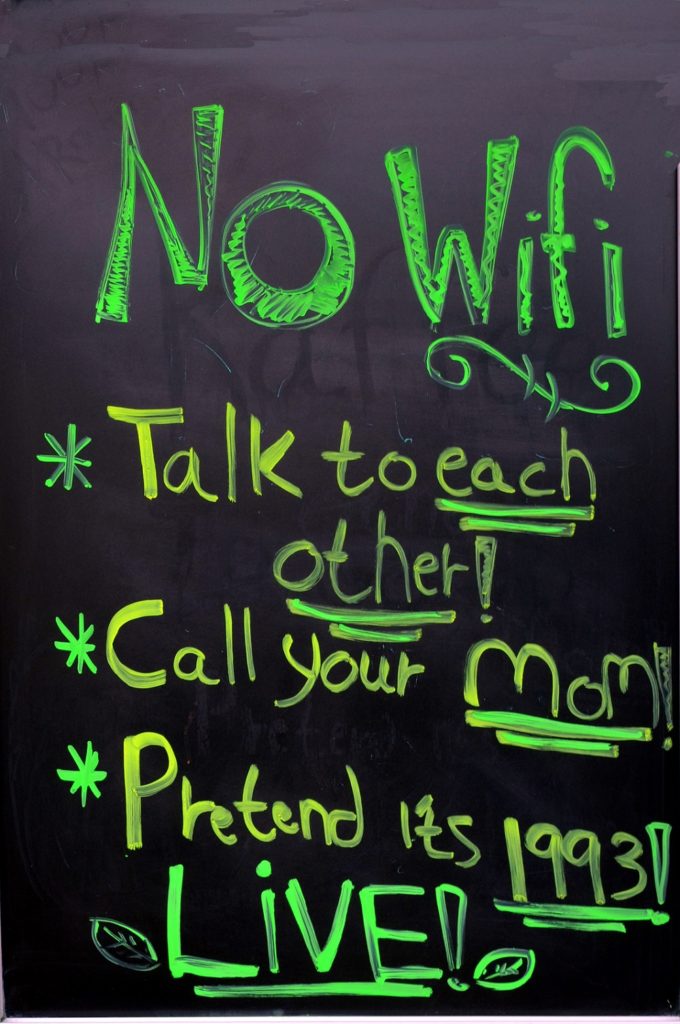
I loved this meme from Facebook I recently read; it states…
No Wifi. Talk to each other! Call your Mom! Pretend it's 1993! LIVE!
It seems both my sons should be classified as "Wifi Explorers." They constantly look for Wi-Fi hotspots so they can stay connected without using their data. As parents, we are thankful for the data limits we can set on their devices through our phone carrier. Once that limit is reached, their data usage stops. Usually, the last week of every month is difficult for both of them, and we tend to see more of them at home. Yeah!
Obviously, we try to limit the amount of time they are on their devices. They both love the outdoors and spend quite a bit more time in the wilderness, in fact, much more than most of their friends. Students, like many adults, cannot understand the need to take a break from social media and news. Taking that break is harder than it sounds. Social media companies keep refining the features that hold a user's attention.
Having dinner with a friend's family recently, their seventh-grade daughter said to me, "Phew. I almost ruined that streak." When I asked what that meant, she said she has a 79-day streak…meaning she has made a post (communication) between her and a friend for the past 79 days.
This record-keeping scared me as a parent and as a school administrator. Streak counters and similar features add a competitive element that can make stepping away feel costly. Social media giants such as Facebook, Instagram, Snapchat, and X, formerly Twitter, are finding new strategies to get kids involved and interacting with their product in hopes of garnering more users...and it is working! Here are some quick facts:
- About 19% of students ages 12-18 reported being bullied at school in 2021-22, down from 28% in 2010-11 (National Center for Education Statistics).
- Among students who were bullied, 22% said at least some of it happened online or by text (NCES).
- That share was twice as high for girls as for boys, 28% compared with 14% (NCES).
- Only about 44% of bullied students told an adult at school what was happening (NCES).
The social media explosion has created a new platform for bully behavior to cultivate. There is an infinite number of ways students can now bully on these platforms. As each new platform becomes popular, it tends to create new mechanisms and contexts for behaviors that already existed. As educators and parents, we must be proactive, learn how to use the latest social media applications ourselves, and continue to have conversations with our students and children.
After conversations and interviews with several administrators, I wanted to bring attention to six of the most hideous ways students use social media to bully other students. Obviously there are many more, but these are dealt with by school staff routinely. Parents and educators need to be cognizant and ready to tackle these situations.
What Counts as Cyberbullying
Not every unkind message is bullying, and treating it as though it is makes the real cases harder to act on. The CDC and the Department of Education published a uniform definition in 2014 for research and surveillance purposes, built on three elements: unwanted aggressive behavior, an observed or perceived power imbalance, and repetition or a strong likelihood of repetition. That is not the legal standard everywhere. State bullying statutes and district policies vary, and some are broader or narrower than the research definition.
Cyberbullying is broadly that same behavior carried over messaging, social platforms, gaming chats, or email. Two things can make it harder to handle than the playground version. It often reaches a student outside school hours, so there may be no clear point in the day when it stops. And it can leave a record, which cuts both ways: evidence is frequently available, but the material may also persist or spread beyond the people originally involved.
What Each of These Types Is Called
The names in this article are plain-language descriptions. Other terms get used for broadly similar behaviors in research, platform policies, and district documents, and they are listed below as search aids rather than as equivalents. They are not interchangeable. Several carry specific and differing meanings across state laws and district policies, and some describe conduct that is not bullying at all. Check the definitions your own state and district use.
| What this article calls it | Other terms sometimes used | What it involves |
|---|---|---|
| Outing someone | Outing, doxing | Posting private information, messages, or images publicly to humiliate |
| Teasing, taunting, name-calling | Harassment, flaming | Repeated insulting or abusive messages, in public feeds or direct messages |
| Catfishing and fake accounts | Masquerading, impersonation, trickery | Building a false identity to gain trust, then exploiting it |
| Inappropriate pictures and comments | Non-consensual image sharing, sextortion | Circulating explicit or humiliating images without the subject's consent. Sexting is not itself bullying, and image offenses may be separate criminal or child-protection matters |
| Forwarding hurtful information | Denigration | Spreading rumors or passing along someone else's hurtful post |
| Threats, intimidation, harassment | Cyberstalking, threats | Contact that makes a student fear for their safety. Harassment also has separate legal meanings, including civil-rights protections, and is not simply repeated bullying |
PU #66 - "Outing Someone"
One of the most popular types of bullying currently is "outing someone." Simply put, this is where a student uses social media to post private information on a public platform. This information can be hurtful. I have dealt with this situation every year as an administrator. A large majority of the referrals are from the girls. Among students who were bullied at school, a higher share of girls than boys reported that some of it happened online or by text, 28% against 14% (NCES, 2021-22). Those figures describe who reported being bullied, not who did the bullying.
"Outing" someone's personal and private information can obviously cause a lot of harm. Outing somebody on social media can spread like a virus. For example, one person writes a post so 300 of their followers can read it. Then those 300 multiply and can turn a piece of information into a "viral" posting. There is no fixed view count that makes something viral, but a post can travel far past the audience it started with.
Obviously, friendships can be lost. Students who are bullied report worse outcomes on a number of measures: among those bullied at school, 28% said it affected how they felt about themselves and 20% said it affected their schoolwork (NCES, 2021-22). StopBullying.gov is careful on the harder question: kids who are bullied are at higher risk of suicide, but bullying alone is not the cause, and most young people who are bullied do not become suicidal.
PU #67 - Teasing, Taunting, and Name Calling
Name-calling is one of the more common forms, though bullying takes many forms and does not follow a set progression. As it is repeated over time and there is an imbalance of power, it can become hurtful and be considered bullying behavior. Continually teasing, taunting, and name-calling on social media can be hard to stop. Many times the student receiving the messages ignores it or does not report it. The reasons vary. They can include fear of retribution, not wanting to be seen as a "tattletale," or a belief that the adults in their life cannot help.
Parents need to check their child's social media accounts routinely, ask questions, and have open conversations about friendships and posts they find. I believe parents need to have the usernames and passwords of their child's accounts. Parents of the bully need to be involved in their student's social media accounts, also. Whether a parent can be held legally responsible for a child's online conduct depends on the jurisdiction and the specific facts, and is not a general rule.
PU #68 - "Catfishing" and Creating Fake Accounts
Popularized by the MTV show in its sixth season, Catfish, this type of bully behavior consists of a person creating a fake profile, usually on social media, to meet another person. The victim of this bully behavior believes they are creating a relationship or friendship with the person. Communication goes on for an extended amount of time.
In a true bully situation, the person can be doing it for a multitude of reasons. Often the bully is doing it to hurt the other person by creating what that person believes is a new relationship. The person experiencing the "catfish" creates feelings of some sort for the other person, only to be hurt or let down in the end.
What makes the MTV show so popular is that the hosts confront the person behind the fake profile and have them explain themselves on camera. Not everyone who builds a fake profile is bullying, and the show covers a range of motives. The confrontations make for uncomfortable viewing.
The many different forms this takes on in schools can be abundant. From a fake Facebook Account to a fake dating site, the bully studies their victim. The amount of time a bully puts into setting up a "catfish" account may seem ridiculous. In my eyes, it is. What consequences actually apply is a separate question, and depends on state law, district policy, the student code of conduct, disability protections, and the facts of the incident.
These situations are harder to investigate as a school official, and sadly, many times they are not reported. Many of the victims feel ashamed that they were duped into believing they were in a relationship or friendship.
Students and parents must be cognizant and have conversations. Sometimes something that is too good actually might be…how we build trust in relationships is vital in the mentoring and modeling by parents and school staff.
PU #69 - Inappropriate Pictures and Comments or Non-Consensual Image Sharing
Bullying can take many forms with just one click. Posting an image or comment meant to humiliate someone, or circulating an intimate image without the subject's consent, can be part of bullying when it is repeated and there is a power imbalance. Sexting between students is not in itself bullying. What turns image-sharing into a school or legal matter is coercion, threats, sextortion, or sharing without consent, and those can be criminal or child-protection issues rather than discipline questions.
School officials deal with this situation frequently. It can be a little more concrete for school staff when holding students accountable because a time, date stamp, and name usually are connected to the image or comments. Students can use a "screenshot" to get a copy of the hurtful images or comments and can report it to an adult.
Two features of an app matter more than its name, because the names change every few years. The first is anonymity: when a post carries no account attached to a real student, holding anyone accountable becomes close to impossible. The second is disappearing content, which removes the evidence a school investigation depends on and makes a student's account of what happened harder to corroborate. Some districts restrict anonymous-posting apps on school networks, though network restrictions and disciplinary policies vary by district and jurisdiction.
PU #70 - Forwarding Hurtful Information
Many times a student does not start a hurtful post on social media, yet they forward it on to their friends and contacts. The argument most often from students and parents is that the post originated from someone else. School officials state that they entered the bullying circle by forwarding it on. Consequences may not be the same for the student forwarding it on, but it should not be overlooked, as they were contributors.
The controversial TV show called 13 Reasons Why depicts 13 reasons why a young girl died by suicide. I understand that it was created to open dialogue about suicide. I have personal problems with the show because I feel it glamorizes suicide. Research on the show's effects is mixed, and it does not establish that the series caused any individual death.
Rumors being passed by a student can be considered bullying, as I stated before…they have now entered the bully circle. The same should be for spreading rumors on social media. Many times a student says, "I really don't believe what the post states." I then ask, "So, why did you forward it on then?" The answer usually is, "I don't know, I only passed it on to my friends."
The ability for anyone to keep private information secret seems to be deteriorating across all age levels and mediums in the world. The feeling, even for a brief moment, gives students a feeling of power and excitement. We must teach kindness, tolerance, and empathy. How would it feel if the information being circulated was about you?
PU #71 - Threats, Intimidation, Harassment
Students tend to have more courage writing something on a social media platform than they would in person. This can be good and bad! Some students get frustrated with peers and make comments that can be intimidating, threatening, or harassing.
When these comments continue or are combined with other bully behaviors, a serious offense has occurred requiring adult intervention. Setting up a reporting system with a parent at home, or with at least one trusted school official, is a vital strategy to get it handled.
Life threats or threats of physical violence require immediate attention. School staff should follow their district's threat-assessment and emergency procedures along with any state or local reporting requirements. A threat that appears imminent or credible may call for emergency services and law enforcement. As school staff investigates, the situation can become more complex, and other students may be connected to the situation. The amount of time and students involved should not be a deterrent or a limiting factor in effectively dealing with the bully.
Intimidation seems to be more questionable when school officials investigate. The bully's physical stature and words used towards the student are subject to critical review. When it is done repeatedly, and there is an imbalance of power, bully behaviors need to be dealt with swiftly and effectively. Intimidation comes into question when school officials, parents, and even the students perceive the actions and words of the bully differently. Adequate information will need to be gathered in order to support further school actions.
Harassment is not simply repeated bullying. It carries its own definitions in law and district policy, including civil-rights protections tied to characteristics such as race, sex, disability, and national origin, and a single severe incident can trigger a school obligation to respond. Bullying, discriminatory harassment, threats, and criminal conduct are distinct categories, and one incident can fall into more than one of them.
When cyberbullying is damaging or causing injury, police and the court system can become involved. Civil liability varies widely by state and by legal theory, and whether a particular set of facts supports a claim is a question for a lawyer licensed in that state.
PU #72 - Drop the Phone!
We must continue to have conversations with students about social media, be proactive with our dialogue, and continue to understand and learn the latest technological platforms. This may sound like a lot of time that you do not have, but the consequences for not could be much more severe with your students or child. You may want to limit the number of social media sites your child is currently using. What follows is what we chose to do as a family, not a researched standard. For example, my wife and I let our sons have one social media account per year starting in 8th grade. Each year, they added another, but found that most of their friends were only able to manage 2-3 accounts. Each time we added a social media account, we also created our own account. We made sure that they friended us or allowed us to follow them on their account. We were then able to monitor routinely their conversations and interactions with their peers. This was done randomly, and most of the time we were monitoring their friends and the interactions they had with our sons. We could then model positive interactions with peers. To be honest, it was shocking what many students are willing to say or do on social media. We wondered if their parents knew…probably not!
The more time you put into creating strong relationships and role modeling positive interactions, the better positioned your child is to navigate social media. The best way to communicate is to put the phone down and pretend it is 1993!
Two Types This List Doesn't Cover
Two behaviors turn up in most school policies and in the research literature but sit outside the six above, and both are easy to miss because neither one produces a message anybody can screenshot.
Exclusion is deliberately leaving a student out: a group chat everyone else is in, a shared album they are not tagged in, an event invitation that goes to everyone but them. NCES found 4% of students ages 12-18 reported being excluded from activities on purpose. It rarely gets reported because there is nothing to report, only an absence, and a student who complains about it risks sounding oversensitive.
Cyberstalking is repeated contact that makes a student afraid for their physical safety, sometimes with location tracking or monitoring software installed on a device. Criminal definitions of this conduct vary by state. Behavior of this kind may call for both a school response and law-enforcement involvement depending on the circumstances, rather than one instead of the other.
Warning Signs a Student Is Being Cyberbullied
Because there is no bruise and no playground incident, adults usually find out about cyberbullying from a change in behavior rather than from a report. None of these signs confirms cyberbullying on its own. Every one of them has many other possible causes, from an unrelated friendship problem to a health issue. Several appearing together are a reason to start a conversation, not a diagnosis.
- Going quiet or getting visibly upset after looking at a phone, then not saying why
- Deleting an account, going private, or abandoning a platform they used constantly
- Avoiding school, a specific class, or an activity they used to want to attend
- Pulling back from a friend group with no explanation, or losing interest in things they enjoyed
- Changes in sleeping or eating patterns
- Hiding a screen, or unusual secrecy about who they are talking to
- Falling grades alongside any of the above
The most useful thing an adult can do here is ask directly and without a reaction attached. A student who expects the phone to be confiscated will say nothing, which is part of why only about 44% of bullied students told an adult at school.
What to Do When You Find It
There is no single correct sequence here, and what applies depends on district policy, platform procedures, state law, and how urgent the situation is. The steps below are common starting points rather than a protocol.
- Think about preserving the record. Screenshots showing usernames, dates, and times are often what a school or platform review works from, so clearing a thread straight away can remove information that turns out to matter later.
- Use the platform's reporting tools. Major services have reporting paths for harassment and impersonation, and a platform report is separate from anything the school does.
- Treat blocking as a judgment call. It stops the contact, which is sometimes the priority. On some platforms, it can also limit later access to the material, so the order is worth a thought in a given case rather than a fixed rule.
- Tell the school, and ask what its policy actually covers. A written message creates a dated record that a hallway conversation does not. Ask which conduct the district policy applies to and what response timeline it sets.
- For urgent safety concerns, follow emergency and district procedures. Threats that appear imminent or credible, stalking, and sextortion may call for law enforcement. Schools also have their own threat-assessment, mandatory-reporting, civil-rights, and disability obligations that can apply at the same time rather than instead.
- Handle images of minors with particular care. State laws on youth-produced sexual images differ substantially on possession, distribution, mandatory reporting, and what a school must do. School staff should follow their state's mandatory-reporting law and their district's procedure, and should avoid downloading, forwarding, or retaining explicit images of minors while doing so.
Off-campus conduct is the question school staff get asked most and the one with the least satisfying answer. A school's authority over off-campus student speech is constrained by First Amendment precedent as well as by state law and district policy. Substantial disruption to the school environment is part of that analysis, not the whole of it. Conduct on school networks and devices is generally easier ground for a school to act on, though that is not automatic either. Ask your district for its policy language, and for anything contested, for its counsel's read.
Where to Get Help
If a student is in immediate danger, or talking about suicide, call or text 988 to reach the Suicide and Crisis Lifeline, or call 911. The Crisis Text Line is available by texting HOME to 741741.
StopBullying.gov, run jointly by federal agencies, has reporting guidance for parents and educators along with state-by-state policy summaries. On the connection between bullying and suicide, it is worth reading their framing directly rather than relying on the numbers that circulate online, most of which overstate what the research supports.
Frequently Asked Questions
What are the main types of cyberbullying?
Outing or doxing, harassment and name-calling, impersonation through fake accounts, sharing explicit or humiliating images without consent, spreading rumors by forwarding posts, and threats or cyberstalking. Exclusion, leaving a student out of group chats and shared spaces on purpose, is one adults miss most often because it produces no message to point at. Some of these overlap with conduct that is criminal or a civil-rights matter rather than bullying, and the categories are not tidy.
Is cyberbullying illegal?
It depends on what was done and where. All states have bullying laws and most address electronic harassment, but they differ on what schools must do and on whether conduct is criminal. Conduct such as threats of violence, stalking, sextortion, and offenses involving sexual images of minors is addressed by criminal law in many states, but the definitions, thresholds, and consequences differ. Check your own state's statute and your district's policy rather than assuming.
Does cyberbullying cause suicide?
No, and the way this gets reported does real harm. Students who are bullied are at higher risk, but StopBullying.gov states plainly that bullying alone is not the cause and that the vast majority of young people who are bullied do not become suicidal. Most young people who die by suicide have several risk factors. Treating bullying as a single explanation makes it harder to see the others.
Can a school discipline a student for something posted at home?
Sometimes. Whether the conduct caused a substantial disruption at school is part of the analysis, but a school's reach over off-campus speech is also limited by First Amendment precedent, state law, and district policy. Conduct on school networks and devices is usually easier ground, though not automatic. For anything posted from home, ask the district what its policy says and how it has applied it.
Should parents have their child's social media passwords?
There is no single right answer, and it shifts with age. Full account access gives a parent the clearest view and is common for younger students. Older teenagers tend to respond better to an agreement about what gets reported and when. What matters more than the arrangement is that the student expects a conversation rather than a confiscated phone.
- Repetition and power imbalance are central, but not the whole picture - the CDC and Department of Education uniform definition names unwanted aggressive behavior, a power imbalance, and repetition, and conduct like threats or non-consensual image sharing can require a response without meeting it.
- Most of it never gets reported - only about 44% of bullied students told an adult at school, and among bullied students, 22% said it happened online or by text (NCES, 2021-22).
- Preserving the record is often useful - screenshots showing usernames, dates, and times are what a school or platform review tends to work from, so clearing a thread early can remove what later matters.
- Serious conduct can trigger several obligations at once - threats, stalking, and image offenses may involve law enforcement, and schools may have their own threat-assessment, mandatory-reporting, civil-rights, child-protection, and disability duties that apply alongside it rather than instead.
- Bullying is a risk factor for suicide, not a cause - StopBullying.gov is explicit that most young people who are bullied do not become suicidal and that those who die by suicide usually have multiple risk factors.
MORE BULLYING PREVENTION GUIDE RELATED READINGS:
- 3 Types of Bullying in School + 1 Immense Social Challenge
- 5 Reasons Why Schools Have a Difficult Time Stopping Bully Behaviors
- 5 Reasons Why We Need to Define Bully Behavior and Stop Generalizing Events as "Bullying"
- 6+ Steps to Addressing Bullying When It Occurs
- 9 Strategies We Can Teach Students to Problem Solve
- 7 Ways How to Raise a Defender of Bully Prevention
- Provocative Victims and 7+ Practices for Victory
- One School Wide Philosophy: High-Trusting Relationships
- 13 Ideas to Combat Bullying at the Community Level
- 6 of the Most Hideous Cyber Bullying Tactics Used By Students (Currently here)
- 11 Communication Strategies to Combat Bullying
- 20 Ideas To Successfully Use Bully Data
- 5 Reasons Why Strong Instruction Affects Bully Prevention
- #1 Instructional Lesson for All Students on Bully Prevention
- Power of Buddy Classrooms: 19 Ideas
- 8 Ways to Teach Empathy
- 10 Ways to Empower Defenders
- 9 Reasons Culture Trumps Strategy
- One School-Wide Strategy: Kindness Campaign
Handling a case like this well is largely a school-leadership skill: knowing what your district policy actually permits, how to document an investigation, and when a matter stops being discipline and becomes a police report. The sponsored programs listed on this page include school administration and school counseling credentials, and several run online for teachers already working in a classroom. Administrator and school counselor certification and licensure requirements vary by state and may include an approved preparation program, specified degree or coursework, supervised experience or internships, and state-required assessments. Verify that a program meets your state's requirements before enrolling.
As a 5th grade teacher, in 2010 Jon won the Presidential Award for Elementary Math and Science Teaching (PAEMST). As a principal, his school won the 2012 Blue Ribbon Award. In 2018, he won the National Distinguished Principal Award (NDP). In 2019 he won the National No Kid Hungry Breakfast Hero Award.
Jon is the author of three guides published on teacher.org: An Educator's Guide to Combat Bullying & Bully Prevention; Teacher Evaluation: A Transition Guide to Exemplary Performance; and You are the Wild Card: Infusing Fun Back into Curriculum. He has authored a children's picture book that was released January 2019 titled Benjamin’s Visit to Principal Reads Office…again! (available at www.archwaypublishing.com)
- Learning How to Say No and Set Boundaries with Parents - November 21, 2022
- How to Implement a Check-In, Check-Out (CICO) Behavior System - September 26, 2022
- Teacher Core Values: 7 Strategies for Living Your Code - August 15, 2022