
5 Questions for Better Teacher Record Keeping


Accurate record-keeping means capturing academic, attendance, and behavioral data consistently enough to guide instruction and hold up in a conversation with a parent. The strongest systems pair a digital platform, such as PowerSchool or Infinite Campus, for shareable data with a simple daily habit, such as a clipboard or checklist, for everything else. The goal isn't more data. It's data you'll use.


Accountability has become synonymous with many four-letter words and is immediately associated with a negative connotation whenever it is used. Educators don't shy away from the concept, but feel a need to be at the proverbial "table" when establishing the expectations, routines, and procedures that will hold us all accountable. School administrators model effective communication by setting the standard for effectiveness and efficiency at the top.
Nothing upsets a parent more than a teacher's inaccurate grading practices coupled with zero notification about their student's progress. Then, to add insult to injury, when the parent discusses these concerns with the teacher, the teacher can't produce any of the work, nor does the teacher have solutions to the problem. Errors and confusion can persist, which is a recipe for complete disaster.
Paperwork is mounting for educators, both teachers and administrators. The ability to document events, track data, grade or score student work, and even celebrate progress all require responsibility in keeping accurate records in both instructional and non-instructional settings. Tracking student data is vital to their educational endeavors, and adjusting instruction to that data is essential.
The varied methods of recording information are as numerous as there are schools. Whether teachers choose to use technology to track quantitative data such as Web 2.0 tools, an Excel Spreadsheet, or even a data-based technology warehouse, it can make life easier for a classroom teacher. Likewise, informal and anecdotal information can be collected on a clipboard, a 3x5 note card, or even a journal. This qualitative data may provide an even clearer picture of a student's growth than test data.
The transfer of work from the teacher to the student is a key indicator of an exemplary record-keeping system by a master teacher. When students take part in managing information, especially their own work assignments, they take one more step toward ownership of their learning. When exemplary teachers build agency, there is evidence of this transfer of power. The following five questions will support your transition from being a proficient to an exemplary teacher when keeping accurate records.
1. What Types of Instructional Data and Records Do Teachers Maintain?
Many school districts purchase web-based data warehouses. These warehouses contain a multitude of information and data: demographics, academics, attendance, and more. Widely used web-based school-wide management tools include PowerSchool and Infinite Campus. There are many more systems, but these two seem to cover all the necessary components and can effectively keep accurate student and teacher records. Having all student information in one location supports a teacher's ability to plan strong instruction.
Teachers must maintain several academic records pertaining to instruction. Here is a short list of academic records many exemplary teachers keep up to date in order to support their instructional decision-making:
- Summative Instructional Data
- Tests, quizzes, and other assessments
- Project-based learning
- And more
- Formative Instructional Data
- Writing tasks
- Pre-assessments
- Checklists
- Rubrics
- Performance tasks
- Surveys
- And more
- Attendance
- Tardy
- Reasons for tardiness
- Absences
- Reasons for absences
- Attendance plans
- Track progress on plans
- Anecdotal data (qualitative data)
- Observational information
- Socio-emotional information
- And more
- Assignment/task management
- Turned in
- Missing
- Late
- Behavioral data
- Positive Behavior Interventions System (PBIS)
- Positive behavior referrals
- Acts of kindness
- Negative behavior referrals
- Behavior infractions
- Bullying incidents
- Response to Intervention data (RtI)
- Small groups
- Individual progress plans
- Positive Behavior Interventions System (PBIS)
- Tardy
A best practice is to only collect data you're going to use. Many times, educators collect data but don't use it. However, there are data sets that must be collected by the administration in your school district. Exemplary teachers are always trying to become more effective and efficient with data. One strategy is to collect and use data to support changes in instruction or improve communication. If these two goals aren't met, the exemplary teacher needs to reassess why they're collecting this data.
Schools generally restrict students from accessing records about other students in these systems to protect education-record privacy and comply with FERPA and local access policies, but students can still be allowed to track their own assignments such as classwork and homework.
2. How Does Accurately Tracking Data Affect Instructional Decisions?
Instructional decisions can be as easy as turning to the next page in the book. This doesn't take into account individual students. The two biggest excuses teachers use with administration for falling into this process are: 1) the authors of the book placed this concept next in the book, or 2) the school district pacing guide states that's where the teacher should be at this point in the year. Neither excuse differentiates instruction for the students seated in front of the teacher, nor does it take data into account. First-year teachers, and developing teachers generally, are still learning the curriculum and may not know how to use student feedback and achievement data to change instructional decisions. Exemplary teachers use this data to change instruction for individual students, groups, and the whole class.
For data to be effective, there needs to be a quick turnaround when teachers grade or score student work. The faster they can grade it, the sooner instructional decisions can be made. Using data to adjust instructional plans helps teachers become more effective and efficient. If a teacher is just plowing through the curriculum to meet a deadline, they have a harder time meeting the needs of individual students. Differentiating curriculum takes more time and planning. It's much easier to follow the curriculum word for word, page by page, with little regard for a student's comprehension and progress. The ability to reteach concepts, provide choice in modalities, and adjust the depth of knowledge a student needs to access a learning concept takes time for a teacher. Exemplary teachers use data to drive these strategies.
The use of formative and summative data, such as the assessments listed above, can be a valuable resource for teachers to track progress. For example, a teacher using reading data, including comprehension, accuracy, fluency, and vocabulary, can set individual goals with students. Teachers can determine which data point is most concerning. If a student is working on fluency, a possible goal could be:
Jimmy will read 75 words correct per minute with 95% accuracy on a third-grade reading passage by May 1st.
Using the S.M.A.R.T goal process, the above goal meets the criteria:
- Specific: The goal is specific to fluency.
- Measurable: The goal states 75 words correct per minute.
- Achievable: Thinking about where the student needs to be by the end of the assessed period, this is what we should expect.
- Realistic: Thinking about the past progress of this specific student, can the student make the given goal by the end of the assessed period?
- Time-based: Setting an end time for the goal reinforces a sense of urgency for the individual student to attain it.
Data can be used to group students by need. In this way, teachers can teach more effectively and efficiently. When multiple students have the same need, it's redundant and time-consuming to teach them individually. Flexibly grouping students by need saves teachers time and helps teachers accurately differentiate curriculum. Grouping students is an art form, which exemplary teachers spend time precisely planning throughout the school year. Well-designed flexible grouping can help teachers target instruction to students' current needs.
There are many other ways data can be used to change instruction. The previous example is just one such strategy. The goal is for every student to make progress toward learning goals. Some school districts even set a broader baseline goal for all students of "one year's growth in one year's time." This may not be enough for our lowest-achieving students. The sense of urgency and advocacy for students is evident with all exemplary teachers.
3. How Does Keeping Accurate Records Affect Communication with Students, Colleagues, and Parents?
Teachers are celebrated and requested by parents and students when they're effective communicators. These teachers are proactive, have a growth mindset, are patient, and are willing to give grace when needed. Exemplary teachers understand that parents are the greatest teammates they have in educating their students. They continue to work on all relationships and to communicate with all parents, even the most difficult ones.
Accurate record keeping supports teaching decisions and illustrates a student's progress. Providing timely feedback, grading or scoring an assignment within a day or two of assigning it, can support instructional adjustments and parent and student communication. Likewise, a teacher known for losing student work creates a reputation that gets repeated from student to student, family to family, and year to year. Exemplary teachers stay on top of grading. When a student doesn't do as well as expected, the teacher communicates to both the student and the parent, understanding that a student's success is a direct reflection of their teaching and communication. The students who make the most progress have teachers who communicate progress immediately and celebrate success with both the student and the parent. This proactive nature sets these master teachers up for future success, and parents request them as their reputation is discussed in the community and even within the school. Teachers know within their own building which colleagues have parent problems, and which peers are ultra-organized.
Grades and student progress are just one area of communication with parents. Socio-emotional and behavior issues are part of accurate record-keeping too. Keeping a notebook, journal, or discipline log makes this data powerful when communicating with parents, colleagues, and other professionals. For example, if a student has documented sensory-processing difficulties and ADHD (Attention Deficit Hyperactivity Disorder) with frequent outbursts and severe behaviors, teachers need to collect data. Three pieces of data a teacher can collect are the duration, intensity, and frequency of the behavior, and the goal is to decrease one or all of these. A teacher may use a journal, a simple spreadsheet, or an ABC (Antecedent/Behavior/Consequence) or TOR (Trigger/Outburst/Repair) chart. Here's an example of a TOR chart. It's used to track student behavior by recording the date, location, triggering behavior, the outburst, and how the student repaired the relationship with other students or adults.
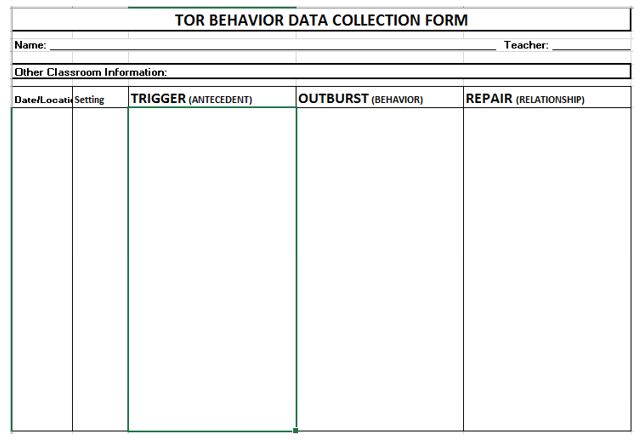
Accurate tracking data also affects how we communicate with our colleagues. We use data and records for several purposes outside our classroom. In the above scenario, the student may be referred to a team for further support. Using data to describe a student's progress or regression is vital to determining the next steps in support. Exemplary teachers understand this process and know that keeping accurate data will not only help the student but may also provide more effective support for the teacher.
Teachers also share students with many specialists in a typical school. Whether the student transitions to PE or a literacy specialist, communication of data and accurate records is vital to supporting students. A student may have a behavior plan, 504 plan, IEP, or health care plan, and this information is useful to every teacher, specialist, and classified employee who may supervise or work with that student. Exemplary teachers are the primary advocates for these students, ensuring everyone is on the same page about how the students' needs are to be met. For example, a student with a peanut allergy may have difficulty eating in the lunchroom without adult support. When students bring PB&J into school (or when peanut products appear in school meals), an exemplary teacher talks with the lunch staff about changing the student's seat. If the peanut allergy is severe, it may require eating in a completely different location for safety.

4. What Are Some Best Practices for Keeping Accurate Non-Instructional Data and Records?
Exemplary teachers use tools and practices to keep accurate data and records for all students. They use checklists, Web 2.0 tools, and other tools to track a multitude of non-instructional data. As simple as a checklist for tracking permission slips turned in, these teachers have a system. The systems may look different in each classroom, but exemplary teachers understand that without a system, papers get lost, and disorganization creates chaos in their classrooms and for the rest of the school staff who count on them for information.
A great example every teacher deals with is the handing in of assignments, such as homework. A teacher must think about the most effective and efficient system to maximize student success. For example, at the beginning of the day, as a student walks into the classroom, they check their name off the homework chart next to the teacher's inbox. This signifies that the student is present and that the homework is complete. Every student knows the first thing they do in this classroom: hand in and check off homework themselves. This gives ownership back to the student and creates agency. Checklists are a great strategy for teachers and students to use when turning in anything, and some teachers have built electronic tools to support students with assignments.
Digital tools such as Remind and Class Dojo are popular communication tools among classroom teachers for reaching students and parents. Older students who have a device can sign up for a teacher's Remind on their own. Teachers can then use the app to share course information and remind students about assignments. Web 2.0 databases like PowerSchool, SchoolMaster, and Infinite Campus also support teachers in managing non-instructional data and records. Silverback Learning's data warehouse, Milepost, is one example: it uploads data and organizes it onto a digital dashboard that supports both instructional and non-instructional decisions.
Whichever platform a teacher settles on, it's worth building in a backup habit from day one: an exported spreadsheet saved outside the platform, or a printed copy of anything irreplaceable. Platforms change vendors, accounts get locked, and a semester of anecdotal notes is hard to reconstruct from memory.
RELATED - Top Technology Apps for Teachers
There are countless other ways to organize non-instructional data, but the key to using it well is always to ask: Is this the most effective and efficient way to collect, manage, and use the data?
5. How Can Teachers Establish a Data and Record Keeping System That Empowers Students and Creates Agency?
Empowering students by fostering agency is a strategy that all exemplary teachers practice. These teachers understand that when students take charge of many classroom procedures and routines, ownership and academic growth increase. What might get described to a teacher as "your classroom runs like a well-tuned engine" is really a lot of practice, teaching, and modeling that went into building that system. These teachers have to be willing to give up power to empower students.
Some teachers use job charts to make sure all students get to take part in supporting the classroom, while other teachers establish routines that all students follow every day. Students can support accurate record-keeping and data management when given the responsibility. Depending on the grade level, students can do many jobs that build agency. Here's a list of jobs at the elementary level, drawn from various classroom-management sources:
- Teacher Assistant
- Technology Assistant
- Tables Manager
- Lights Manager
- Paper Manager
- Line Leader
- Recycling Manager
- Schedule Manager
- Library Books Manager
- Lunch Box Manager
- Mailbox Manager
- Locker Manager
- Cleaning Manager
- Calendar Leader
- Pencil Manager
- Absent Student Manager
- Clipboard Manager
- Recess Materials Manager
- Windows Manager
Setting up middle and high school students to manage their own work requires the same practice, modeling, and reteaching as for elementary students, just with different jobs. These roles work well at the middle and high school level:
- Front Row Leader: Sits in the front row and collects papers, making sure each one has a name on it and is turned in on time.
- Door Opener: Answers the door whenever anyone visits the classroom to ensure the teacher's instruction can continue.
- Secretary: Answers the classroom phone, takes notes such as a list of students who are absent, and helps out when there's a guest teacher.
- Desk Straightener: Straightens desks at the end of each period.
- Materials Distributor and Collector: Distributes any books or materials to students whenever needed, and collects materials at the end of the class.
- Quote Writer: Chooses an inspirational or thought-provoking quote each day to write on the board.
- Information Checker: Looks up information online when needed and finds answers, serving as the classroom's own search engine.
- Smart Board Guru: Helps with technology and the materials needed to keep the Smart Board functioning.
- Paper Returner: Knows where graded papers are located and returns them to their respective owners at the beginning of the class.
- Board Cleaner: Keeps all boards clean and manages all cleaning supplies.
See this graphic from mathchips.com for more examples.
There are countless ways to engage students in classroom procedures, especially when it comes to maintaining accurate records and data. Students generally should not be given access to another student's official grade records or the school's grade-entry system. Follow your district's privacy and access-control policies for who can handle that data. Other students and unauthorized individuals should not have access to a student's private education records. Parents generally have FERPA rights to inspect their own minor child's education records. Student jobs like Secretary and Paper Returner are fine, but they should be scoped so students never see another student's grades, health information, or behavior records.
Creating agency within students starts with teachers understanding and handing over many of the procedures and routines. What exemplary teachers build is a fine-tuned system, and it's best tested when the classroom teacher is absent. Whatever breaks down when there's a guest teacher is exactly what needs to be retaught, modeled, and practiced further. These teachers take the feedback from guest teachers, students, and colleagues to improve their practices.
(Charlotte Danielson Model: Domain 4, Component b)
Frequently Asked Questions
What's the difference between formative and summative record keeping?
Formative records, such as writing tasks, pre-assessments, checklists, and rubrics, track progress while learning is still happening, allowing a teacher to adjust instruction in real time. Summative records, like test and quiz scores, capture what a student learned after the fact. Exemplary teachers keep both because formative data drive the next lesson, while summative data document the outcome.
How long should teachers keep student records?
Student-record retention periods vary by record type and may be governed by state law, state or local retention schedules, and district policy. How long report cards, teacher notes, and behavior records must be kept varies by jurisdiction, record classification, and district policy, so check your district's records-retention policy rather than assuming a default.
What record-keeping tools do most teachers actually use?
Most schools standardize on a student information system like PowerSchool or Infinite Campus for grades and attendance, then leave day-to-day classroom data, like behavior notes, informal assessments, and permission slips, to whatever system the teacher builds themselves: a clipboard, a spreadsheet, or an app like Remind or Class Dojo for parent communication.
Can students help manage classroom records?
Yes, for non-sensitive tasks like checking off turned-in homework or managing a classroom job chart. Ordinary peer grading, before the teacher collects and records the grade, doesn't violate FERPA either. What students generally should not access is another student's official grade records or the school's grade-entry system, and any tasks involving student data should follow your district's privacy and access-control policies.
Why does record keeping affect parent communication?
Parents notice when a teacher can't produce work or explain a grade on request. Teachers who grade quickly and document behavior incidents as they happen can back up what they tell a parent, which builds the kind of trust that makes harder conversations easier down the line.
- Collect data you'll use - Data collection without a downstream instructional or communication purpose just adds paperwork. If it isn't changing a decision, reassess why you're keeping it.
- Pair a platform with a habit - A district-wide system like PowerSchool or Infinite Campus handles shareable data, but the anecdotal, day-to-day record still needs a simple personal habit, like a clipboard or a TOR chart.
- Timely feedback supports communication - Grading and scoring work promptly can support instructional adjustments and make parent and student conversations easier than falling behind does.
- Give students ownership where FERPA allows it - Job charts and self-managed checklists build agency, but grade entry and private student information stay with the teacher.
Building a record-keeping system is one piece of running an organized classroom. The programs listed here can help with the rest, from classroom management coursework to advanced certifications that dig into data-driven instruction. Several are designed for teachers who are already working full-time.
MORE ROCK MY EVALUATION RELATED READINGS:
- Reflecting on Teaching
- Maintaining Accurate Records (Currently here)
- Communicating with Families
- Improve the Participation in the Professional Community
- Growing and Developing Professionally
- Showing Professionalism
As a 5th grade teacher, in 2010 Jon won the Presidential Award for Elementary Math and Science Teaching (PAEMST). As a principal, his school won the 2012 Blue Ribbon Award. In 2018, he won the National Distinguished Principal Award (NDP). In 2019 he won the National No Kid Hungry Breakfast Hero Award.
Jon is the author of three guides published on teacher.org: An Educator's Guide to Combat Bullying & Bully Prevention; Teacher Evaluation: A Transition Guide to Exemplary Performance; and You are the Wild Card: Infusing Fun Back into Curriculum. He has authored a children's picture book that was released January 2019 titled Benjamin’s Visit to Principal Reads Office…again! (available at www.archwaypublishing.com)
- Learning How to Say No and Set Boundaries with Parents - November 21, 2022
- How to Implement a Check-In, Check-Out (CICO) Behavior System - September 26, 2022
- Teacher Core Values: 7 Strategies for Living Your Code - August 15, 2022