
Questioning and Discussion Techniques: 5 Questions for Danielson 3b


Questioning and discussion techniques make up component 3b of the Danielson Framework. Distinguished places greater emphasis on students initiating questions, extending one another's thinking, and taking responsibility for participation, while at Proficient more of that work is carried by the teacher. Check which edition of the rubric your district uses.


No one will argue that questioning and discussion drive instruction. They belong in every lesson. Yet it is often the component teachers spend the least time refining. Ask a teacher in a post-conference which questions they asked during the lesson, and the answer is frequently one or two. Ask what level of Bloom's Taxonomy those questions sat at and the answer is often a guess.
Building on prior knowledge is a keystone skill in creating a powerful teaching lesson. How a teacher does that varies, but the fastest route is questioning students. Some questions follow straight from the science of learning. The best teachers turn it into something closer to an art form, crafting questions that fit both the required content and the particular students in front of them. That mix of art and science is what makes component 3b one of the harder places to earn a top rating.
A note on which version of the framework you are working from. The Danielson Group released an updated Framework for Teaching in 2022, and districts have been transitioning to it since. The four-domain, 22-component architecture held, and so did the four rating levels: Unsatisfactory, Basic, Proficient, and Distinguished. What changed is that Domain 3 is now called Learning Experiences rather than Instruction, and most component titles were rewritten. Component 3b kept its name. Its three elements did not. According to state transition guidance published for districts moving between editions, the 2013 rubric listed Quality of Questions, Discussion Techniques, and Student Participation, while the 2022 rubric lists Critical Thinking and Deeper Learning, Reasoning and Reflection, and Student Participation. Check which edition your district evaluates on before your next observation, because the language in your post-conference will come from one or the other.
The five questions below will support your move from Proficient toward Distinguished.
1 - How Do You Build Discussion into Your Lessons?
There are many components to a lesson plan. Teachers have to hook the students into wanting to learn the topic. At the start of most lessons, the teacher states the learner objective, the rationale, and how students will be assessed by the end. Then comes some version of the "I do, we do, you do" model. Finally, the teacher sets an independent task that shows how well each student understood and mastered the objective. There are many variations on this shape. Madeline Hunter's lesson format and the 5E inquiry-based lesson design are two of the best known.
You have probably seen the Learning Pyramid, the one that assigns a retention percentage to each mode of instruction and puts lecture at the bottom and teaching others at the top. It is worth knowing that the specific numbers have no surviving evidence behind them. The National Training Laboratories is credited with the model, but the underlying research was lost and has never been reproduced, and researchers have published direct rebuttals of it. Treat the percentages as illustration rather than data.
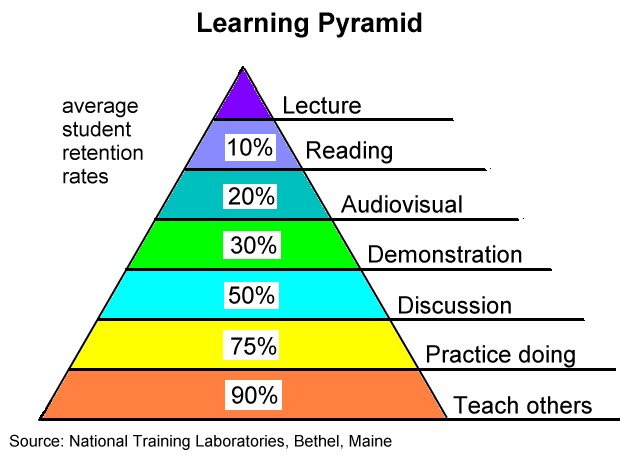
The defensible version of the claim is still useful, and it is the one that matters for 3b. Active-learning research generally supports incorporating meaningful student participation rather than relying exclusively on lecture, which is part of why discussion earns its own component in the framework.
Teachers at the top of this component build time for students to talk with the teacher whole-group, in small groups, and in pairs across most lessons. They use different structures to draw out responses, from a simple Think-Pair-Share to a Socratic Circle or a Kagan cooperative structure.
There is a fine line between too much discussion and not enough content, and a second question about when discussion belongs inside a lesson. Some teachers follow a textbook or teacher's guide on this, and others go by feel. Teachers working at the Distinguished level know the content well enough to plan their questions ahead of time, then adjust the cognitive level up or down based on what students give them.
Two patterns show up often enough in developing teachers to be worth naming. In the first, the teacher is not asking enough questions to get feedback worth acting on. These teachers lean on lecture and carry the philosophy, "Students should know it, because I taught it." To them, teaching it means they said it out loud already. What is missing is the give and take, the formative checks throughout a lesson that predict whether the objective will land. In the second camp, the teacher asks so many questions and runs so much discussion that content never gets covered, and the pacing slips further behind every week. That teacher thinks the students are talking more than they are, so the job is done. Both patterns miss the same balance.
Fine-tuning that balance while also reading the room is what makes this difficult for new teachers. Experience plays a real role. Teachers who have been at it a while can read an overly chatty class and decide to add discussion rather than suppress it, because they know the talking is going to happen anyway and it may as well be pointed at the content. Turning off-task talk into structured discussion is one of the more effective classroom management tools available. The best classroom management tool is good instruction.
2 - What Level of Questioning Do You Use in Your Lessons and Why?
Tracking the questions you ask is an eye-opener for most teachers. Almost everyone agrees they should be asking higher-level questions to push students toward deeper understanding. Far fewer track what they actually asked. Once a teacher starts recording it, it turns into a habit that carries into every lesson after, and it makes raising or lowering the depth of knowledge a deliberate choice rather than an accident.
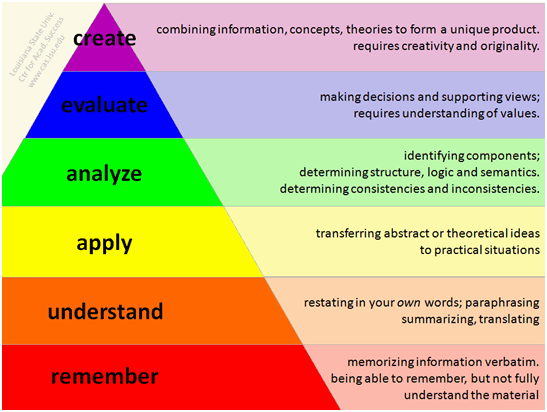
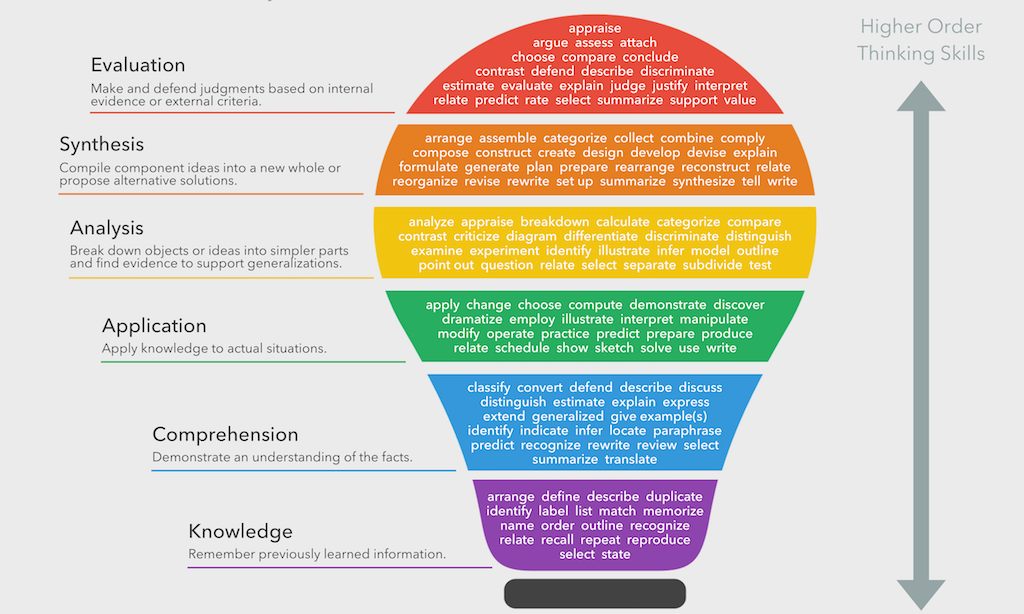
Changing the wording of a question can raise its difficulty with only a small adjustment. Vocabulary is the lever. The verb you choose determines the kind of thinking a student has to do to answer. Study the words attached to each level of the taxonomy above: complexity climbs as you move from the base toward the top.
Questions from every level have a place. A teacher cannot simply reword a question to make it harder and expect better thinking. It depends on how new the concept is and what level of understanding students are showing right now. Sentence stems are a practical way to move from low-level questioning toward differentiating in the middle of a lesson. Here are stems for each level, running from the base of the taxonomy to the top, from Flickr user enokson:
Remember
- Can you recall…?
- Where is…? Who is…?
- Can you list four…?
- Can you name…?
Understand
- What is the main idea of…?
- How would you summarize…?
- How do you explain…?
- Can you find an example of…?
Apply
- What would happen if…?
- How would you clarify…?
- Who do you think…?
- What is a situation like…?
Analyze
- Why do you think…?
- Can you compare…?
- How would you categorize…?
- What can you infer?
Evaluate
- Which is more important…?
- Can you defend…?
- What are the pros and cons of…?
- How would you feel if…?
Create
- What is an alternative…?
- Could you invent…?
- How can you imagine…?
- What could you design to…?
The graphic below shows Bloom's 1956 original, though most schools now work from the 2001 revision. The levels map across cleanly: synthesis was renamed create and moved to the top, which pushed evaluation down to second-highest.
3 - How Do You Get a High Level of Student Participation in Discussions?
Student participation is one of the three named elements of component 3b, and it survived both editions of the rubric unchanged. Getting it right is multifaceted. Engagement, motivation, student agency, and the quality of the questions themselves all feed into it. Active participation strategies keep students interested in the content and, done well, connect them to it at a deeper level. Component 3c, Engaging Students in Learning, covers that ground in more detail. Motivation is bound up with instructional style: a teacher who does not appear invested in the material has a hard time convincing students to be. Agency, meaning a student's capacity to run their own learning, is worth setting explicit goals around. And the ability of both teacher and students to generate questions worth discussing is the heart of this component.
Find material that students find interesting on its own terms. When the content is going to be a hard sell, connecting it to something students already care about raises participation. Discussions that start from high-interest concepts are easier to keep on task, which makes them more productive. This takes time, and new teachers should expect the search for good material to be slow at first. Reusing the same question stems helps here too, because the structure becomes predictable and students stop spending energy decoding the format.
At the same time, do not avoid asking questions you cannot answer. Modeling that you are also still learning, and that the honest response is to go find out, is worth more than appearing to know everything. Ask open-ended questions that differentiate easily, that tolerate multiple correct solutions, and that reward divergent as well as convergent thinking.
4 - How Can a Teacher or Student Build Questions off Previous Questions Asked?
Students can use question starters to build off each other's responses the same way teachers use stems to extend discussion. A teacher working at the Distinguished level has procedures, routines, and structures that get students engaging with each other rather than routing everything through the front of the room. Those protocols carry weight beyond academics: they are where kindness, tolerance, and empathy get practiced. There are many strategies for this, and what follows are a few of the most used.
It starts with a learning environment that is respectful of everyone in it, where students are willing to take a risk without expecting ridicule. Here are typical classroom protocols for discussion from litcircles.org:
| Discussion Elements | Looks Like | Sounds Like |
|---|---|---|
| Active Listening | Eyes on speaker Hands empty Sit up Mind is focused Face speaker | Speaker's voice only Paying attention Appropriate responses Voices low One voice at a time |
| Active Participation (respond to ideas and share feelings) | Eyes on speaker Hands to yourself Hands empty Talking one at a time Head nodding | Appropriate responses Follow off others' ideas Nice comments Positive attitudes |
| Asking Questions for Clarification | Listening Hands empty | Positive, nice questions Polite answers |
| Piggybacking Off Others' Ideas | Listening Paying attention | Positive, nice talking Wait for people to finish |
| Disagreeing Constructively | Nice face Nice looks | Polite responses Quiet voices No put downs |
| Focused on Discussion (body posture and eye contact) | Eyes on speaker Hands empty Sit up Face speaker Mind is focused | Speaker's voice only Appropriate responses Voices low |
| Supporting Opinions with Evidence | One person talking Attention on the speaker | One voice |
| Encouraging Others | Prompt people to share Ask probing questions | Positive responses |
One caution about a table like this one. Listening and participation do not look the same for every student. Sustained eye contact, facing the speaker, and stillness are culturally specific expectations, and they can be difficult or inappropriate to require of autistic students, students with ADHD or sensory processing differences, students with visual or motor disabilities, and students from cultures where direct eye contact reads differently. Treat the descriptors as one starting point to adapt, honor whatever accommodations and supports a student's plan calls for, and look for evidence of engagement in what students contribute rather than in how they hold their bodies.
Learning structures are built on protocols plus content worth discussing. Here are ten of the most popular structures that have students build their responses off each other:
- Fish Bowl or Socratic Circles
- Save the Last Word For Me
- Philosophical Chairs
- Pinwheel Discussion
- Concentric Circles
- Snowball Discussion
- Talk Moves
- Kagan Structure: Rally Robin
- Kagan Structure: Timed Pair Share
- Kagan Structure: Numbered Heads Together
Teaching students to recall, summarize, restate, or analyze another student's response gets them listening to each other instead of waiting for their turn. With how much public argument now models the opposite, teaching students to defend a position respectfully is worth the class time. It comes from modeling the language, then holding students to the protocol every time.
5 - How Do You Transition Questioning from Teacher-Created to Student-Created?
This is one of the distinctions between the top two rating levels, and the 2022 rubric gives it more emphasis than the 2013 version did. A Proficient teacher questions students skillfully and pulls higher-order thinking out of them. At Distinguished, students are increasingly doing more of that work themselves, alongside the other aspects the rubric weighs across critical thinking, reasoning and reflection, and participation. It sounds like a tall order. What it takes is teaching students the same skills the teacher has been using.
| Element of 3b (2022) | Proficient | Distinguished |
|---|---|---|
| Critical Thinking and Deeper Learning | Teacher asks questions that require reasoning rather than recall. | Students pose questions of that quality to each other without prompting. |
| Reasoning and Reflection | Teacher presses students to explain their thinking and support claims. | Students challenge and extend each other's reasoning as a matter of routine. |
| Student Participation | Teacher uses structures that pull in students who would otherwise stay quiet. | Students themselves notice who has not spoken and make room for them. |
That table is a plain-language summary of the direction each element moves, not rubric text. Pull the exact wording from the Danielson Group rubric your district evaluates on, because the phrasing your evaluator scores against is the phrasing that counts.
Handing students the role of questioner is more enjoyable than it sounds. At any grade level, modeling how you build a question out loud supports learning, because students often have no idea what they are supposed to be thinking about while they learn. Take a fifth-grade social studies unit on the explorer Vasco da Gama. What questions come to mind first?
- What is da Gama known for, and why am I learning about him?
- Where was da Gama from?
- What difficulties did he face on his voyages?
- How is da Gama like other Portuguese explorers of the same period?
- What do I already know about Portuguese exploration that helps me here?
- What could I make that would deepen my own understanding of this?
Those questions run from the remember level all the way to create. A teacher can model them, and students start to see how questions get built. From there, students use stems or each other's questions to develop their own, justify why they asked what they asked, and critique each other's respectfully.
Socratic Circles and fish bowls have no fixed sequence for questioning. They have protocols, but the questions get made on the fly, and students build off each other. A teacher can occupy several roles. You can ask the questions and run the circle, which is not a true Socratic Circle but is a reasonable way to teach the format at the start. You can participate at the same level as the students. You can observe the participants, the way the outer circle observes while taking notes. You can observe the whole process silently and record what you see. Or you can run several circles at once and move between them, listening. To learn more about these structures, see question 4 above.
Rubrics and checklists help with the handoff. Setting expectations for what discussion looks like, sounds like, and feels like is a straightforward way to get better discussion, and setting them before every use of a structure means students always know what is being asked.
A simpler rubric you can design with your students might look like this:
The point counts below are one customizable classroom example, not a Danielson requirement and not an evaluation instrument. The thresholds are arbitrary. Adapt them to your grade level, the goals of the specific lesson, and the needs and accommodations of the students in the room.
3 Points = 100% on task, supported other students often, asked at least 3 questions, made at least 3 comments or extensions from other students
2 Points = 100% on task, supported other students, asked at least 2 questions, made at least 2 comments or extensions from other students
1 Point = 80% on task, did not support other students, asked 1 question or made 1 comment or extension from another student
0 Points = under 80% on task, hindered the discussion group, did not ask questions or make comments
When students score themselves, reflect, and set goals for the next discussion, the transfer of ownership becomes visible. That visible transfer can provide evidence relevant to Component 3b, depending on the rubric and evaluation process your district uses.
(Charlotte Danielson Framework for Teaching: Domain 3, Component 3b)
MORE ROCK MY EVALUATION RELATED READINGS:
- Being Exemplary When Communicating with Students
- Using Questioning and Discussion Techniques (Currently here)
- Engaging Students in Learning
- Using Assessment in Instruction
- Demonstrating Flexibility and Responsiveness in the Classroom
Frequently Asked Questions
What are the three elements of Danielson component 3b?
In the 2022 Framework for Teaching, component 3b has three elements: Critical Thinking and Deeper Learning, Reasoning and Reflection, and Student Participation. The 2013 edition named them Quality of Questions, Discussion Techniques, and Student Participation. Districts are still transitioning between editions, so confirm which rubric your evaluator uses.
What is the difference between Proficient and Distinguished for questioning and discussion techniques?
The distinction runs across all three elements rather than resting on one. In broad terms, Distinguished places greater emphasis on students initiating questions, extending one another's thinking, and taking responsibility for participation, whereas at Proficient more of that work sits with the teacher. Student ownership is an important marker, but it is not the whole of it.
What evidence should I bring to a post-conference for 3b?
Anything that shows the questioning was planned rather than improvised, and that students carried part of it. A lesson plan with the questions written in advance and tagged by cognitive level works well. So do student-generated question lists, self-scored discussion rubrics, and a tally of who spoke and how often.
Does the Danielson Framework use a rating called Exemplary?
No. The four rating levels are Unsatisfactory, Basic, Proficient, and Distinguished, and those labels are the same in the 2013 and 2022 editions. Exemplary is a level in some other evaluation instruments, which is where the confusion usually starts.
How many questions should I plan for a lesson?
There is no number that works across grade levels and content. The more useful habit is writing your key questions into the plan ahead of time and marking what level of thinking each one demands, so you can raise or lower the difficulty during the lesson based on what students give you.
- Student ownership is a hallmark of Distinguished performance - students increasingly initiate questions, extend reasoning, and support broad participation.
- Know which edition you are scored on - the 2022 framework renamed Domain 3 to Learning Experiences and replaced two of Component 3b's three elements.
- Plan your questions in writing - tagging each one by cognitive level is what lets you adjust difficulty mid-lesson instead of guessing.
- Protocols make discussion teachable - Socratic Circles, Philosophical Chairs, and Kagan structures give students a repeatable format for building on each other.
- The Learning Pyramid percentages are not data - the underlying research was lost and never reproduced, though the broader case for active participation holds up.
Moving a rating on Domain 3 is largely a matter of practice and feedback. Graduate study in curriculum and instruction or educational leadership can support further professional development and, depending on state credential requirements and district policies, may qualify teachers for additional credentials or compensation. The sponsored programs on this page include options built for teachers already carrying a full course load.
As a 5th grade teacher, in 2010 Jon won the Presidential Award for Elementary Math and Science Teaching (PAEMST). As a principal, his school won the 2012 Blue Ribbon Award. In 2018, he won the National Distinguished Principal Award (NDP). In 2019 he won the National No Kid Hungry Breakfast Hero Award.
Jon is the author of three guides published on teacher.org: An Educator's Guide to Combat Bullying & Bully Prevention; Teacher Evaluation: A Transition Guide to Exemplary Performance; and You are the Wild Card: Infusing Fun Back into Curriculum. He has authored a children's picture book that was released January 2019 titled Benjamin’s Visit to Principal Reads Office…again! (available at www.archwaypublishing.com)
- Learning How to Say No and Set Boundaries with Parents - November 21, 2022
- How to Implement a Check-In, Check-Out (CICO) Behavior System - September 26, 2022
- Teacher Core Values: 7 Strategies for Living Your Code - August 15, 2022