
6 Questions to Tackle in Using Assessment in Instruction


Using assessment in instruction means treating formative checks (quizzes, exit tickets, class discussion) and summative tests as two different tools with two different jobs, then actually changing tomorrow's lesson based on what the data shows. The distinction that trips up new teachers: formative data should reshape instruction right away, not just fill a gradebook.


The hardest part of Charlotte Danielson's evaluation framework isn't giving assessments, it's proving you used the results to change something. These six questions cover the full loop: building a strong assessment, reading formative data, giving useful feedback, building student agency, and differentiating what comes next.
1 - How Do I Develop Strong Assessments?
Every assessment starts with the learning criteria for that grade level. Start with your state's current academic standards and any applicable district curriculum requirements, since test questions get written to match whatever standard is in place.
Two consortiums originally built computer-based tests from the Common Core State Standards: the Smarter Balanced Assessment Consortium (SBAC) and the Partnership for Assessment of Readiness for College and Careers (PARCC). Both saw wide adoption at their peak, though participation has shifted a great deal since. New Jersey's NJSLA and Illinois's IAR are examples of the state-specific assessments now used in place of PARCC in several states. Smarter Balanced is generally described as computer-adaptive, adjusting difficulty based on a student's answers, though the exact design varies by state and grade band. Check with your own state's department of education or assessment office to confirm what's currently used where you teach.
Here's a Common Core standard next to a matching sample question from the Smarter Balanced Item Bank:
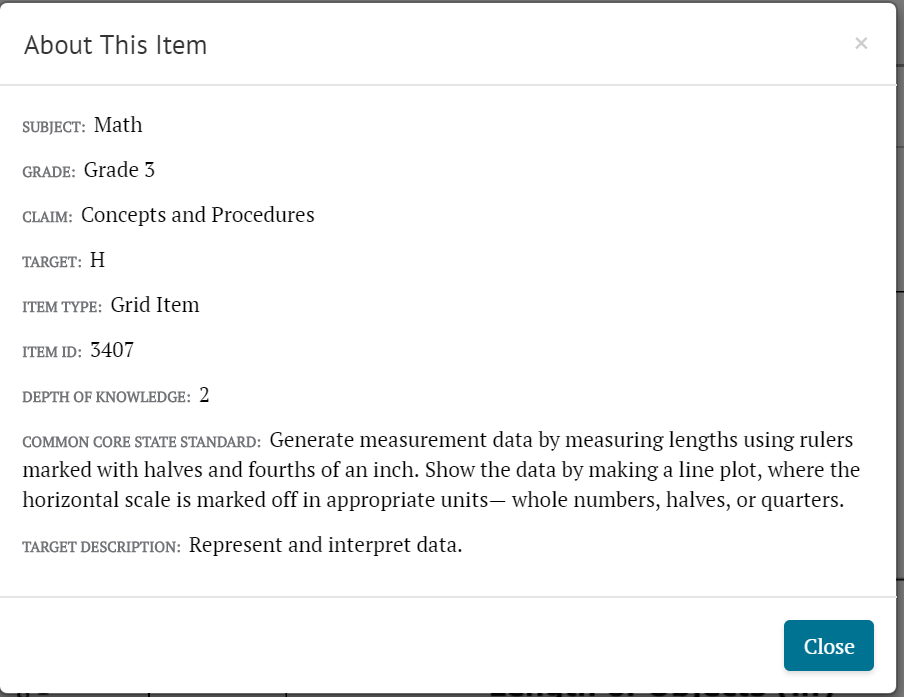
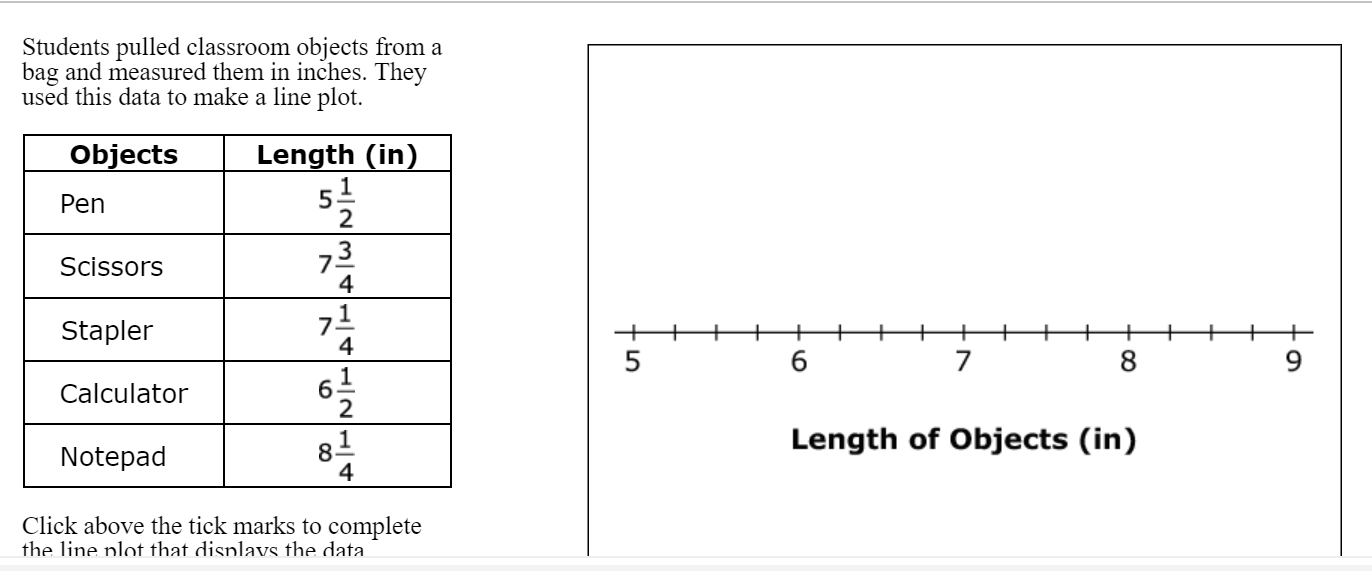
School boards choose curriculum that covers their state's standards, but publishers rarely cover everything, so districts have to fill the gaps themselves. Montana is a good example: Indian Education for All is a constitutional and statutory requirement woven into the state's standards, and the state expects every district to build it into curriculum rather than treat it as an add-on.
Teachers generally follow the district's approved curriculum, though strong teachers supplement it when something fits their students better. Loop in your administration before veering off it. That conversation matters more than people expect.
Computer-delivered questions come in a few basic formats, according to Smarter:
- Selected-response: pick one or more answers from a set of options.
- Non-traditional response: drag-and-drop, editing text, or drawing, taking advantage of computer delivery to test skills a paper test can't.
- Constructed-response: write or calculate an answer instead of picking one.
- Performance tasks: a scenario spanning one or two class periods, testing depth of understanding rather than a single fact.
Whoever writes the test also decides what depth of knowledge each question targets. Bloom's Taxonomy is the usual tool for setting that. Both SBAC and PARCC review their own items to confirm they're giving teachers useful instructional data, and textbook and curriculum companies do something similar.
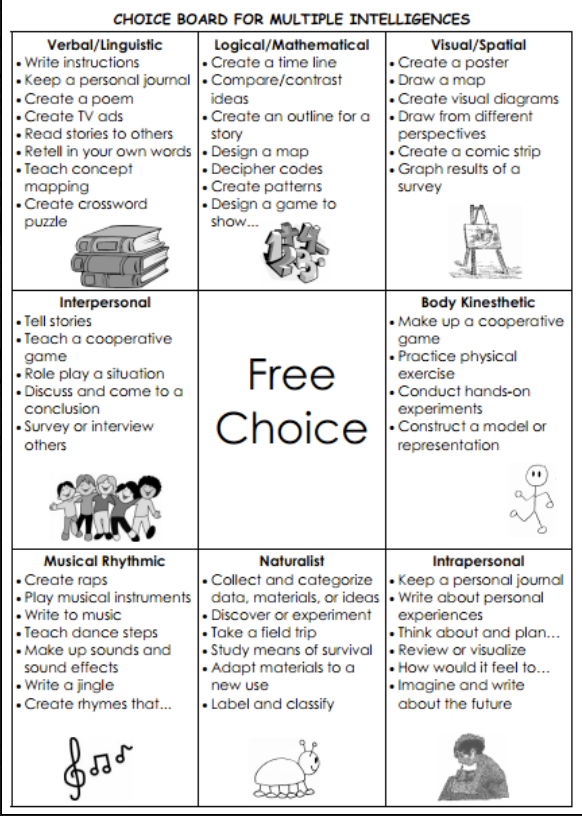
Alternative assessments can do something a computer can't: give a student more than one way to show what they know. A student who prefers a visual format might draw a comic strip about the "shot heard round the world" instead of writing an essay about the Revolutionary War, an idea drawn loosely from Howard Gardner's Multiple Intelligences framework. The value isn't a specific intelligence type doing the work. It's the choice itself. Here's a sample menu of assessment choices that could fit almost any learning target, from the Sweet Life of Third Grade Blog:
2 - When I Monitor Instruction and Pose Questions, How Does It Help Me Build Strong Formative Assessments?
Relying only on an end-of-unit summative assessment can reveal gaps too late for immediate adjustment. Building formative checks into daily instruction instead means catching a gap while there's still time to close it.
Picture a quick exit ticket after a fractions lesson: half the class misses the same step. That's the cue to open tomorrow's class with a five-minute reteach before moving on, not to plow ahead and hope it clicks later.
Some districts build common formative assessments for every teacher to use. In others, teachers build their own. Either way, an assessment nobody acts on is a waste of everyone's time.
Start from the end and work backward, the way Jay McTighe and Grant Wiggins lay out in Understanding by Design. Once you know what the summative assessment will ask, build formative checks that lead there.
Formative checks work best when they're fast to give and quick to read. Here are 20 you can use tomorrow, adapted from blogger Sarah Dougherty:
- Outcome Sentences
- Conga Line
- Inner/Outer Circle
- Headlines
- Plus, Minus, Interesting (PMI)
- Pair-Share
- Paired-Squared
- Jigsaw
- Modified Jigsaw
- Affirmations
- 3-2-1
- Quick Write/Draw
- Gallery Walk
- Think-Write-Share
- Red Card/Green Card
- Beach Ball
- Exit Tickets
- SOS
- Poll the Class
- Self-Assessment
3 - When I Review the Formative Data, What Are My Next Steps?
Most teachers agree formative data matters. Fewer know what to do with it. Say an exit ticket shows 65% of the class understood a concept. Some teachers just move on. Teachers with a plan ask four questions instead: who fully got it, who partly got it, who needs real support, and can these results form efficient groups for the next lesson?
Once you've grouped students, the harder call is what to actually change. Teaching the same lesson louder doesn't fix anything. Differentiating the process, the content, or the product, the way Carol Ann Tomlinson describes it, is the better move. Her research on this is worth reading in full.
4 - What Role Does Feedback Play in Assessment, From the Teacher and From Peers?
Hattie's work identifies feedback as an important influence on learning, though its effectiveness depends heavily on the type and context of the feedback, and most teachers still hand back a test with a grade and nothing else. That grade hides a lot: a "C" can mean a dozen different things about what a student actually understands, and feedback should start at the beginning of a lesson, not just at the end.
Hattie's research points to a few things that make feedback actually land: keep it specific to a standard or goal rather than general praise, build a classroom where mistakes are safe to make, use peer feedback deliberately, and give it after a student has already attempted an answer rather than before. Feedback focused on the task, not the student, broken into digestible pieces, and tied clearly to the gap between where a student is and where they need to be, moves the needle more than a grade ever will.

5 - How Can I Help Students Monitor Their Own Work?
Handing students the wheel on their own learning is harder than it sounds, but self-assessment, checklists, rubrics, and peer review can start as early as kindergarten.
Self-assessment works at three points: before a unit (what do you already know), during it (are you on track), and after it (how far did you come). Pairing that with your own formative and summative data gives you a fuller picture than test scores alone.
Clear rubrics and checklists put students in charge of hitting a target instead of guessing at one. Peer assessment can do the same, as long as the classroom culture supports giving and receiving feedback with respect.
6 - How Should I Differentiate Assessments for Students?
Differentiation is about figuring out what a student already knows, what they still need, and how they can show it. In a 2015 Education Week commentary, James R. Delisle argued it's too hard to implement well: classrooms have too wide a range of abilities, and teachers are often unclear on whether to differentiate curriculum, instruction, or both.
He's not entirely wrong. Personalizing instruction well takes real time and real skill. Carol Ann Tomlinson, who's spent her career studying this, describes differentiation as tailoring instruction to individual needs by adjusting content, process, product, or the learning environment, backed by ongoing assessment and flexible grouping, as she explains on Reading Rockets.
Start small. A reading teacher might begin by differentiating content within a Daily 5 reading structure, with every student reading at their own level. A math teacher might split one group onto double-digit addition, most of the class onto multiplication facts, and a third group onto double-digit multiplication. Not every assessment can be individualized this way. Students may also encounter standardized state assessments and, depending on the state or their own plans, assessments such as the ACT or SAT, and grade-level benchmarks still matter alongside personalized ones.
(Charlotte Danielson Model: Domain 3, Component d)
MORE ROCK MY EVALUATION RELATED READINGS:
- Being Exemplary When Communicating with Students
- Using Questioning and Discussion Techniques
- Engaging Students in Learning
- Demonstrating Flexibility and Responsiveness in the Classroom
Frequently Asked Questions
What's the difference between formative and summative assessment?
Formative assessment happens during learning and tells you what to adjust right now, like an exit ticket or a quick discussion check. Summative assessment happens at the end and tells you what a student mastered overall, like a unit test. Both matter, but only formative data is meant to change tomorrow's lesson.
How often should I use formative assessment data?
As close to daily as you can manage. The value of formative data comes from acting on it quickly. A check on Monday that doesn't change anything until Friday has already lost most of its usefulness.
What's the fastest way to use assessment data to group students?
Sort by mastery level right after a formative check: who's ready to move on, who partially understands, and who needs direct support. Even a rough three-way split beats teaching the whole class at one pace.
Do I have to use Smarter Balanced or PARCC for state testing?
It depends on your state. Many states that once used SBAC or PARCC have since built their own assessment aligned to the same standards, so check with your state department of education or state assessment office for the current statewide assessment.
- Formative and summative data do different jobs - formative should change tomorrow's lesson, summative measures what already happened.
- Act fast on formative data - a check that doesn't change Tuesday's lesson has already lost most of its value.
- Feedback beats a grade alone - Hattie's work identifies feedback as an important influence on learning when it's specific and timely.
- Differentiation works best in small doses - start with one part of a lesson, not a full rebuild of every assignment.
Getting evaluated well on this domain often comes down to formal training in assessment and data-driven instruction, and that's exactly what a lot of curriculum and instruction or educational leadership programs teach. The programs listed here include options built around that kind of coursework.
As a 5th grade teacher, in 2010 Jon won the Presidential Award for Elementary Math and Science Teaching (PAEMST). As a principal, his school won the 2012 Blue Ribbon Award. In 2018, he won the National Distinguished Principal Award (NDP). In 2019 he won the National No Kid Hungry Breakfast Hero Award.
Jon is the author of three guides published on teacher.org: An Educator's Guide to Combat Bullying & Bully Prevention; Teacher Evaluation: A Transition Guide to Exemplary Performance; and You are the Wild Card: Infusing Fun Back into Curriculum. He has authored a children's picture book that was released January 2019 titled Benjamin’s Visit to Principal Reads Office…again! (available at www.archwaypublishing.com)
- Learning How to Say No and Set Boundaries with Parents - November 21, 2022
- How to Implement a Check-In, Check-Out (CICO) Behavior System - September 26, 2022
- Teacher Core Values: 7 Strategies for Living Your Code - August 15, 2022