
Classroom Seating Arrangements: 5 Questions Every Teacher Should Ask

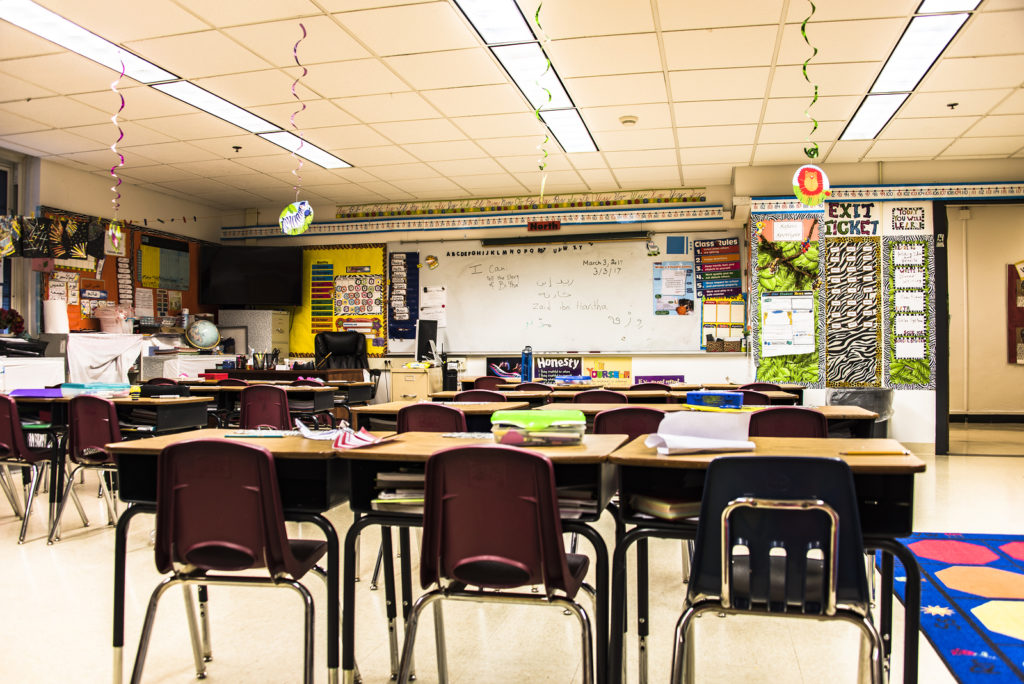
No single classroom seating arrangement works for everything. Match the layout to the activity: rows for independent work and testing, pods of four for cooperative learning, a horseshoe for whole-class discussion. Check each student's IEP or Section 504 plan for any required seating accommodations, then plan for safety, sight lines, and clear exit paths.


Five rows with six desks in each row. Each row sits two feet from the next, every desk pointed toward the front of the room where the chalkboard and the teacher's desk are located. Does this paint the picture of the standard old school classroom? Starting in first grade, I could be labeled as the front row and closest to the teacher's desk. Yes, I was one of those kids. The teacher used proximity as a classroom management tool. From first grade until I graduated high school, this was typical of almost all of the classroom designs. In fact, I would bet there are still a majority of classrooms across the United States that are similar. This reminds me of a factory that creates widgets, widgets being students.
Classroom seating arrangements have moved a long way from that model, and a lot of research has been done on what works best when organizing the physical space in your classroom. This component in Charlotte Danielson's Framework for Teaching can be discounted and treated as less crucial than other components. That is far from the truth. In reality, the best teachers spend time organizing their room before school starts, and they change their classrooms throughout the year to meet the needs of their students. A teacher may start the year with rows of desks, then group those desks together as community is built in the classroom.
Which Classroom Seating Arrangements Work Best for Each Activity
There is no arrangement that wins across the board, which is why the question is worth revisiting more than once a year. Wannarka and Ruhl's 2008 review of the empirical research in Support for Learning found the pattern most teachers eventually discover on their own: rows support on-task behavior during independent work, and grouped arrangements support interaction during collaborative work. The layout is a tool, not a personality.
| Arrangement | Best for | Trade-off |
|---|---|---|
| Traditional rows | Independent work, testing, direct instruction | Back rows disengage, and students face each other's backs |
| Paired rows | Partner work without full group noise | Harder for the teacher to circulate between rows |
| Pods or clusters of four | Cooperative learning, Kagan structures, project work | Some students always have their back to the board |
| Horseshoe or U-shape | Whole-class discussion, demonstrations, every student in view | Eats wall space and struggles with large class sizes |
| Double horseshoe | Discussion in a tight room, quick inner-outer partner pairing | The outer ring turns around and chats with the inner ring |
| Circle or roundtable | Seminar-style talk, morning meeting, restorative circles | No clear front of the room for projected material |
| Stadium or angled rows | Board visibility with faster transitions into groups | Needs floor space that most elementary rooms do not have |
Most teachers end up running two or three of these across a week. The practical question is not which arrangement is best; it is how fast your students can move between them without losing ten minutes.
Grouping Desks in Teams of Four
Spencer Kagan suggests grouping desks in teams of four. In this manner, a teacher can automatically implement cooperative learning structures. The students who face each other are called "face partners." The students that are next to each other are called "shoulder partners." When a teacher asks students to think about a question and discuss, he or she can ask students to talk to their shoulder or face partners.
One specific technique within Kagan's program goes further on how the four are chosen. It builds each team from four achievement levels (low, medium-low, medium-high, and high) without telling students their placement, then arranges the team so the highest and lowest learners are not each other's face or shoulder partner, on the reasoning that it deepens discussion. That is one grouping method from one program, not a general best practice, and ability grouping is contested enough in the research that it is worth reading Kagan's own materials before adopting it. Kagan has also created a multitude of learning structures using this four-student arrangement. Here are the Essential Five Kagan Learning Structures, according to Kagan Trainer, Gavin Clowes:
- Rally Robin - BetterLesson.com
- Timed Pair Share
- Rally Robin - YouTube
- Rally Coach - YouTube
- Stand Up, Hand Up, Pair Up - YouTube
Safety remains the number one characteristic that teachers should use when designing their rooms. After that, what should we think about as we design our own classroom? Here are five questions you can tackle in order to move from being a proficient teacher to an exemplary teacher in organizing your classroom.
1. What Safety Measures Should I Think About as I Design My Room?
Unfortunately, there are many schools across the United States that are in complete disarray due to deterioration. Many areas do not have the funds to update their schools. Teachers have to make do with what they are given. Flipping their mindset, as well as the mindset of parents and students, can be difficult, but that is what a master teacher will do in order to ensure students are learning.
Walls that are crumbling, cracks and uneven floors, and bad electrical outlets can be found in many classrooms across the country. None of that is a teacher's to repair. Structural and electrical hazards go through your school or district facilities and safety procedures: report the problem in writing, keep a copy of what you sent, and escalate to your building administrator or safety committee if nothing moves. Districts also set their own policies on outside fundraising, so check yours before starting anything. I know these are not ideal situations, but we must advocate for our students as best we can for their safety, health, and education, and on a building hazard, a documented report is what actually moves it.
When the physical components of walls, roof, seating, and electricity are ensured, a teacher has other safety measures to consider. Electrical cords, power strips, and other wires should not be in the walkways. An overabundance of desks in the main walkway areas also makes for hazardous situations. In the event of an emergency, students should not be impeded from leaving the classroom due to furniture or other obstacles. Whatever arrangement you land on, walk the exit path yourself before students arrive.
An exemplary teacher must think about the highly accessed areas and how procedures and routines address student convenience and safety. Computers in the classroom may be along one wall, stored in a cart or cubby, so procedures must be created to keep all students from accessing the same area at once. Limiting the number of students and creating routines for students to practice taking and putting away computers can increase the speed and efficiency with which students access these devices. Other supplies and materials must be thought about in the same fashion. How can students reach them quickly and transition between learning activities without a pile-up?
2. Do I Have Different Learning Areas and Zones in My Room's Design That Align to Different Learning Activities?
As educators move away from rows and aisles of desks as the only furniture or seating options in their classrooms, teachers must think about the different learning areas and zones in their room. At the elementary level, teachers can design their classroom for whole group, small group, and individual learning areas. Some classrooms may even have two different areas for whole group learning and sharing activities. Many teachers have a carpeted area where students come for direct instruction, demonstrations, or sharing, as well as tables or desks for all students in a different area of the room. Many teachers have small kidney-shaped tables where small group instruction can happen.
Master teachers take into account that a student may learn better standing, kneeling, lying down, or even pacing in a small work area. Giving up that control can be difficult for some teachers, because they may believe that sitting in a standard desk with all eyes on them is the only way students learn. That is not true. Here are four typical learning areas in a master teacher's classroom, along with their form and function.
Area 1: Individual Desks or Learning Areas
The most traditional area. Students here learn best when they have their own individual desk or learning area. This can make it harder for students to pair up and share, sometimes requiring them to get out of their desks to communicate, because the closest student is several feet away.
Area 2: Tables or Small Groupings of Desks
Students in this area learn best when they work cooperatively and in teams. They share learning spaces at a table or by putting furniture together, which keeps every student within an arm's reach of another student.
Area 3: Flexible Seating Areas
This area may be mixed into areas 1, 2, and 4. These students learn best with a different type of seating, and their learning is tailored to specific needs. Some teachers design their whole classroom this way. Others use this seating so all students can work cooperatively, much like area 2. The flexible seating options listed in question 3 belong here.
Area 4: Pacers, Standers, and Students Who Need to Be Moving
Students in this area learn best when they are allowed to pace, stand, or constantly be up and moving. These students may also participate in areas 1, 2, and 3. Teachers must place them where movement is allowed and there is adequate space, often along one side of the room so they do not distract other students.
Some educators have also divided their classrooms into a 7 Learning Zone system that connects routines, procedures, and areas of the classroom.
- Discovery Zone - display examples, record observations, and use data
- News Zone - display learning targets, classwork, homework
- Supplies Zone - student supplies area, reference materials, student work
- Community Zone - evaluate progress, correct misconceptions, take notes, area to connect
- Quiet Zone - making area of the room quiet, independent time, make-up work, testing, writing
- Teacher Zone - defined teacher area to work with adults, confidential area, manuals, references
- Subject Zone - examples and resources connected to subject areas, anchor charts, visuals, notes
3. Is My Room Organized So All Students, Including Students with Special Needs, Have Accessibility to Learning Tools, Learning Zones, and Furniture?
Start here, before you move a single desk. Review the IEP and Section 504 accommodations you are responsible for implementing and identify any seating requirements before moving desks. If a plan specifies a seating accommodation, the school must implement it as written. Keep in mind that "preferential seating" is not one standardized accommodation and does not automatically mean a front-row desk. For one student it might mean proximity to the primary speaker, for another a spot out of the line of sight of the door, and for another a desk near the board. Follow what that student's plan documents rather than inferring the placement yourself, and ask your special education case manager or an administrator if the wording is unclear. Access to plans and the procedures around them are set by your school or district. A seating chart that breaks an accommodation has to be redone, so it is cheaper to build the plan around those requirements from the start.
As mentioned above, the teacher may be working with students in a small group, whole group, or individual manner. While the teacher is designating these locations, they can also be thinking about what works best for the students in their classroom. Designating different learning zones and areas may be the first step in making sure all students have their needs met.
When a teacher thinks about different areas and zones, they match specific learning preferences with flexible seating locations. Some students may do their best work at a desk away from other students, while others may work best at a table next to a peer. Other students need to move because they have a sensory need or may have special needs. Here are some ideas for flexible seating that take a sensory need into account.
- Bouncy Chair - an exercise ball placed on a chair mount, so students can bounce and work on their core
- Wobble Stool - a stool that wobbles and lets students work on their core
- Crate Seat - a crate with padding on it that can be moved around the room easily
- Rocking Chair - a chair that rocks and provides repetitive motion
- Disk-o-Seat Cushion - an inflated cushion that meets both sensory and core balance needs while the student is able to move
- Bucket Chair - a chair shaped much like a bucket that can be placed anywhere in the room, and many styles of bucket chair rock
- Couch - students can sit or lie on a couch, similar to learning experiences at home
- Standing Desk with Tall Stool - students can stand at their desk, or sit at a desk that is taller than a normal desk
- Stools - a seat without a back or arms
- Gaming Chair - a bucket-shaped chair that rocks and can be moved anywhere in the room
- Theraband Chair Set Up - a large rubber band connected to the chair or the desk directly in front of the student, so the student can swing their legs and get exercise pushing and pulling against it
- Camp Style Chairs - fold-up chairs usually made of cloth
- Pillow Seats - different sizes of pillows that students can sit on, and they are easily movable
- Foam Pads - a foam pad placed on a chair surface or the ground, providing more comfort as well as the ability to move
- Benches - a seat without a back or arms, useful for multiple students working in the same area or working together
- Peddle Bike Chairs - chairs devised with bicycle pedals for students to use while learning
- Peddle Bike Desks - desks devised with bicycle pedals for students to use while learning
- Texture Seats and Desks - different types of textures attached to chairs and desks, because some students like the feel of sandpaper or Velcro attached to their desk for sensory stimulation
- Carpet Squares - a carpet sample students can use to create a learning area, and they are easily moved
4. How Does Access to Technology Play a Role in My Room's Design?
As more classrooms attain the goal of one-to-one technology, space and access can be an issue. Some classrooms have desktops located along walls or in pods, and these all take up space. Mobile devices are taking over many classrooms, such as Chromebooks or iPads. These devices can move anywhere in the classroom and can be stored in many ways.
Some technology is stored in computer carts. These carts hold all the computers, can be recharged by plugging them in, and can also be shared by other classrooms. Storing the cart in the classroom is a big decision, because it must be easily accessible to all students, must not block pathways, and needs well-established procedures for taking devices out and putting them away.
Wall-mounted storage can be efficient if your school has one-to-one devices in that classroom. A permanent storage area must not block pathways and cannot be bumped easily by students passing by. It has to be an accessible wall area where multiple students can reach the devices quickly and safely.
Wireless capability can be an issue if your school does not have adequate coverage. Adding more technology in a school may also be a problem because of the number of devices connected to the network. When the computer network bogs down, the devices run slower or may not work at all. For computers that need to be hard-wired into the network, you may have the same connectivity problems if your school does not have enough bandwidth. When the number of devices increases, the bandwidth splits that many more times.
5. How Do Students Play a Role and Take Initiative in the Room's Arrangement and Adjustments According to Their Specific Learning Needs?
There are two main philosophies in the ownership of the classroom: this is the "teacher's" classroom, and this is "our" classroom. Where the teacher owns the design of the room, there is limited input from students in the movement of furniture, no accessible and delineated learning zones, and not much movement around the room. Exemplary teachers understand that the classroom must be flexible and adaptable to the students in front of them. They also understand that students should play a role in these decisions.
Teaching students to understand themselves through self-regulation may not seem like it connects with how you organize your classroom, but master teachers know that is not true. They understand that by teaching students about the different learning tools, learning areas, and learning zones, students can support themselves in their learning. Agency is the ability for students to take on their own learning needs. Students who are allowed to have choice in meeting their own needs can be powerful and create agency. A National Board Certified Teacher, Amy Konen, states in her Teacher.org blog titled, Daily 5 and Alternative Seating: 4 Reasons Why They Are a Perfect Fit Together,
"When students have choice, they gain control over their learning. When they are given choices of where to sit, they feel more competent to choose what is best for them to enhance their learning. It helps them become more involved with their learning because they are the ones who are making decisions regarding their environment and their order of completing tasks. This is not to say I do not have any control in this area and kids are just running around doing whatever and however they want during this time. Choice will be put in place as the expectations and routines are learned within this time."
(Charlotte Danielson, Framework for Teaching: Domain 2, Component 2e, Organizing Physical Space)
MORE ROCK MY EVALUATION RELATED READINGS:
- Creating an Environment of Respect and Rapport
- Establishing a Culture for Learning
- Managing Classroom Procedures
- Organizing the Physical Space in Your Classroom (Currently here)
- Managing Student Behavior
Frequently Asked Questions
What is the best classroom seating arrangement?
There isn't one. The best arrangement depends on what students are doing that day. Rows work for independent practice and testing, pods of four work for cooperative learning, and a horseshoe works for whole-class discussion. Teachers who get the most out of their room teach students to move between two or three arrangements quickly.
How often should I change my classroom seating arrangement?
Many teachers start the year in rows while routines are being established, then move to groups once classroom community is built. Beyond that, change it when the activity changes or when the current setup stops working. The arrangement is a tool, so there is no rule that says it has to last a quarter.
Do I have to follow IEP seating requirements when I rearrange desks?
Yes. If an IEP or Section 504 plan specifies a seating accommodation, the school must implement it as written. Because the wording differs from student to student, check the accommodations you are responsible for before you build a seating chart, since a layout that breaks one has to be redone.
Does flexible seating work in every classroom?
Not always. Flexible seating depends on floor space and budget, and secondary teachers with 34 desks in a small room often can't build separate zones. A workable middle ground is keeping standard desks and teaching students to reconfigure them for different tasks.
How does classroom seating affect student behavior?
Seating changes who talks to whom and how much time students spend on task. Wannarka and Ruhl's 2008 research review found that rows support on-task behavior during independent work, while grouped arrangements support interaction during collaborative work. Where a student sits also shapes how often the teacher interacts with them.
- Match layout to activity - Rows support independent work and testing, pods of four support cooperative learning, and a horseshoe supports whole-class discussion.
- Check accommodations first - Seating accommodations specified in a student's IEP or Section 504 plan must be implemented, so build the seating chart around them rather than retrofitting them.
- Safety sets the limits - Keep cords and power strips out of walkways and confirm nothing blocks the exit path before students arrive.
- Kagan teams of four - Grouping desks in fours creates face partners and shoulder partners, the structure Kagan's cooperative learning program is built on.
- Give students a say - Teaching students to choose the seating that fits the task builds the self-regulation that makes flexible arrangements work.
Classroom design is one of the areas where a strong preparation program shows its value, because you learn to read a room before you are responsible for one. The programs listed on this page include education degrees and endorsements that cover classroom management and instructional design, with online and hybrid formats for teachers already working full time.
As a 5th grade teacher, in 2010 Jon won the Presidential Award for Elementary Math and Science Teaching (PAEMST). As a principal, his school won the 2012 Blue Ribbon Award. In 2018, he won the National Distinguished Principal Award (NDP). In 2019 he won the National No Kid Hungry Breakfast Hero Award.
Jon is the author of three guides published on teacher.org: An Educator's Guide to Combat Bullying & Bully Prevention; Teacher Evaluation: A Transition Guide to Exemplary Performance; and You are the Wild Card: Infusing Fun Back into Curriculum. He has authored a children's picture book that was released January 2019 titled Benjamin’s Visit to Principal Reads Office…again! (available at www.archwaypublishing.com)
- Learning How to Say No and Set Boundaries with Parents - November 21, 2022
- How to Implement a Check-In, Check-Out (CICO) Behavior System - September 26, 2022
- Teacher Core Values: 7 Strategies for Living Your Code - August 15, 2022