
If You Had Only One Behavior Strategy to Use in Your Classroom, What Would It Be?
9/26/2022



If you had only one behavior strategy to use in your classroom, what would it be?
This question is nonsensical as we all know it takes several strategies to be an effective teacher, but what strategy works most frequently?
Being a former teacher and principal, and now a superintendent, I have spent my career working to increase the number of tools in all my toolboxes. Whether that toolbox is for budgeting, professional learning communities, or networking, I am addicted to learning new things and meeting new people that can support me in my everyday job.
As superintendent, one thing I miss is working with the kids! I miss the relationships…the reason "why" we all have a job in education - the kids!
I also miss working with teachers who make that impact daily in the classroom with those kids.
Relationships drive education!
If this statement is true, then the most effective behavior strategies should all be based on relationships!
When I started in education, I studied Lee Canter's Assertive Discipline philosophy. This philosophy led many teachers down a wrong path in my opinion, a path of commanding respect and requiring compliance of students, though that was not Canter's intention.
In my first year of teaching in 1998, I remember putting check marks next to a student's name every time they misbehaved. I then thought back to my own music teacher in elementary school who used the same system 12 years earlier with me. I could walk in the door, smile or snicker and in the first 10 seconds of class, I'd see my name on the front board with a check mark. I knew in my brain I had one more free check mark before my mom, who was a teacher, was contacted. A third checkmark meant both of my parents would be contacted and then the consequences would be substantial. My parents supported the teachers, and subsequently supported Lee Cantor and his Assertive Discipline. What was missing were any strategies that built relationships.
My behavior philosophy changed when I first heard Denny McLaughlin and his High Trust Psychology® in the late 1990's. It flipped my thinking on how to support students by first building strong trusting relationships. Then, adding in more professional development from the Love and Logic Philosophy ®, I then knew I had the start to a powerful toolbox where the strategies I could access worked with 95% or more of my students.
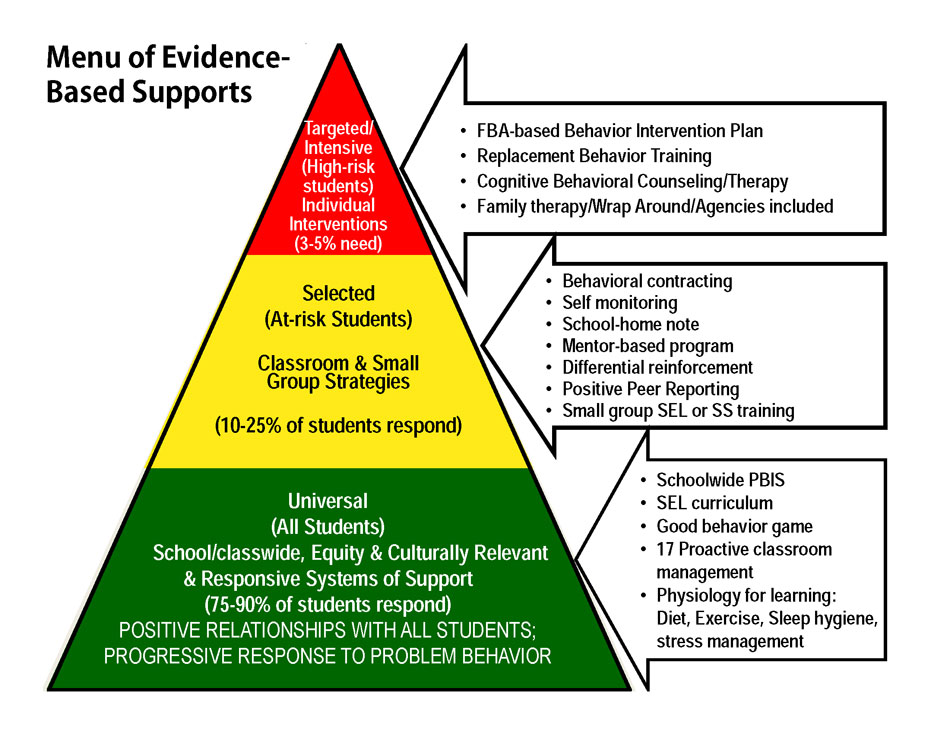
(This universal MTSS triangle example is in the public domain.)
Over the next 12 years of my career, I continued to find further strategies that fit into those first philosophies, and I was then able to support the last 4-5% of the students in my class. These students would now be considered "Tier 3" students according to the multi-tiered systems of support philosophy.
About a decade ago, I finally found a strategy that I could tailor that not only supported the 5% of Tier III students, but it was a great strategy to use with all students who were struggling with behavior. I quickly built numerous variations of this strategy to fit each individual student and story.
This strategy is called Check-In and Check-Out (CICO).
The one reason this strategy works is that it is based on strong relationships with students. It is not about shaming students by writing their names on the board or placing a check mark after their names to achieve compliance. It is a consistent, fair, and supportive strategy that connects each student with an adult in order to meet individual needs!
There are more and more books by PhD's coming out every day on CICO. After using this strategy for years, what I have found in my experience is that the strategy can be tailored to each student. If we try to put restrictions and boundaries on the strategy for our Tier 2 and Tier 3 students, the strategy will be less effective.
I agree all educators need to know how to implement a consistent CICO system first. Once an educator understands that the CICO strategy isn't working for all students it is targeting, I would then recommend exploring variations before abandoning the strategy altogether.
I believe if done well, this strategy can work for 95% or more of your Tier 2 and Tier 3 students, which leaves a handful or fewer that may need a more therapeutic setting than we can offer with our experience as educators. We can keep some of these students in our schools if we can offer mental health support in the schools. Yet, there may be a remaining few that even these strategies are not effective with over time.
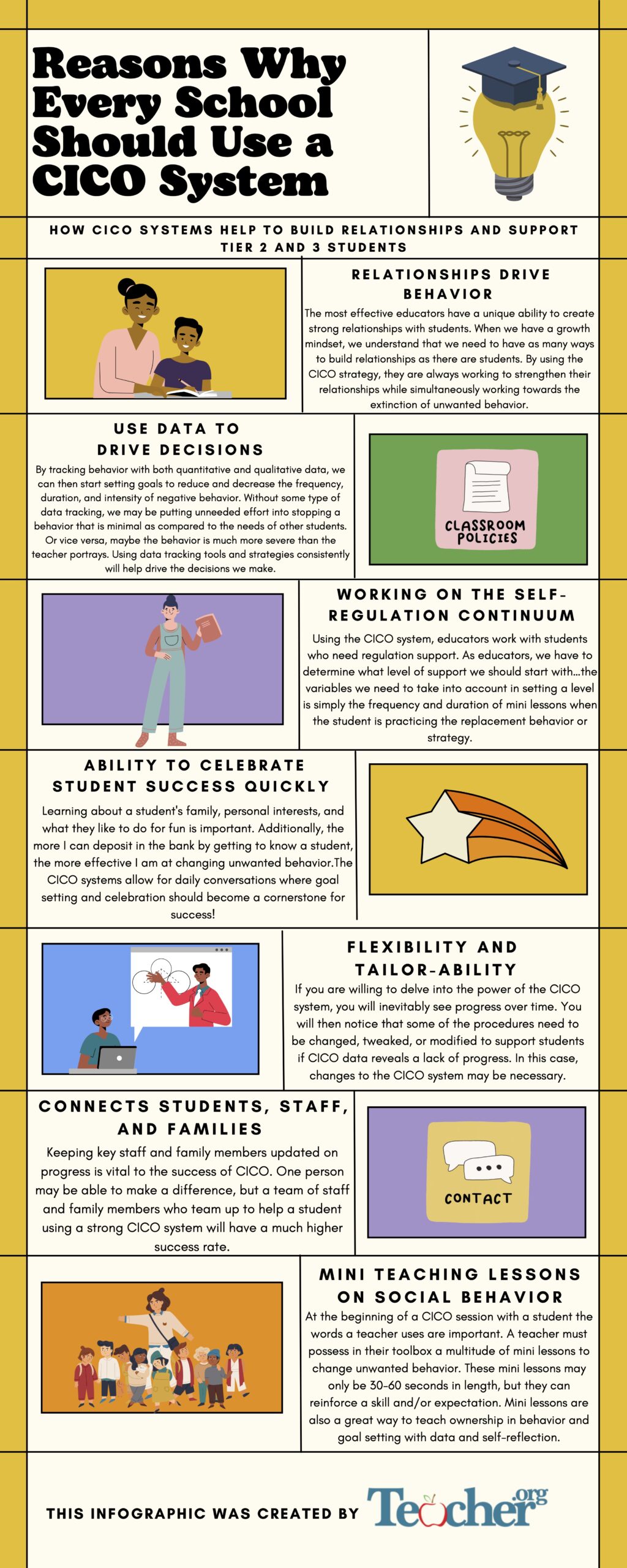
Also check out our Reasons Why Every School Should Use a CICO System Infographic

How to Create and Implement an Effective CICO System in Your School
With this caveat, let's dig into the CICO strategy. One fantastic book I have recently read that has reaffirmed much of what we have implemented is, Responding to Problem Behavior in Schools: The Check-In, Check-Out Intervention by Hawken, Crone, Bundock, and Horner (©2021). They define CICO like this…
"CICO, is a school-based intervention for providing daily support and monitoring to students who are at risk for developing serious or chronic problem behavior…It is based on a daily check-in/check-out system that provides the student with immediate feedback on their behavior via teacher rating on a daily progress report and increased positive adult attention. Behavior interventions are clearly defined, and students are given both immediate and delayed reinforcement for meeting those expectations."
Staff members who are working with a student using the CICO system meet regularly to review their behavior or social skill data. They set goals that can be discussed daily, weekly, or for a longer period of time. When a CICO system is started, one-on-one meetings may be needed multiple times in one day.
Successful CICO systems work towards the extinction of unwanted behavior. For example, if the student is meeting their daily goal, then we move towards a weekly goal. Once that weekly goal is met, we move towards a longer period between checks until extinction of the unwanted behavior occurs, or it becomes a rarity.
In my experience, I believe the CICO system can be implemented at different levels of intensity. The lowest level that the CICO can start with is the classroom, homeroom teacher, or other staff member. The next level of intensity would be a designated CICO coordinator, followed by a school counselor, and at the highest level of intensity would be a school principal. If your school has a social worker, therapist, or school psychologist this level may be next after the school principal.
Each of these professionals have a different skill set, possibly different programs in their toolbox, and expertise to help meet the needs of the student. The goal is to work the student back down to the levels of intervention the classroom teacher can manage.

Behavior Data Collection
With collection of behavior data, it is best practice to be tracking these three things in order to decrease unwanted behavior: 1) frequency, 2) duration, and 3) intensity. Frequency and duration can be tracked easily with charts, graphs, and quantitative data etc… Granted, intensity has to be judged qualitatively, but can still be objective.
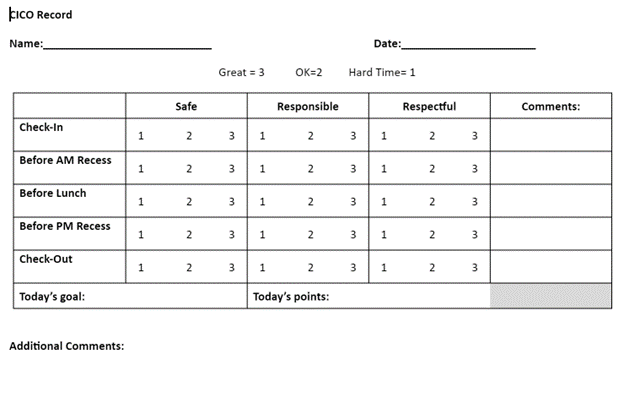
A Google search will pull up tons of data tracking tools for frequency and duration (www.pbis.org is a great site to start your search). Using a rubric like the one shown below, which I use in many CICO systems, gives educators tangible data to set goals and work towards extinction.
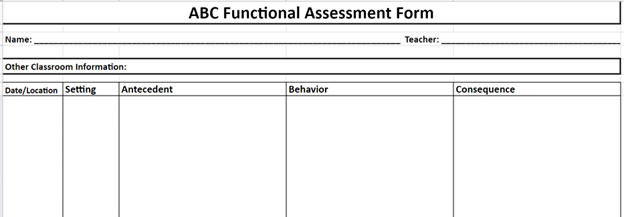
When working to reduce the intensity of a situation, the use of an ABC chart or TOR chart can describe the increase or decrease of the intensity of an unwanted behavior. In an ABC chart (see example I created below), an unwanted behavior is tracked and described in three distinct fashions: 1) "Antecedent" to the behavior, 2) the exhibited "Behavior," and 3) the "Consequence" for the behavior. A bonus to this chart is the ability to also track location, time, and who was involved. This gives you a tool that tracks all three: frequency, duration, and intensity.
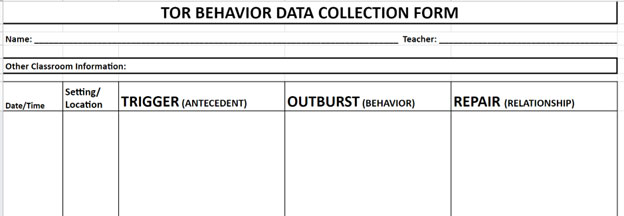
A variation of the ABC chart is the TOR chart (see example I created below). I have moved to this chart when tracking intensity because it matches my philosophy on making relationships and culture the most important aspect of our school community.
The three main components of a TOR chart are as follows: 1) "Trigger" to the unwanted behavior, 2) "Outburst" or behavior, and 3) how the relationship is "Repaired." The emphasis on this chart is how the adults support the student in repairing the relationship connected to the unwanted relationship (student to student behavior, student to teacher behavior, or student to self).
Ten Reasons Why I Think Every School Should Use a CICO System to Build Relationships and Support Tier 2 and 3 Students
1 - Relationships Drive Behavior
"How is your relationship with the student and/or family?" We hear this every day. It is usually the first question your principal asks you as a teacher when there's a behavioral problem with a student. Even when we think we have a good relationship with a student, behavioral problems may persist.
But we must also continue to build our toolbox of strategies, connect with, and build relationships with students. When we have a growth mindset, we understand that we need to have as many ways to build relationships as there are students. Unfortunately, educators that are ineffective at relationship-building will not find success with the CICO strategy. It may seem tedious and unfruitful.
The most effective educators have a unique ability to create strong relationships with students. These educators understand when using the CICO strategy, they are always working to strengthen their relationships while simultaneously working towards the extinction of unwanted behavior.
2 - Consistent Communication
Having a consistent communication strategy with both students and parents is vital in changing any unwanted behavior. Many times we do not value the power of our parents, or how important it is to communicate to them about their students.
In a world where a student may not know what will be happening from moment to moment in their home, it can be very affirming if they are able to count on an educator to be consistent and fair at school. But, in most cases we cannot provide all the interventions and support they need in the six hours they spend at school. Yes, we need parental support from home, and in many cases the parents are doing the best they can with the tools and strategies they have.
In these circumstances, we must continue to build common ground with parents, while also building trust with them. Students and parents both seek consistency from schools.
3 - Use Data to Drive Decisions
Many times we hear teachers say, "This student is always getting into trouble." My first questions to these teachers are "what does ‘always' mean?" and "How do you know?" Sometimes the unwanted behavior from the student is a pet peeve of the teacher and the ramifications are more severe than for other behavior.
By tracking the behavior with both quantitative and qualitative data, we can then start setting goals to reduce and decrease the frequency, duration, and intensity of the behavior. Without some type of data tracking, we may be putting unneeded effort into stopping a behavior that is minimal as compared to the needs of other students. Or vice versa, maybe the behavior is much more severe than the teacher portrays. Using data tracking tools and strategies consistently will help drive the decisions we make.
4 - Mini Teaching Lessons on Social Behavior
At the beginning of a CICO session with a student the words a teacher uses are important. A teacher must possess in their toolbox a multitude of mini lessons to change unwanted behavior. These mini lessons may only be 30-60 seconds in length, but they can reinforce a skill and/or expectation.
If the educator gets to the point quickly, makes the student think and respond, then the educator can hold the student accountable to the mini lesson. Whether a teacher is doing a mini lesson that teaches a replacement behavior to an unwanted behavior, or models for students how to interact with a teacher or another student, we can make an impact and increase a student's toolbox of social behaviors.
Mini lessons are also a great way to teach ownership in behavior and goal setting with data and self-reflection.
5 - Ability to Celebrate Student Success Quickly
In the Love and Logic ® philosophy, the creators use the analogy of a bank account: before we can withdraw from an account, we must have made deposits. The same can be said for changing an unwanted behavior. We must have put in positive praise, as well as having had many positive conversations around a student's interests before we can ask a student to change an unwanted behavior. Some research recommends a 7:1 ratio of positive statements to requests for behavioral change when correcting an unwanted behavior.
In my experience, it is more about the small moments of positive time spent together building a relationship. Learning about a student's family, personal interests, and what they like to do for fun is important. Additionally, the more I can deposit in the bank by getting to know a student, the more effective I am at changing unwanted behavior.
I can do this quickly by celebrating successes. If we look hard enough, we can find something in every student that warrants positive and specific praise…even with the smallest levels of compliance! The more we praise the behavior we want, the more that behavior will persist!
The CICO systems allow for daily conversations where goal setting and celebration should become a cornerstone for success!
6 - Working on the Self-Regulation Continuum
Have you heard of the self-regulation continuum? The opposite of self-regulation is dysregulation. This is behavior that is unpredictable and hard to control for adults and for the student. The process starts with what is referred to as, co-regulation. When working with a student, we may bounce back and forth between dysregulation and co-regulation with our final hopes of the student being able to self-regulate.
Using the CICO system, educators work with students who need regulation support. As educators, we have to determine what level of support we should start with…the variables we need to take into account in setting a level is simply the frequency and duration of mini lessons when the student is practicing the replacement behavior or strategy.
7 - Connects Students, Staff, and Families
Keeping key staff and family members updated on progress is vital to the success of CICO. One person may be able to make a difference, but a team of staff and family members who team up to help a student using a strong CICO system will have a much higher success rate.
Communicating goals, social skill needs, and progress are important for everyone in order for the student to meet expectations. Also, celebrating success not only with the student, but with families can increase the chances of success and effectiveness.
The best educators understand that celebrating success frequently also creates a stronger bond and increases trust between the family and the school.
8 - Flexibility and Tailor-ability
If you are willing to delve into the power of the CICO system, you will inevitably see progress over time. You will then notice that some of the procedures need to be changed, tweaked, or modified to support students if CICO data reveals a lack of progress. In this case, changes to the CICO system may be necessary.
Educators can start with some easy changes: 1) person implementing the CICO, 2) the duration or length of time with the student, 3) frequency of the number of meetings with the student, 4) location of mini-lesson, or 5) increase of parent involvement.
More substantial changes may include a change of social skills programs or adding in a reward connected to achieving goals. Students can choose a reward that may include a choice in the following areas: tangible reward, social reward, activity reward, or others.
9 - Promoting the Idea of Behavioral Ownership
When behavior is checked frequently and discussed with the student, it creates good opportunities for goal setting. We ultimately want students to be self regulated and to understand they have control over how they react. Specifically, we want them to own what they do and say when frustrated or triggered by something in their environment. Celebrating their success when they own their behavior is vital to the success of the CICO system.
In my experience, even students who may need a more therapeutic setting can manage at least one success in self regulation that deserves to be celebrated by the teacher and family. Students as young as kindergarten can, in most cases, start seeing their own behavior in terms of "cause and effect." We can then build off this ownership of behavior by changing the learning environment for the student.
The best educators understand that every aspect of the learning environment can be modified: where a student learns, how long a student can regulate in this location, who supports the student, what goals are they working towards, the content that is being taught, how the content is taught, when the content is taught, and how much outside and parental support they may need to be successful.
10 - High Accountability for Students, Staff, and Families
There are an infinite number of behavior strategies that can be used with students. The CICO system has one of the highest accountability attributes. How often a student's behavior is checked, monitored, discussed, and celebrated can determine their success.
In CICO, not only are students held accountable to their behavior, but staff and families have a large role to play in making sure they are doing what they say they are going to do too! Nothing breaks down a student's success faster than an adult that doesn't follow through. This only serves to reinforce the notion that a parent or staff member cannot be trusted. Once trust is broken, the success of the CICO system deteriorates.
With high accountability comes engaged staff and families. The better we can stay engaged in the student's progress by holding ourselves accountable, the higher the chances for success!
Reasons Why Every School Should Use a CICO System Infographic

As a 5th grade teacher, in 2010 Jon won the Presidential Award for Elementary Math and Science Teaching (PAEMST). As a principal, his school won the 2012 Blue Ribbon Award. In 2018, he won the National Distinguished Principal Award (NDP). In 2019 he won the National No Kid Hungry Breakfast Hero Award.
Jon is the author of three guides published on teacher.org: An Educator's Guide to Combat Bullying & Bully Prevention; Teacher Evaluation: A Transition Guide to Exemplary Performance; and You are the Wild Card: Infusing Fun Back into Curriculum. He has authored a children's picture book that was released January 2019 titled Benjamin’s Visit to Principal Reads Office…again! (available at www.archwaypublishing.com)
- Learning How to Say No and Set Boundaries with Parents - November 21, 2022
- If You Had Only One Behavior Strategy to Use in Your Classroom, What Would It Be? - September 26, 2022
- Live Your Code: 7 Strategies That Will Help You Be the Most Effective Educator You Can Be - August 15, 2022