
4 Strategies to Reframe Negative Language in the Classroom


Reframing negative language in the classroom means swapping phrases like "I can't do it" or "I don't want to" for growth-oriented ones like "I can't do it yet" or "I get to." The shift works with students and with parents in tough conferences. Four strategies do most of the work: growth mindset, the word "yet," "you get to," and teaching kids what they can and can't control.


Reframing what someone says is a skill, and like any skill, it gets easier with repetition. Teachers use it to unwind a student's negative self-talk or a parent's discouraging comment about their own child, and the best ones do it without turning the conversation into a conflict.
I've had the chance to lead a school that takes parent-teacher conferences seriously. This past fall, 100% of our parents showed up, either in person or by phone. This spring, 92% came in person. That kind of participation doesn't happen by accident, and reframing is part of how we get there. It's the same instinct behind taking a positive approach to college readiness: name the real problem, then hand the person a way forward instead of just the bad news.
Setting the Bar for Parent Contact
We use a three-tries policy. A teacher first tries for a face-to-face conference. If that doesn't work after two attempts, they try a phone call. If that still doesn't land, they give me the parent's name and I send a letter home about the student's progress and the need to team up. That letter goes in the child's permanent file as proof we tried three times. I rarely have to send many of these letters, because the policy itself does a lot of the work.
As principal, I sit in on the hard conferences and show up for the good ones too. Teachers can pull in the counselor, literacy specialist, resource teacher, or Title I teacher for support. Having another adult in the room helps the classroom teacher, and it helps even more when the meeting is a difficult one.
In every hard conversation, we look for ways to frame things toward the positive. We talk about growth over raw scores, and about social progress alongside academic progress. Reframing is how we do that without ignoring the truth. Diving straight into the negative sets up the parent, and the student, to fail before the conversation even starts.
That doesn't mean skipping the truth. After we name a growth area or a specific need, we have to leave the parent with something to work with: proof that teaming up with us gives their child a real shot. That's built on one premise: every child can learn.
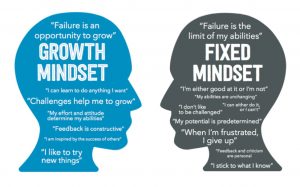
1. Cultivating a Growth Mindset
Carol Dweck's research on growth mindset has been around long enough that most teachers have run into it in one form or another, whether through a conference session or a meme shared on Twitter. Plenty of teachers put up posters and build anchor charts around it, and some go further and directly teach students how to name their own feelings using growth-mindset language. Students who talk about themselves in harsh, fixed terms usually learned that language somewhere, and often it's from home.
When we talk with parents whose kids show strong negative self-talk, we're often looking at where that language started. Most parents care about their child completely and still don't realize some of what they say lands as discouragement. Those are hard conversations. Nobody wants to hear that something they said to their own kid was hurtful. Part of the job, though, is giving parents hope and a way to team up with us. Growth-mindset approaches are intended to encourage students to view abilities as developable and to keep trying, and in the room with parents, that's often what reframing looks like: taking their words and handing them back with a little more room to grow into.
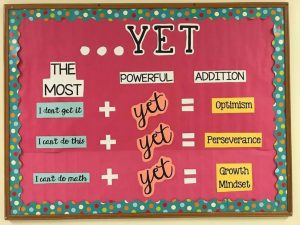
2. The Power of "Yet"
Students say "I can't do it" constantly. Add "yet," and the sentence changes shape: "I can't do it yet." It's a small rewording, but it's meant to signal that a skill can still develop, not just soften the sentence.
"Yet" also carries grit with it. Angela Duckworth's research has identified grit, perseverance and passion for long-term goals, as one factor associated with success in some contexts. "Yet" is grit in miniature: it signals that the search for a solution isn't over, even if it takes a long time to find one.
Parents say versions of this too. "I was horrible at math, so I'm sure my son can't do it either." That's exactly where "yet" belongs. We can talk through what we're doing at school to support their son, and give them something concrete to try at home so we're working the same problem from two directions. The message underneath it: we believe we can get this student where he needs to go.

3. "You Get To"
Students say things like "I don't want to go to school" or "I don't want to talk to my teacher" more than you'd expect. Part of reframing that is helping them see what they actually have: a free, public education that isn't guaranteed everywhere in the world. "You get to go to school today" and "you get to talk with your teacher today" say something different than the original complaint, even though the situation hasn't changed.
This phrase runs on empathy. The exercise asks a student to consider their situation from another perspective, one where school isn't guaranteed everywhere. Since it's free here, it's easy to take that for granted. Reframing it as access, not obligation, is a small way to push back on that.
Parents use the same complaints. "I don't want to go to a parent-teacher conference." "I don't want to help my child with math, he should do it on his own." "I don't want to go to the holiday concert." These are trickier to reframe with an adult, and there's a real line not to cross. But when it fits, something like "You get to hear me talk about your child's progress," or "You get to support your child at home, since you're more his primary teacher than I am, and I can give you the material to help," or "You get to go to the holiday concert. Before you know it, they're out of school and that chance is gone," can shift the room.
"I don't want to" and "I have to" both frame the moment as a burden. "You get to" frames it as access. That's a real shift, not just wordplay, especially for the students in our schools who've already lost a lot: a parent, stability, a sense of normal. For them, "you get to" carries more weight than it might for anyone else.
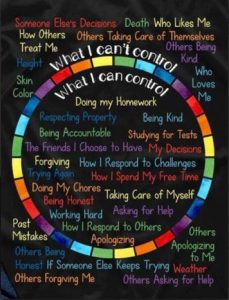
4. What Can We Control (and What We Can't)
Students often believe they control things they don't, and the reverse is just as common. Many haven't learned how to name and process a situation yet. Kids need structure and some ability to predict what's coming, which is part of why they gravitate toward classrooms that provide it. No environment gives anyone control over every variable, though, and that's a hard thing for a kid to hear.
One approach is a simple visual: a circle. Inside the circle are the things a student can change. Outside are the things they can't. Once a student can sort a problem into one side or the other, we can teach strategies for the "inside" items and a different set of strategies for letting go of the "outside" ones.
The same conversation happens with parents. We talk about what they control at home, what we control at school, and what neither of us controls. In our building, the goal is building ownership and independence in equal measure.
By the time our students leave sixth grade, we want them heading out as independent learners who own their behavior, actions, and words. Parents and teachers can model that language, and even practice it with a student before they try it themselves. The sphere of control in these moments belongs to the student, not to us.
If a student believes a friend is upset with them, our job as adults is to ask questions, model questions, and practice the conversation before the student tries to resolve it themselves. We hold back on purpose. Step in too early on a conflict like this and the student loses the chance to practice, and starts expecting an adult to fix it for them. We want students starting these conversations with their own words first.
Sometimes that means modeling the language right there, in front of both students: "Jimmy, you can tell him to stop poking you." This gives students an opportunity to practice resolving conflicts independently, and it reinforces their sense of what's actually theirs to control.
Frequently Asked Questions
What does it mean to reframe a student or parent's negative language?
Reframing means replacing a discouraging phrase with one that points toward growth, without changing the underlying facts. "I can't do it" becomes "I can't do it yet." "I don't want to go" becomes "I get to go." The situation stays the same. The framing around it changes what the student or parent believes is possible.
How does the "three tries" policy work for parent contact?
At our school, a teacher attempts a face-to-face conference first. After two unsuccessful tries, they move to a phone call. If that still doesn't connect, the teacher passes the parent's name along, and we send a letter home documenting the outreach and asking the parent to team up. At our school, that letter goes in the student's permanent file, though record-retention practices vary by district and state.
Why does "yet" matter more than it seems like it should?
"Yet" turns a closed statement into an open one. It signals that a skill is still developing rather than permanently out of reach, and it echoes the idea of persistence emphasized in research on grit. Used consistently, it's a reframing technique meant to help students treat a current gap as temporary rather than fixed.
Can "you get to" reframing come across as dismissive to a struggling parent?
It can, if it's used carelessly. The strategy works best when a teacher reads the room first and reserves it for moments where a parent needs a nudge, not a crisis where they need to be heard. Reframing should never replace listening, especially with a parent who's actually struggling.
How do I teach a student the difference between what they can and can't control?
One approach is a simple circle diagram: things inside the circle are within a student's control, things outside aren't. Once a student can sort a problem into one side or the other, you can teach direct strategies for the controllable items and coping strategies for letting go of the rest.
Reframing Phrases at a Glance
| What You Hear | Reframed Version | Strategy |
|---|---|---|
| "I can't do it." | "I can't do it yet." | The Power of Yet |
| "I don't want to go to school." | "You get to go to school today." | You Get To |
| "I don't want to go to a conference." | "You get to hear about your child's progress." | You Get To |
| "I have no control over this." | "What's inside my circle, and what's outside it?" | What We Can Control |
- Add "yet" to closed statements. "I can't do it" becomes "I can't do it yet," which turns a dead end into a timeline.
- Swap "I don't want to" for "you get to." The situation stays the same, but the framing shifts from burden to access.
- Sort problems into a circle of control. Teach strategies for what's inside it, and different strategies for letting go of what's outside it.
- Consider a documented parent-contact process. At our school, a three-tries system creates a record of outreach when families can't be reached.
- Reframe with empathy, not as a script. These phrases work when they respond to what a parent or student actually needs in the moment, not as an automatic reply.
These reframing strategies are the kind of thing that gets easier with a mentor or a structured program behind you, especially if you're still early in your teaching career. The programs featured on this page cover classroom management and instructional strategy alongside certification, for teachers who want more than just a license.
As a 5th grade teacher, in 2010 Jon won the Presidential Award for Elementary Math and Science Teaching (PAEMST). As a principal, his school won the 2012 Blue Ribbon Award. In 2018, he won the National Distinguished Principal Award (NDP). In 2019 he won the National No Kid Hungry Breakfast Hero Award.
Jon is the author of three guides published on teacher.org: An Educator's Guide to Combat Bullying & Bully Prevention; Teacher Evaluation: A Transition Guide to Exemplary Performance; and You are the Wild Card: Infusing Fun Back into Curriculum. He has authored a children's picture book that was released January 2019 titled Benjamin’s Visit to Principal Reads Office…again! (available at www.archwaypublishing.com)
- Learning How to Say No and Set Boundaries with Parents - November 21, 2022
- How to Implement a Check-In, Check-Out (CICO) Behavior System - September 26, 2022
- Teacher Core Values: 7 Strategies for Living Your Code - August 15, 2022