
Fidget Tools for the Classroom: 10 That Work Better Than a Spinner

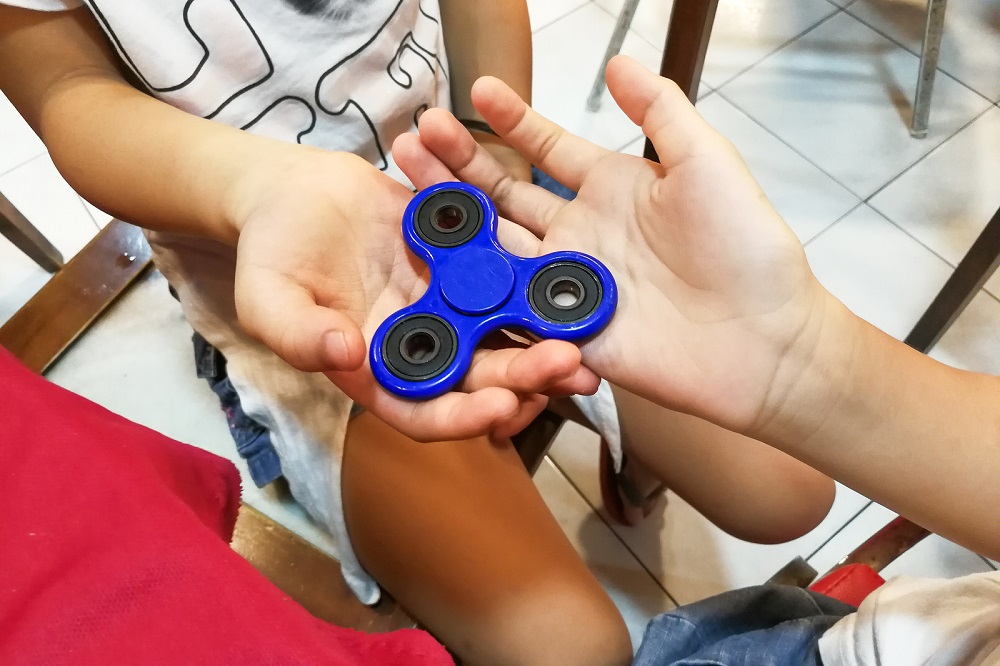
Fidget tools for the classroom may be more useful when selected based on an individual student's needs and response. Tangles, stress balls, putty, kinetic sand, and rocking chairs each give a different kind of input, and many are quieter and less visually demanding than a spinner. Teach the rules first.


Now that we are back to school, have you noticed that even on Day 3 those fidget tools have started turning up in your classrooms? How could they already need a tool, you are asking. It is only the third day of school; how could they possibly need a break? We have not even done anything yet. The truth is change can create an increased level of anxiety or send a sensory system out of whack. As kids come back to school, they are experiencing a change in their routine. (Remember saying in the middle of the year last year, these students cannot handle transitions?) Think of all the transitions they have already gone through by day 3. A structured time schedule, a new classroom, a new teacher to get used to, and for some, a new school altogether. They are having to learn a whole new set of procedures. For some, summer looked nothing like the school day they are walking back into. Now they are asked to be at school by a specific time with a whole room full of other students, to stay engaged for over 6 hours, and to be responsible for their learning. They are exposed to so many commands throughout the day: come to the carpet, work quietly, choose your lunch, pick a learning spot, a learning goal, and now learn what the PE, Library, and Music teacher expectations are as well. There is so much information to hold in one's head that it can be overwhelming immediately. Without loosening the steam on the pressure cooker, the results can result in power struggles, meltdowns, shutdowns, headaches, tears, overexcited behaviors, or student pushback. How does one balance the barrage of new information a new school year brings with settling overwhelmed and stressed students - AND does not involve the use of a fidget spinner?
The trick is pairing a tool with what an individual student actually needs, then watching closely to see whether it helps. Ten of my favorite tools are outlined below.
| Tool | Type of input | Noise level | Often used for |
|---|---|---|---|
| The Tangle | Tactile, two-handed movement | Quiet | Students who need their hands busy while listening |
| Movement brain breaks | Whole-body movement | Varies by activity | Transitions, and students who shift activities poorly |
| Klix | Tactile and auditory | Audible clicking | Students who need noise and movement but can't leave their seat |
| Stress balls | Tactile, squeezing | Quiet | Fine and gross motor strengthening, visible stress |
| Theraputty | Tactile, resistive | Quiet | Sustained hand work during listening tasks |
| Sequined pillows | Tactile, repetitive stroking | Quiet | Calming an anxious or escalated student |
| Kinetic sand | Tactile, moldable | Quiet | Sensory seekers, and students who avoid messy play |
| Chewy tubing | Oral, jaw work | Quiet | Students who chew pencils, sleeves, or collars (safety cautions apply) |
| Rocking chairs | Rhythmic motion | Quiet to a slight creak | Anxiety, active listening, longer work periods |
| Doodling | Fine motor, visual | Quiet | Boredom during lectures and long listening blocks |
The Tangle
In schools, we are constantly helping children perform activities that use both hands and both sides of the body. The Tangle is a quiet tool (which can make it a teacher's favorite) whose shape, texture, and color are made to hold a student's interest, and it lets a student move, work both hands, and cross the midline while staying in their seat. In my classroom, some students have held their attention better with one in their hands.
Tangle Creations, which makes them, describes Tangles as one of the most widely recommended educational and therapeutic tools for a range of special-needs populations including ADHD, autism, anxiety, depression, and bipolar disorders. The company's reasoning is that the brain stem is the switch that triggers attention, and that because most sensory-motor information flows through it, the sensory input a Tangle provides helps keep a learner alert (tanglecreations.com). That is the manufacturer's account rather than an independent finding.
I have used Tangles with many students who needed something to do with their hands before they could settle into anything else. Several told me it helped when they needed stamina for studying or test taking. That is my classroom observation over a lot of years, not a research finding, and I would offer it to you on those terms.
Movement Brain Breaks
Short movement breaks have become a common classroom practice, and in my experience they help students let go of one activity before starting the next. The break itself can serve as the marker between the two, which is useful when the schedule changes faster than the students do.
If you have a student who is not transitioning well, advance warnings, visual schedules, or predictable transition cues may help some students move between activities. Prep them for the upcoming change (Jonny, in two minutes you will hear the chimes and we will be moving to the carpet). They know what to expect when the sound occurs. It might also help to give that student the job of signaling the transition or the brain break, which puts them in charge of the change rather than subject to it.
Klix
These are tools that help stimulate two modalities: the auditory and the kinesthetic. It is effective for situations where a student needs to move and experience noise but cannot move about the room or use their voice (humming, noises, etc). The Klix is an interlocking loop that makes little clicking noises as the person manipulates the sections. Some Klix have sections that are tighter than others. I have had students who prefer the "softer" clicks and some that need the "harder" clickers. These are tools students can use without looking at them, thus allowing for more attention in the classroom.
In my classroom, this type of tool has worked well for students with ADHD or anxiety who need movement to help them engage in cognitively demanding tasks. Several have stayed with a demanding task longer while using one. That is what I have observed, not something I can point you to a study for. The hard part is if you are triggered by the noise of the Klix. I have had teachers say, I cannot stand these in my class. My response has been, these are creating a more successful learner in your classroom, and in such cases, we have set up a compromise. A student might work in another part of the classroom to use the Klix without being so close to the teacher to trigger her.
Stress Balls
There are so many types, styles, materials, textures, and sizes for stress balls that they really are a personal preference for students. These provide tactile stimulation that allows a student to use them without looking at them, making them a successful therapeutic and educational tool. They can serve the same purpose as a spinner but are more classroom-friendly, do not require hand-eye coordination, and are less distracting than the spinners, making them a good choice for a quiet tool to use in class. Stress balls allow students who need fine and gross motor strengthening to work on that without others necessarily knowing what they are doing.
A stressed student is working on two things at once: the lesson in front of them, and whatever is bothering them. Squeezing a stress ball gives that restlessness somewhere physical to go, and some students find it easier to stay with the lesson while their hands are busy. David Posen, author of Is Work Killing You?: A Doctor's Prescription for Treating Workplace Stress, describes this act of squeezing as muscular relaxation, and says the benefit is that it "releases some kind of energy" while also prompting you to relax.
Theraputty
Roland Rotz and Sarah D. Wright, authors of Fidget To Focus: Outwit Your Boredom: Sensory Strategies for Living with ADD, make the case that when a task isn't interesting enough on its own to hold our focus, mild sensory-motor input alongside it can let the brain engage fully and stay with the primary activity. Putty is a quiet tool for students to use to create this sensory input. My favorite, classroom-friendly type of putty is Silly Putty because it is small, contained in an egg, and does not stick, stain, or ruin carpet and clothing.
Putty lets students stretch, press, pull, and squeeze, which works fine motor skills and gives steady resistive input to the hands. Some students find that input useful or calming while they listen, and others have no use for it at all.
Sequined Pillows
There are pillows with rows and rows of sequins that, when you run your hand over them, can reveal different colors, create patterns and words, and stimulate texture and touch sensations that are soothing and relaxing. The power behind the pillow is that it creates a nurturing object to cuddle, and it allows students to engage in a repeated pattern of activity, which can help calm and soothe an anxious and elevated student. These pillows come in many colors, and some are stuffed, and some just need to be stuffed. I currently have three in my fifth grade classroom and could use fifteen more. I also just gave one to my 20-year-old son who uses it while studying for tests in college.
Kinetic Sand
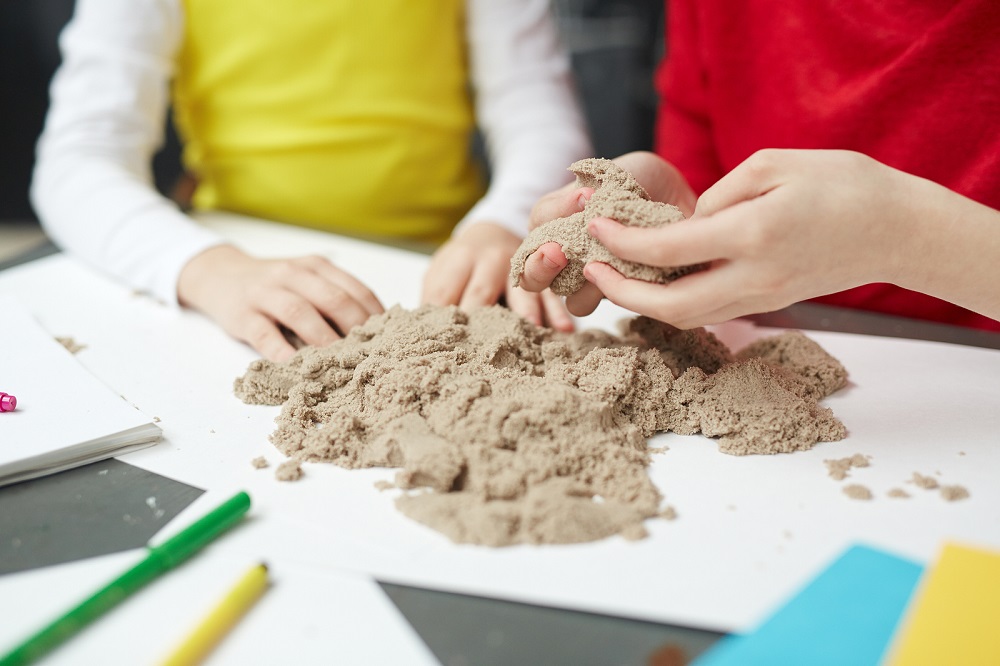
This is a sand-like substance that is easily moldable. It hardens when squeezed and "melts" when released. It doesn't leave granules behind on your hands, making it a successful calming tool to use in the classroom. Not only does it allow students to work on their fine motor development, but it also allows students who either crave or are sensitive to tactile input to have a successful experience. Kids who need input will squeeze, press, and push, and some sensory seekers find that calming.
Some students who avoid messier materials will still work with it because of its soft, non-sticky texture, though sensory responses vary a lot from one student to the next. Running fingers through the sand is a slow, repetitive motion, and some students settle while they do it. I like it in the classroom because when sand ends up on the floor, carpet, etc., one simply makes a small ball and presses it on top of the "mess," and it instantly is picked up and becomes part of the ball.
Chewy Tubing
As babies, we learned about our environment through our mouths, sucking and chewing on everything. Chewing gives the jaw steady, repetitive work, and for some students that is enough to settle them.
Oral tools need more care than anything else on this list, and nothing here is a general recommendation. Choking, hygiene, allergies, swallowing, dental concerns, and school or district policy all bear on whether a given student can safely use one. If a student has significant oral or sensory needs, follow the provisions in their Individualized Education Program or Section 504 plan and the recommendations of qualified personnel such as an occupational therapist or speech-language pathologist, rather than trying tools on your own. Where a classroom permits food, and a particular student can safely have it, crunchy options like pretzels or carrot sticks, or drinking through a straw, give the mouth and jaw similar work.
Rocking Chairs
A rocking chair gives a student steady rhythmic movement while they work. Some students find that movement calming, and some find it easier to listen or stay with a longer task while they rock. It is one of the few options here that a student can use while reading or listening without their hands being involved at all.
Doodling
A bored student is going to find something to do. Permission to free-draw can keep that student with the lesson a little longer instead of checking out of it altogether. Psychologist Jackie Andrade's study on doodling found that adult participants who doodled while listening to a recorded message recalled more of its content afterward than those who just listened. That was one study, with adults, on a monitoring task. It is a reason to allow doodling rather than proof it will work for a given student.
Used purposefully, these are one more thing you can offer a student who is struggling to settle. With appropriate selection, clear expectations, and monitoring, these tools may support some students' regulation or engagement.
Frequently Asked Questions
How do I set rules so these become tools and not toys?
Teach them the way you'd teach any classroom procedure, before anyone gets one. Name what the tool is for, show what using it correctly looks like, show what misuse looks like, and say what happens if it becomes a toy. Calling them tools rather than toys in front of students does real work here. Check your school's rules first, too, because some buildings don't allow putty or sand in carpeted rooms.
Do fidget tools help every student?
No, and the evidence is thinner than the marketing around these products suggests. Most of the research people cite here studied movement and physical activity, often in students with ADHD, and found that added movement during demanding tasks was associated with better performance for that group. That is not the same as evidence for any particular commercial fidget product, which has been studied far less. The two are not interchangeable. Treat fidget tools for the classroom as something to try with an individual student and monitor, not a whole-class purchase.
What's actually wrong with fidget spinners?
A spinner asks for visual attention and hand-eye coordination, which pulls a student away from the lesson instead of freeing them up for it. It also performs for the room. The tools here work without being looked at, which is the whole point.
What if a tool distracts other students, or me?
That's a real constraint, not a failure of the tool. A Klix that helps one student can make a teacher's skin crawl. Move the student to another part of the room, switch to a quiet tool with similar input, or set the noisier tool for independent work time only.
Do I need an OT or an IEP before using these?
It depends on the tool, the student, and your school or district's rules. Handing an ordinary classroom item to a group is a different question from putting an oral or resistive tool in the hands of a student with significant sensory needs. If a student already has an Individualized Education Program, a Section 504 plan, or a behavior intervention plan addressing sensory or regulation needs, follow it, and involve their team from the start rather than waiting to see whether something works on its own. Your occupational therapist or speech-language pathologist is the right person to ask before you improvise.
- Start from the student, not the product - work out what kind of input a student seems to need, pick a tool that offers it, and judge it by how that student responds.
- Quiet tools travel further - Tangles, putty, stress balls, kinetic sand, and sequined pillows work in almost any room. Klix and movement breaks need more planning.
- Teach the procedure before you hand anything out - modeling and explicit expectations are what separate a tool from a toy.
- The evidence is thinner than the marketing - most of the research concerns movement rather than specific products, so try a tool with one student and watch what happens.
- Oral tools are a different category - choking, allergy, dental, and policy questions apply, and an existing IEP or Section 504 plan comes first.
- Your own tolerance counts - a tool that helps one student and derails the teacher isn't working. Compromise on placement or switch the tool.
Reading a student's sensory needs accurately is a learnable skill, and special education coursework and behavior-analysis training both address it directly rather than leaving it to trial and error. They are separate professional pathways with separate credentials, and the sponsored programs on this page include options in each, several built for teachers already working full time. If pursuing a professional credential or educator endorsement, verify that the program meets the applicable requirements in your state.

- 11 Strategies to Encourage Students to Own Their Learning - January 19, 2018
- Student Behavior During the Holidays: 5 Potential Stressors - December 21, 2017
- 10 First-Year Teacher Struggles That Catch Veterans Too - November 27, 2017