
Email Etiquette for School Leaders: When to Hit Send


Email etiquette for school leaders comes down to when you send, not just how you write. Draft whenever your own schedule allows, then use schedule send so the message lands during the staff workday. Many leaders reserve after-hours sends for emergencies, following their district's own communication policy.


A recent post from the private Facebook group, Principal's Principles Leadership, sparked a long thread about how we can inadvertently cause stress for our staff. "Schedule Send" can help you reduce this stress and help us prioritize the tasks we do.
"Schedule Send" - An Inbox Activity for All Educational Leaders
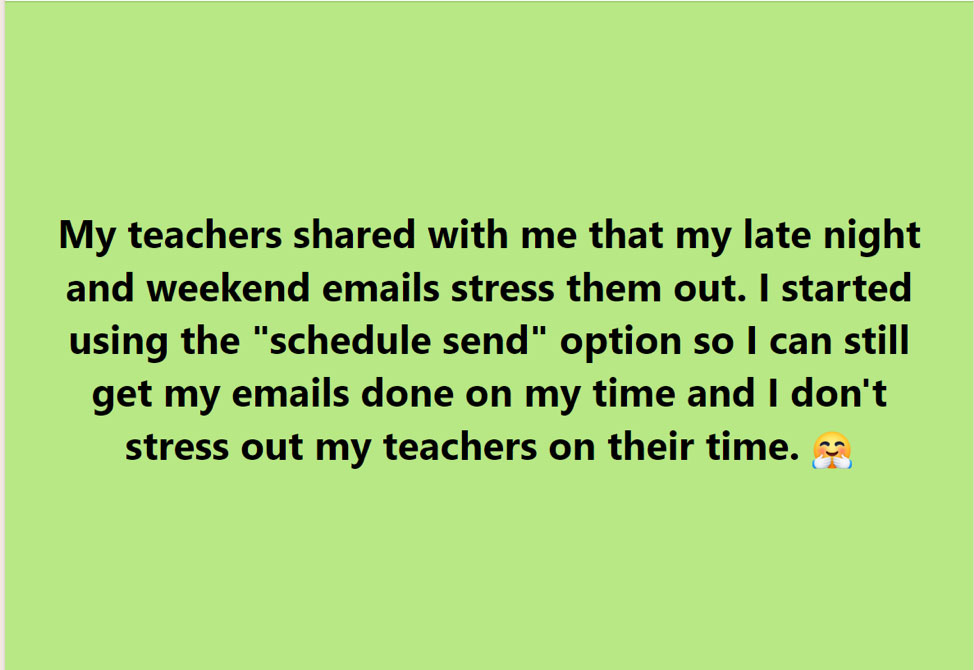
*Posted with permission from first-year assistant principal, Shahna Schultz.
My teachers shared with me that my late night and weekend emails stress them out. I started using the "schedule send" option so I can still get my emails done on my time and I don't stress out my teachers on their time.
Assistant Principal Shahna Schultz (Broward Math and Science Schools, Margate, Florida) states,
"As an administrator, email has become a way to ask and respond to the many questions and concerns enveloped within my school. It has also become a way for me to organize the countless events, responsibilities, and reminders happening schoolwide throughout the week.
Originally, my post was to share a strategy I used to protect the positive rapport I worked so hard to build the last 5 months with my teachers. Little did I know that the topic of protecting teachers' off time was one that many administrators already strive to strategically approach. Being fresh out of an instructional position, I clearly remember the anxiety I would feel Sunday afternoon when I received a notification (most weeks several notifications) from my administrator.
As a current assistant principal, I value the benefits of sending emails late at night and into the weekend to make sure I get my duties done, and to get myself organized for the week ahead. With all the demands that come with educational leadership, small techniques like "schedule send" can have a huge impact on school culture.
The countless comments on my post taught me that school leaders who care about building positive relationships take time to consider how their actions impact the work lives and the personal lives of their teachers. My teachers expressed to me that sending emails during their personal time sets off negative emotions and causes stress and anxiety. As noted in the many comments on my post, school leaders from around the country receive the same feedback.
It is our duty as school leaders to ensure that we establish and maintain healthy boundaries that promote balanced work and personal lives not only in ourselves, but for our teachers. Sometimes, that is as simple as scheduling an email to send on a Monday rather than the weekend or a holiday."
The Problem: It's Nearly Impossible to Get it All Done During Work Hours
As a superintendent, I am working seven days a week (most weeks to some capacity) to keep things rolling as efficiently as I can. I routinely place the phrase, "Don't respond until Monday," at the beginning of all emails past 5:00 PM on Friday until Monday morning! Some staff heeds this warning, but others see that as "clickbait."
From an administrator's perspective, many of us are working with students or people during the day while on campus. Many of us get to our emails before or after school, which can be outside of the staff workday.
"We must understand that sending emails outside of scheduled work hours can be [a form of] "clickbait" which can cause stress and anxiety for our staff!"
From a teacher's perspective, I am sure they want to know what on earth an administrator could be sending late at night or on the weekend that is so important that it needs to go out at that time. This can cause stress and anxiety about impending work- or work-related situations.
If this causes stress for our staff - and not being able to complete all our tasks during the workday causes anxiety for us - what can we do? As leaders, we know our stress can be contagious. This brings up the larger question, "How can we tackle our own stress and anxiety?"
"As leaders, we know our stress can be contagious."
Assistant Principal Schultz is cognizant of her staff's mental health. She then makes a change to address this by using the "schedule send" option in her Outlook email. This is a great strategy, and it changed my thinking. This, in turn, positively affects her own mental health. Learning how to manage our time is important to our mental health. I sometimes wonder what teachers think we do all day…what does an administrator do during the day?"
Let's dive into their priorities with an easy activity. You will quickly find it taps into an administrator's philosophy and the personal code they live by daily.
"Sometimes I wonder what teachers think we do all day…what does an administrator do during the day?"
The Solution: "Schedule Send"
 The following activity can help us delve into how we can manage this stress and anxiety, as well as become more efficient at prioritizing. The age-old "Inbox Activity!"
Let's try it!
Place these eight items in order of importance and give your rationale for doing so. What will you do first and why?
- A parent is on hold on the phone waiting to talk to you.
- Two staff members are arguing loudly in the hallway with each other in front of students.
- Staff evaluations are due, and your superintendent is hounding you.
- Email from an angry neighbor of the school about a student.
- A parent is waiting in the office for your 8:00 AM meeting; it is 8:23 now.
- A paraprofessional is bringing a student in from the playground, bleeding from an apparent fall.
- Your secretary has a question about rescheduling your 8:30 meeting.
- Your fiancé is calling on your phone, and she never calls at this time.
I would love to see how teachers, parents, community members, and administrators would rank these. When you start prioritizing, you dive right into your personal philosophy! What is your philosophy, and what is it based upon?
Learning from divorce, studying the servant leadership concept, partaking in High Trust professional development, advancing to the superintendent role, attending church regularly again, and now dating a fabulous special education teacher, my philosophy has transformed.
Whatever your rationale is for putting this list in order can be a direct reflection on your life, and it is based on the philosophy and code you live by. I am not here to tell anyone what philosophy they should use, but I will give rationale for what I believe in!
I have built my code around two philosophies: 1) Servant Leadership, and 2) High Trust Psychology.
What are they, you ask?
Servant Leadership
Servant Leadership is a form of leadership that was originally developed in 1970 by Robert Greenleaf. It is based on the concept that the leader is a "servant first." Servant leadership focuses on the needs of the school staff being served first.
High Trust Philosophy
My close friend and researcher, Denny McLoughlin, created a philosophy of how we view not only our classrooms, but the world around us. He was lucky enough to study under Dr. William Glasser. You can visit Mr. McLoughlin's website to dig deeper into what he has to say about the concept of High Trust Philosophy.
These two philosophies are at my core; here is how I would rearrange those eight items in order:
- Your fiancé is calling on your phone, and she never calls at this time.
- Two staff members arguing loudly in the hallway with each other in front of students.
Yes, you see my list…I would deal with two things…TWO, and not eight!
This is not a trick question, but here is the rationale for my decision.
Setting an Email Send Window Your Staff Can Count On
Most advice on email etiquette for school leaders stops at how to write the message. The harder question is when it lands. Schedule send solves the leader's half of that problem, and it doesn't tell your staff anything. A teacher who has learned to brace for Sunday afternoon notifications won't stop bracing because you quietly changed your habits, so the technique works best paired with a stated window everyone knows about.
What a Send Window Looks Like in Practice
Writing for ASCD, middle school principal Megel Barker describes what he calls "email silence": an agreement between the principal and staff not to email each other during a set period. At his school, they agreed on no email after 7:00 p.m. on school days and none before 6:00 a.m. When he reads messages at 8:00 p.m., he schedules the replies to arrive after 6:00 a.m. the following day, and he has told staff to hold him accountable when he slips.
Those particular hours aren't a standard, and no one is claiming they should be. They are one school's negotiated agreement, and the specific numbers matter far less than the fact that they exist and that staff knows them. A window that fits an elementary school starting at 8:15 is not the window for a high school where staff is on campus at 7:00 a.m.
The Exception Worth Naming Out Loud
Any send window needs a stated exception for urgent situations, and most leaders draw that line at a threat to health or safety. Say so explicitly when you set the window, because the unspoken fear behind a 10:00 p.m. email is that something has gone badly wrong.
The exception also raises the question of channel. Most districts already have an emergency communication plan naming how urgent messages go out, whether that is a mass notification system, a text alert, or a phone tree. That plan takes precedence over anything an individual leader improvises, so check yours before assuming email is the route.
How to Schedule a Send in Outlook and Gmail
Both platforms put this one click from the Send button:
- Outlook - In new Outlook and Outlook on the web, compose the message, use the dropdown beside Send, choose Schedule send, then take a suggested time or set a custom one. Microsoft notes this is unavailable on IMAP and POP accounts. Classic Outlook for Windows uses Options, then Delay Delivery, then "Do not deliver before," and that version holds the message locally, so Outlook has to be running at the delivery time.
- Gmail - Compose the message, click the arrow beside Send, choose Schedule send, then pick a date and time.
Menu names and availability shift between versions, platforms, and account types. If you can't find the control, it is worth two minutes with your technology coordinator to locate it once.
Make It an Agreement, Not a Personal Habit
A window one administrator keeps privately is a personal preference. A window the whole leadership team keeps, written down and shared with staff at the start of the year, becomes something teachers can plan their evenings around. That is the difference between a nice gesture and an actual change in working conditions.
The Rationale: Respect-Equity Between Leadership and Faculty
Family First
My family comes first (as well as my faith before my job). Answering the phone must be an emergency. Here's why…
My family knows if they call between 8:00 AM and 4:00 PM, I will answer the call automatically, no matter who I am with or where I am. My girlfriend and family know my schedule. If it is not an emergency, they can always text me, and I can respond to them at any time I am free…but on my schedule.
This is a high-trust philosophy technique where you "set the standard." This is a proactive strategy that will give you time and help you prioritize. It builds trust in communication between you and your family. When I am with a student, parent, or staff member, here are the words I use when I receive a phone call,
"I am sorry, but I have to take this call. My family never calls during the day unless there is an emergency."
If it's an emergency, I would then delegate everything to my secretary. My secretary knows how to handle the rest and understands who is in charge when I cannot be…my designee. In my servant leadership philosophy, I am always building leadership capacity and empowering staff.
I believe in fostering a trusted coworker and helping them develop the skills and understanding of protocols to actually be able to take over your job! It's a hard concept to understand if you are afraid of someone stealing your job, but I thrive on it! In fact, in my current position, I have asked all my supervisors and directors to always build a number two - even a number three for some!
Culture Trumps Strategy
 The second task I would complete would be heading straight towards the two staff members arguing. If you believe school culture drives academic success, you understand how this would be my number one school task (after my family). I highly recommend you put family first!
No matter how much you work on culture in your school, it still comes down to buy-in from every single person who works there. Ask yourself, how is my crossing guard building school culture today? School culture is not only built by everyone, but it needs to be done every day! Unfortunately, some schools think they have a good culture, but they don't understand that for a school's culture to be great, it has to be the first priority. How do we do this?
Culture starts by building relationships with our students, staff, and all stakeholders. We must take time to build trust. Trust is built in tiny little moments in which you listen, respond, and follow through. The more time you put into building trust, the more stakeholders believe and trust in you, and the more the relationship solidifies.
All schools have some stress among their staff members. Whether it is left over from the pandemic years, or the fact that not everyone thinks the same way, there is bound to be some struggles.
My staff knows I am going to quickly address the issue of two staff members arguing. They know I put culture first - my words and my actions illuminate this notion. It's not that I am going to squash the debate or argument, but there is a time and place for that. Adults arguing in front of students is just plain unacceptable.
Here are the words I would use in this situation:
"Hello, teammates! How are we doing today? I see and hear we may need a better place for this conversation. Here are two choices right now: 1) let's go to my office and I will get coverage for you, or 2) let's set up a time for us to meet when you both are free."
Notice the precise words I use. I first acknowledge we are all on the same team. The next series of words connects with a high-trust philosophy. Trust is built on the Choice Theory first developed by Dr. William Glasser. Giving a person two choices that you can live with empowers the person to make a decision. Ultimately, they are making the choice, and the supervisor is in this circumstance. Notice I didn't go into the argument and tell them what to do; of course, if fists were flying, I might take it directly to my office!
The two choices I could live with are the following: 1) meet now, or 2) meet later. Notice the other words I put into those two choices, "...my office," and "us." That part is non-negotiable; they will both be meeting with me. This is where positive culture building can happen much quicker. We can review the situation, brainstorm solutions, but more importantly, set the standard for what happens when there is an argument or disagreement in the future! Though it may seem reactive to this circumstance, it is actually a proactive strategy for dealing with future situations.
Many administrators are afraid of conflict and miss this part! They may stop the argument and never address it. In order to have a "great" culture, you must have high expectations and accountability. We need high accountability in how we contribute to our culture and especially how we talk to each other. I would make sure these two staff members understood my expectations by resetting the standard. In addition, they must know that we are always modeling for our students, especially problem-solving skills. I want staff who are highly effective at resolving conflict and understand how to handle the situation in the future. I can guarantee they will be working with students in the same manner.
Much like students, we are constantly working to reduce the frequency, duration, and intensity of negative behaviors. And in the situation with the two teachers arguing, that's exactly the goal I set out to accomplish!
I can almost guarantee that I have never argued or fought with a staff member in front of kids in my 24 years of education. Hopefully, you can say the same.
Prioritizing the Other Six
 Let's review the other six tasks that I didn't address and how these would be handled…actually, how someone else would handle these tasks. Again, how I handle them goes back to both philosophies explained above: Servant Leadership and High Trust.
A parent is on hold on the phone waiting to talk to you.
My secretary knows how busy my mornings were when I was a principal. I was never in my office. As soon as staff and students were on campus, I was out and visible. In addition, I am taking the temperature of my students whom I may be seeing later in the day. Taking the temperature consists of conversations, sometimes offering food, or even playing with students if I happen to be outside. Likewise, I am routinely checking in with staff in much the same manner. I highly recommend this strategy.
Staff evaluations are due, and your superintendent is hounding you.
Deadlines are inevitable. While I was in high school, I needed a high level of concern in order to get stuff accomplished. I would start studying the night before a test or wait for the last moment to get a project completed. I was an A/B student with this strategy, but as an adult, it has created a lot of stress and anxiety. I have had to retrain my brain to start earlier with projects in order to meet deadlines earlier.
I have changed my evaluation process. I now meet with staff three times a year (beginning, midyear, and at the end of the year). We are constantly adding to progress reports that connect back to the pre-established goals. By the end of the year, staff evaluations are almost done. This strategy has helped me meet deadlines.
Email from an angry neighbor of the school about a student.
An email from an angry neighbor is important, but in the scheme of the day's events, this is something that I can put off until later. Instead of answering back with an email, I would call the neighbor and let them know I am coming over to their house to chat face to face. The best communication includes my voice, tone, and body language. This personal touch helps the neighbor realize that the relationship between the school and our close neighbors is important to us.
A parent is waiting in the office for your 8:00 AM meeting; it is 8:23 now.
Unless it is a meeting for a special education student on their individualized education plan (IEP), I try never to schedule meetings when students and staff are arriving for the day. The beginning of the day is the most important time period for everyone. I would not have scheduled this meeting at this time, nor would my secretary.
When I was a principal, scheduling parent meetings after drop-off in the morning was typical. I would ask parents to wait for about 10-15 minutes after the first bell rings. I had a routine in the morning that was predictable for staff and students. I would circulate until the bell rang. After that, I would check all the doors to make sure they were locked and latched. After that, I would then meet with parents. Parents understand that starting the day correctly is important to me, everyone else, and the culture of our school.
A paraprofessional is bringing a student in from the playground, bleeding from an apparent fall.
It's important to set up procedures so that every injury does not have to come to the principal. Having a school nurse is even more exciting. If not, training as many people in first aid can be a lifesaver. Everyone in the office should be first aid trained, as in most schools, bringing the student to the office is a routine protocol. In addition, training staff on a rotation to be CPR, AED, and first aid trained increases awareness and safety for everyone. This student would not come to me as a principal unless I was the only one around trained to handle the situation, or emergency responders needed to be called.
Your secretary has a question about rescheduling your 8:30 meeting.
Again, talking with my secretary as I walked by, or texting them, would help get this meeting rescheduled. Having a close relationship with your secretary can make or break your job. Setting expectations and boundaries is not being a micromanager; it can actually be appreciated. As Brené Brown states, "Clear is kind, unclear is unkind." The clearer we can be in our communication, the better you and your secretary can work together.
The Results: A Proper Work-Life Balance
 Prioritizing the tasks leaders do each day may seem trivial for some, but the most effective administrators live by a code. This code helps us prioritize what we do every day. We are constantly doing what is most important and rationalizing this against our code.
Something as easy as an option in email to "schedule send" can help our own mental health and keep us organized.
As educators, many times we prioritize ourselves last. How we take care of others is how we should be taking care of ourselves. Learning how to take care of ourselves comes with experience and living our code.
As Assistant Principal, Shahna Schultz, put it:
"It is our duty as school leaders to ensure that we establish and maintain healthy boundaries that promote balanced work and personal lives not only in ourselves, but for our teachers."
Frequently Asked Questions
Is it wrong for a principal to send email at night?
Writing at night isn't the problem. Delivering at night is. Most of the friction comes from the notification landing on a teacher's phone during their own time, which is exactly what scheduled delivery prevents. Draft when your day allows and let the message arrive when your staff is on the clock.
Does schedule send work in Gmail as well as Outlook?
Yes. Both put the control beside the Send button, and both let you pick the exact date and time the message goes out. Some districts also run add-ons that do the same thing, so check what your technology department already has in place before installing anything.
What counts as urgent enough to email staff after hours?
That's a judgment call your district's policy should answer before you're standing in it. Health and safety situations clear the bar almost anywhere, and so do closures or a facility problem staff need to know about before they arrive. Other time-sensitive operational matters may qualify too, depending on your role and your district's expectations. Whatever the situation, follow your district's emergency communication plan rather than defaulting to email.
Do teachers have to respond to email outside contract hours?
That depends on the district, and often on a negotiated agreement rather than a policy handbook. Expectations vary widely, so the answer for any specific teacher lives in their own contract and their district's communication policy. What a leader controls is the expectation they set, and saying plainly that no reply is needed until the next workday costs nothing.
How do you stop scheduled emails from piling up on Monday morning?
Stagger the delivery times rather than dropping everything at 6:00 a.m. Spreading messages across the first two days of the week, and moving recurring information into a single weekly memo or a shared document, keeps the Monday inbox from becoming its own source of stress.
- Timing is the etiquette - For school leaders, the biggest courtesy in email is the delivery time, not the greeting or the sign-off.
- Schedule send is one click - Outlook and Gmail both offer it from the dropdown beside the Send button, with no add-on required.
- State the window out loud - One principal writing for ASCD describes a 6:00 a.m. to 7:00 p.m. window on school days, agreed with staff rather than imposed on them.
- Name the exception - Health and safety emergencies override any send window, and those calls belong on the phone rather than in an inbox.
- Prioritizing reveals your code - The eight-item inbox activity works because ranking the list forces you to say out loud what you actually put first.
Leading a building means making calls like these before anyone has trained you to make them. If you're weighing graduate study in educational leadership, the sponsored programs on this page are worth a look for what they cover, how they're delivered, and what they cost. Administrator credential requirements are set state by state, so check yours against any program before you apply.
As a 5th grade teacher, in 2010 Jon won the Presidential Award for Elementary Math and Science Teaching (PAEMST). As a principal, his school won the 2012 Blue Ribbon Award. In 2018, he won the National Distinguished Principal Award (NDP). In 2019 he won the National No Kid Hungry Breakfast Hero Award.
Jon is the author of three guides published on teacher.org: An Educator's Guide to Combat Bullying & Bully Prevention; Teacher Evaluation: A Transition Guide to Exemplary Performance; and You are the Wild Card: Infusing Fun Back into Curriculum. He has authored a children's picture book that was released January 2019 titled Benjamin’s Visit to Principal Reads Office…again! (available at www.archwaypublishing.com)
- Learning How to Say No and Set Boundaries with Parents - November 21, 2022
- How to Implement a Check-In, Check-Out (CICO) Behavior System - September 26, 2022
- Teacher Core Values: 7 Strategies for Living Your Code - August 15, 2022