
5 Classroom Behavior Management Strategies to Add to Your Toolbox


Classroom behavior management strategies work best when you pair a few well-practiced go-to moves with the flexibility to switch tactics for students who don't respond to your usual approach. Five practical options here- brain fuzzing, check-in/check-out, High Trust language, Love and Logic's SEL banking, and restorative practices- cover students at every tier of support.


Some of us have new toolboxes with just a few of the latest tools. Some of us have large toolboxes packed with everything we've collected over the years. Either way, every teacher should keep adding both new and proven tools for different situations.
This toolbox is the key to success for any educator. A broader toolbox can give you more options when a familiar strategy isn't working for a particular student.
Some teachers get by on a couple of go-to approaches, and those approaches may have worked fine for years. The trouble starts when they meet a student who doesn't respond to the usual playbook: behaviors can turn stressful, even unmanageable.
Why a Bigger Behavior Toolbox Matters
Turnover and mobility are significant concerns among beginning teachers, which is exactly why educators and administrators need to be proactive about building behavioral strategies early in a teacher's career. Principals need to offer real professional development, and teachers need to keep collecting tools that meet their students' actual needs.
Building a toolbox isn't just a new-teacher project. Teachers at every experience level benefit from expanding theirs. Today's classrooms include students with a wide range of behavioral and social-emotional needs, including students affected by trauma, so it pays to keep expanding your range of classroom-management strategies.
A growth mindset about behavior matters here. Strategies for handling problem behaviors should continue to expand each year as new students arrive, with the goal of having something that works for each student.
The Three-Tier Model for Behavior Support
Effective strategies tend to map onto a three-tier model. A commonly cited benchmark is roughly 80% of students supported by Tier 1, 15% needing Tier 2, and 5% needing Tier 3, although actual percentages vary by school and student need.
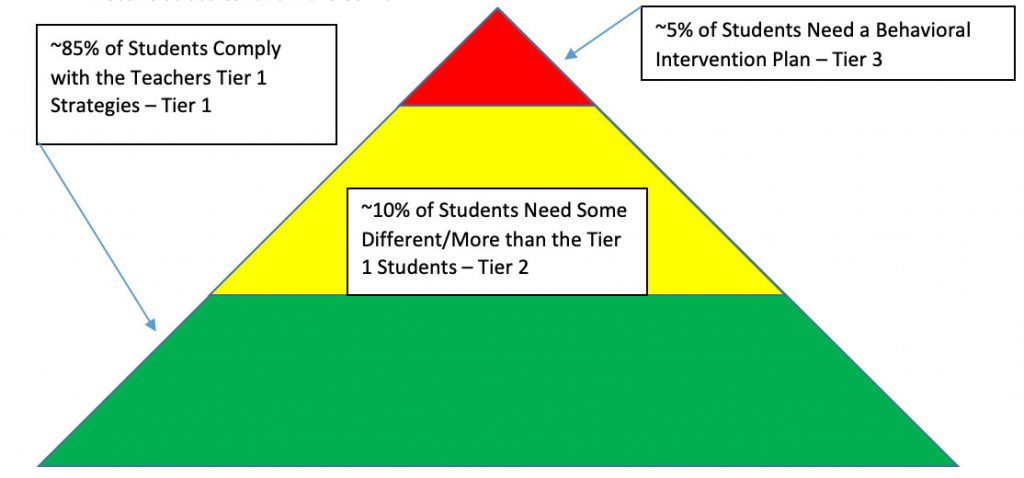
What a teacher brings to the classroom every day counts as Tier 1: strategies that work for almost all students, almost all the time. Classroom management philosophy wasn't part of my own teacher prep coursework, and I'd guess many programs still leave it out. For most new teachers, classroom management gets built on the job, starting with student teaching, and the mentor teacher usually has the biggest influence on how that discipline style takes shape.
Five of the most established discipline and classroom management philosophies in education:
- Assertive Discipline - Lee and Marlene Canter - leecanter.weebly.com
- Love and Logic - Jim Fay and Foster Cline - loveandlogic.com
- High Trust - Denny McLaughlin - hightrust.net
- Multi-Tiered Systems of Support and Positive Behavior Interventions and Supports (MTSS/PBIS) - pbis.org
- Restorative Practices - Schott Foundation or IIRP
The best teachers borrow and blend philosophies and strategies with their own beliefs to build a classroom culture that's theirs.
Tier 2 interventions target a smaller group, roughly 15% of a class. In a class of 30, that might mean four or five students who need something beyond the Tier 1 approach: small-group behavior instruction or dedicated time on socio-emotional skills.
Tier 3 interventions are for one or two students in a class of 30, around 5% of the population, usually with more intense, longer-lasting, or more frequent behavior needs. Tier 3 students may have an IEP, a BIP, or another individualized support plan, but Tier 3 support does not itself require special-education eligibility, and support at this level often has to come from outside the classroom too. These figures are a general benchmark, not a fixed quota. Your school's actual mix may look different depending on your student population and existing supports.
Moving from Tier 1 to Tier 3, the core challenge is usually the same: helping a student regulate. Co-regulation, where an adult actively supports a student's regulation during an activity, is often the bridge. Here are five strategies I've picked up over the years, useful across all three tiers but especially valuable for Tier 2 and Tier 3 students.
5 Behavior Management Strategies to Add to Your Toolbox

1. Brain Fuzz
Getting a student's thought process to shift has gone by many names over the years. Say a student is in the middle of a tantrum about not getting their way. The teacher can start a conversation about something completely unrelated. Two of my go-to brain-fuzz topics are my dog and my favorite pizza, mostly because I can talk about both for hours and have plenty of stories on hand.
Changing a student's train of thought isn't always easy, but I've found that redirecting their attention to an engaging, unrelated topic can help interrupt an escalating interaction. It leans hard on relationships: the better you know a student's real interests, the easier it is to redirect them. A student who loves the Transformers movies, for instance, might get pulled out of a tantrum by a conversation about the Decepticons always losing.
Denny McLaughlin, who developed High Trust Psychology, calls this "giving glass." When you give a student glass, you're changing their thinking by opening a window into a different topic instead of leaving them stuck in a negative loop.
Students can fall into a rumination loop, circling the same negative thoughts about themselves or others. Rumination works against savoring positive emotions, and breaking that loop often requires deliberate daily practice, according to a Psychology Today piece on the brain mechanics of rumination. That research is about rumination generally, not a study of brain fuzzing itself, but the underlying idea- giving a student's attention somewhere else to interrupt a negative loop- is the same one this classroom strategy leans on. As adults, we do this to ourselves all the time to stop perseverating on something.
Brain fuzzing, or giving glass, takes practice. Try it first with an adult you know who gets upset easily, then try it with your students. You may find it works even better with kids.

2. A Check-In/Check-Out-Style Strategy
Check-In/Check-Out (CICO) is an established, evidence-based Tier 2 PBIS intervention, and the formal version typically involves more structure than what's described here: a trained staff member, a daily point card, and regular data review with the intervention team. What I use is a simpler classroom adaptation built on the same idea. The student checks in with me, hears the expectations for the upcoming period (recess, class, lunch), and restates them before heading off. At the end of that period, they check back in.
What makes this strategy work is what happens at both ends: the check-in conversation and the check-out follow-through. Early in a behavior intervention, teachers may also need to co-regulate with the student during the activity itself, not just before and after it.
Some quick tips for making it work:
Check-In (Before the Activity)
- Be specific about the behavior you expect, not just the general vibe.
- Name the behaviors that need to stop, and explain why in concrete terms: for safety, for health, or for learning.
- Talk through what strategies the student will use to stay proactive during the activity.
- Have the student repeat back the expectations and what they'll do if things get hard.
During the Activity (often skipped, but worth building in)
- Decide whether the student needs co-regulation support during the activity.
- Model the behavior, let them practice, and pull them aside to try again if needed.
- Teach the specific behavior that gets better results.
- Let them try again, and repeat as many times as it takes.
- Fade your support out as their success rate climbs.
Check-Out (The Accountability Step)
- Ask how it went, and have them explain with specific examples.
- Ask what they'd do differently next time.
- Ask what it will take to fully self-regulate this activity.
- Track progress on paper or with an app.
- Celebrate progress with the student and their parents or guardians.
- Continue until the student meets a clearly defined, data-based goal set by the school or intervention team.
This strategy works when it's used consistently, tracked honestly, and paired with real celebration of small and large wins. It's easy to write off if it doesn't click right away, but it's built for repetition. Some students need the same socio-emotional support dozens of times before it lands, where a peer might get it on the first try.
3. High Trust Language Techniques
High Trust Psychology is a foundation for strong relationships, with tips and language patterns that carry into your classroom, your conversations with parents and colleagues, and even your own family. "Giving glass" is one strategy from that world. What follows are nine more of McLaughlin's own techniques and claims, paraphrased down to fit here, not independently established psychological findings. For the full versions, look into Denny McLaughlin's workshops directly.
| # | High Trust Technique |
|---|---|
| 1 | Four Levels of Influencing Students a. What is your job or responsibility? b. You may … c. You need to … d. You can either ____, or you can choose me to support you. |
| 2 | Corrective Reinforcement 1. Gently stop the behavior. 2. Show the student a better way to meet their need. 3. Practice it, then celebrate. |
| 3 | The Correct Way to Explain "Doing Something" Frame it as: "We are ____ for safety, health, or learning, and that's the correct thing to do." Avoid the word "right," since that turns it into a moral judgment instead of an expectation. Example: "We're buckling up for safety because it's the correct thing to do." |
| 4 | Front Loading Prepare students before emotions kick in. Example: "When you're at our house, you can stay upstairs with the rest of the guests …" |
| 5 | Giving Effective Directions a. What is your job? (If they can't repeat it, they can't do it.) b. Have the child repeat it back so they learn to listen the first time. c. Let the child register a small success by answering correctly. d. The last thing said or heard is remembered second-best. e. Hallways and open spaces work better with courtesy, laughter, and friendliness modeled openly. |
| 6 | Model and Support for Success Instead of punishing, model and support students toward success. Teach to the rules, never punish with them. Keep every rule positive: you can only teach a positive, not a negative. Rules set the spirit of the classroom, and procedures carry it out. Punishment inflicts pain for a mistake. It can stop a behavior, but it can't teach responsibility. |
| 7 | Sentence Starters "To show more respect …" "For your success, you may …" "What is your job?" Use "correct" instead of "right," since "right" makes it a moral issue rather than an expectation. |
| 8 | The 6 Valleys and 2 Canyons Valleys (traps to avoid): dangling bait, telling a kid what they did, dwelling on the past, asking "why," asking pointless questions, debit/credit begging. Canyons (bigger traps): "give it to me" demands, and worrying as a stand-in for love. |
| 9 | Going to Solution Blame stalls change. In High Trust, energy always goes toward the solution: the faster a person gets there, the healthier they are. |
To bring my friend Denny McLaughlin in for a workshop at your school, reach out through High Trust Thinking's website for current contact information.

4. Love and Logic's SEL Banking Account
Love and Logic, founded in 1977 by educator Jim Fay and psychiatrist Foster Cline, describes itself as a whole-child, research-driven approach that works with students, colleagues, parents, and family alike, much like High Trust. The Love and Logic Institute describes its goal as making parenting and teaching less stressful and more enjoyable by providing adults with practical tools to build respectful relationships with kids.
The strategy I've used most, with students, families, and colleagues alike, is a metaphorical bank account. Each relationship carries a balance you can deposit into or withdraw from, tied to the other person's socio-emotional state. Before I ask for a withdrawal, meaning before I try to change a behavior, I need to have made real deposits: positive interactions banked ahead of time. The same logic applies across every relationship: be proactive about deposits so you have something to draw on when you need to.
There's a lot more at the Love and Logic website beyond what fits here.

5. Restorative Practices
Restorative practices have become increasingly prominent in school-discipline discussions. The core idea: keep relationships sustained, repaired, and intact. Treating that as the top priority changes how a school handles consequences, re-teaching, modeling, and culture overall.
The Schott Foundation built a toolkit that I've adapted for my own school. Their guide, Restorative Practices: Fostering Healthy Relationships & Promoting Positive Discipline in Schools, frames it this way: a student who caused harm takes full responsibility by addressing the person affected directly, understanding the impact, acknowledging the harm, and taking real steps to repair it and avoid repeating it.
Restorative practices reshaped how we handle discipline at our school. When someone is hurt or disrespected, we first repair the relationship and talk through why fixing it matters. As educators, we support both the student who was harmed and the student who caused it through that conversation. The person harmed gets to explain the impact and, if it happens, accept an apology. The student who caused the harm gets to show how they'll make it right.
Adults have to support that repair process on both sides. Often that means giving the harmed student language and actions to stand up for themselves and explain what happened, while helping the other student repair the relationship with genuine words and actions.
One common misconception: if a student can verbalize an apology and own their actions, they're off the hook. They're not. If a student punched another student, an apology with ownership isn't the end of it. Consequences and discipline still apply; they may just look different: in-school suspension, time off the playground until the student can self-regulate, or co-regulation support with an adult. The goal is giving students the language and actions to repair relationships, own their choices, and build toward regulating their own behavior.
Research suggests that well-implemented restorative practices can reduce suspensions and disciplinary referrals, although results vary by program, implementation quality, and implementation duration. The throughline across all of it is placing real value on relationships and repair.
Frequently Asked Questions
What are the most effective classroom behavior management strategies?
The strategies that hold up best combine a proactive Tier 1 approach that works for most students with more targeted options, such as check-in/check-out, co-regulation, and restorative conversations, for the smaller group that needs more. No single strategy works for every student, so building a toolbox of several proven approaches matters more than mastering just one.
What's the difference between Tier 1, Tier 2, and Tier 3 behavior support?
Tier 1 covers the classroom-wide strategies that work for almost all students. Tier 2 targets a smaller group, roughly 15% of a class, who need more structured support like small-group instruction. Tier 3 is for the one or two students in a class who need intensive, individualized support. Some Tier 3 students have an IEP or BIP, but Tier 3 support itself doesn't require special-education eligibility.
What is "brain fuzzing" as a classroom strategy?
Brain fuzzing, sometimes called "giving glass," means redirecting a student's train of thought during a tantrum or meltdown by starting a conversation about something unrelated that actually holds their interest. It's a practitioner strategy, not a formally studied intervention, but the idea is to interrupt a negative thought loop rather than confront the behavior head-on.
How does a check-in/check-out strategy work?
Formal Check-In/Check-Out (CICO) is an established Tier 2 PBIS intervention with more structure than a classroom-level version. In the simpler adaptation described here, a student checks in with the teacher before an activity, restates the expectations, and heads off. At the end of the activity, they check back out and reflect on how it went. Consistency and real follow-through at both ends are what make it effective.
What are restorative practices in schools?
Restorative practices ask a student who caused harm to take responsibility by addressing the person they affected directly, understanding the impact, and taking real steps to repair it. It doesn't replace consequences; it puts relationship repair first, alongside any discipline that still applies.
- Build more than one strategy - A broader behavior toolbox gives you more options when a familiar strategy isn't working, especially with the wide range of behavioral and social-emotional needs in today's classrooms.
- Match the tier to the student - Tier 1 strategies work classroom-wide, Tier 2 targets roughly 15% of students, and Tier 3 serves the 5% who need individualized support, though these figures are general benchmarks, not fixed quotas.
- Co-regulation bridges the tiers - Strategies like check-in/check-out work by helping a student self-regulate with adult support before expecting them to do so independently.
- Restorative practices repair; they don't replace consequences. Fixing the relationship comes first, but discipline can still apply alongside it, and evidence of reduced suspensions varies by implementation.
Building a stronger behavior management toolbox often starts with stronger training and support. The programs featured here include options focused on classroom management, special education, and school counseling if you're looking to go deeper on this side of teaching.
As a 5th grade teacher, in 2010 Jon won the Presidential Award for Elementary Math and Science Teaching (PAEMST). As a principal, his school won the 2012 Blue Ribbon Award. In 2018, he won the National Distinguished Principal Award (NDP). In 2019 he won the National No Kid Hungry Breakfast Hero Award.
Jon is the author of three guides published on teacher.org: An Educator's Guide to Combat Bullying & Bully Prevention; Teacher Evaluation: A Transition Guide to Exemplary Performance; and You are the Wild Card: Infusing Fun Back into Curriculum. He has authored a children's picture book that was released January 2019 titled Benjamin’s Visit to Principal Reads Office…again! (available at www.archwaypublishing.com)
- Learning How to Say No and Set Boundaries with Parents - November 21, 2022
- How to Implement a Check-In, Check-Out (CICO) Behavior System - September 26, 2022
- Teacher Core Values: 7 Strategies for Living Your Code - August 15, 2022