
Recruiting New Teachers: 5 Reasons Every Educator Should Start Now


Recruiting new teachers starts with the people already in the classroom. Students decide how they feel about teaching by watching their own teachers, so what they see matters. Named pathways like Educators Rising, Grow Your Own programs, and CTE education courses turn that influence into a real route into the profession.


I recently watched a presentation in my own school where the students were signing for their Spring Music Concert. One of the songs they chose was Hall of Fame by the band The Script. The lyrics in the song are powerful as they pronounce what profession they are going to be. The chorus names a run of ambitions and puts teaching among them.
There are 67 students in sixth grade, and only four were choosing to go into education. Yes, in 6th grade, this may be a long time from actually making a choice. When I asked other students why they would not choose education, a couple of them stated, "We know what teachers have to deal with." This was in reference to the behavior they see daily from their peers. This rang in my ear about things students see from us as teachers, good and bad.
I am lucky to be part of a staff that focuses on culture, belonging, and relationships. I am hoping students see us working, collaborating positively, and laughing with one another. Truly, education is a fascinating job, and I would not choose another profession. At 19, and starting college, I could have chosen to run my dad's business, but I chose to follow my mom's footsteps. I chose teaching!
What I worry about, especially in my community, is what students are seeing going on with their friends and families. My school has jumped from 30% of our families receiving free and reduced meals to 49% in eight short years. This jump of nearly 20% may not seem significant, but this increase has brought stories of trauma to the forefront. My sixth grade students have dealt with death, drugs, sexual harassment, abuse, and so many more adverse childhood experiences. Teachers are working with these students every day.
We have started using the mantra in our school, "Maslow before Blooms." This is in reference to Maslow's Hierarchy of Needs and Benjamin Bloom's Taxonomy of learning complexity. Notice in the diagrams below the differences between the two hierarchies.
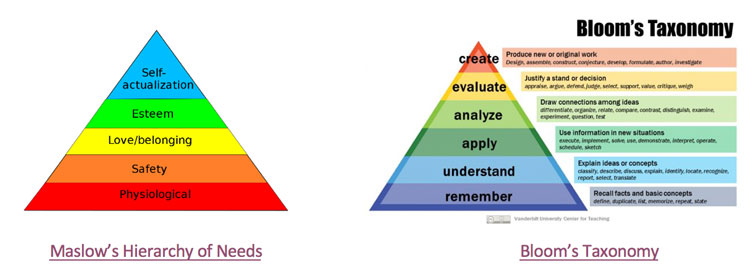
The mantra is our school's guiding philosophy. It means attending to students' needs first, on the view that unmet basic needs make learning harder. A prevailing concept that many politicians and people in power making decisions don't understand or take into account. We need to continue to work on making decisions by first meeting the basic needs of our students, creating strong relationships, and then working our magic with the content!
Students see that teachers are spending a lot of time working on Maslow's needs in the classrooms. The job of a teacher and principal has changed significantly. This may not be as enticing to students choosing education as a profession. The imbalance is sharpest among men at the elementary level. NCES figures for 2017-18 put men at 11% of public elementary teachers and 36% at the secondary level. Recruiting has to reach students who do not currently see themselves in the job.
Overall, I am worried for the state of education. When students are deciding what profession they want to be, many of them do not want to have to deal with their peers' problems. Education puts you right in the mix of dealing with these problems all day long. We need to actively recruit students who have the qualities that will make a great teacher…patience, perseverance, and tolerance. Here are five reasons all educators should always be actively recruiting new people to teach.
1 - Make a Difference
 For roughly 1,100 hours every school year, a teacher's family increases. The best teachers include students in what is going on in their lives, as well as getting to know every student individually. These teachers are continually finding ways to support each student. They understand the students who walk into their classroom without breakfast, adequate sleep, or a supportive parent. Some are even dealing with abuse that occurred before school. You ask, when did it become our job to do what should be done at home by a parent?
I refer back to our diagrams above. Exemplary teachers understand that they need to take care of Maslow's needs before that student is going to be able to learn. Teachers who actively work on this concept in their classrooms are making a difference. Many teachers support students with food, clothing, and other basic needs. Some teachers even go as far as supporting students through the foster care system.
Making a difference in a child's life is probably the number one reason why people choose this profession. I do not believe there is a more noble profession. Anyone who says a teacher only works nine months out of the year is ludicrous, even though it is stated on the contract. Teachers work additional days in the summer, as well as way more than the 187 days and 1,100 contact hours my own contract sets, all in an effort to meet the needs of their students. Teachers make a difference!
2 - Pay It Forward
 The ability to support students and families is an honorable cause. Many people get into the profession because some teacher they had as a student made an impression on them. That impression made them think about education as a profession. We can all think back to that one teacher or couple of teachers that we really connected and formed a relationship with. We may not be able to remember what they taught exactly, but we remember the relationship we had with them.
We then chose to be like that teacher and Pay It Forward. Exemplary teachers connect with students and have those tough conversations about life. They encourage them to follow their dreams and work hard. They even encourage them to go into education! Teachers pay it forward!
3 - Change the Face of Education
 Sometimes teachers get into the profession because of a bad experience in their schooling. They make the conscious choice to teach differently than that teacher or teachers they had in school. They decide what qualities they want to see in their classroom, and then implement them to the best of their ability.
It may be that teacher that yelled or belittled students, or that teacher that literally did everything they could to NOT teach. As a student, you understood at a young age that these teachers were there primarily to pick up a paycheck. You wanted more! You wanted a teacher to push you, encourage you, and connect you with the content!
A paycheck is not your primary reason for getting into education. By choosing to go into education, you make noticeable changes to fix what you see as inadequate. You now find others who choose a career in education to make change. You also understand that teachers can change the face of education!
4 - Kids Are Fun!
 Seeing growth of students both academically and socially is exhilarating. What you thought a student might never learn or understand can be taught in such a way that a student finally "gets it." Though all students learn at a different pace, we can design activities with engagement that are not only fun for them, but for us as teachers, as well.
If you get into this profession and do not like kids, I can promise you will not last long. The intricacies of their lives pull us in, and it becomes a logic puzzle that sometimes is so difficult to solve we must involve more people. Exemplary teachers take on these challenges every day. They see what each student's needs are connected to both Maslow's Hierarchy and Bloom's Taxonomy. They then design learning experiences and devote time to these needs.
Seeing a smiling face, receiving a compliment, a hug, handshake, or high-five makes this job well worth the stress, anxiety, and secondary trauma we take on. It is rewarding, and we must celebrate our students more often.
My wife always says, "We get what we pay attention to." If we celebrate the positives more, we will inevitably see more positives occurring in our class and school. Exemplary teachers think and know, "Kids are fun!"
5 - Teachers Create Every Other Profession!
 Be a preacher, a teacher, a politician, a student, or even an astronaut as the band, The Script, profoundly sings! The teaching profession creates all other professions. It is fascinating to know that sitting in front of us in sixth grade are the future leaders of our community. What professions or jobs they take on may not be dictated by what we teach in sixth grade, but they sure can be influenced.
Exemplary educators teach with passion, conviction, and energy. They understand that the time with students is so short. 1,100 hours may seem like an eternity with some students. These teachers understand that 1,100 is not enough. They make plans to connect with these students outside of the school year. Exemplary teachers are revered by their students…they want to come back and report their progress, good or bad.
The feeling you get as a teacher when a student comes back or remembers you a decade down the road makes this the best profession. Recently, a college athlete and soon-to-be graduate at the University of Providence-Great Falls stated in a Facebook post, "You were one of the best teachers I had. You made a difference in my life." For this 43-year-old man, who rarely cries, it made me well up knowing that I have made a difference. For that reason, I know that teachers create every other profession!
What Recruiting New Teachers Actually Looks Like
Encouragement helps, but a named program gives a student somewhere to go next. Several exist, and they work at different points in a student's life. Which ones a student can reach depends on the state and the district. The first job is finding out what already runs nearby.
| Pathway | What it is | Who it fits |
|---|---|---|
| Educators Rising | A career and technical student organization run by PDK International, with school-based chapters and a curriculum for high school students. Chapters are set up school by school, so availability is uneven. | High school students testing the idea |
| Grow Your Own programs | An umbrella term for locally focused teacher pipeline programs. A 2024 Brookings analysis found every state has adopted some version. Definitions, funding, eligibility, and whether a program leads to licensure vary widely. | Local students, paraprofessionals, community members |
| CTE Education and Training courses | Career and technical education coursework in the Education and Training career cluster, often including guided observation and field hours. Offered district by district. | High school students who want classroom hours before committing |
| Registered teacher apprenticeships | Paid, work-based teacher-preparation pathways that can lead toward state licensure when structured to meet that state's requirements. Structure and availability differ sharply by state. | Paraprofessionals and aides already working in schools |
| Teacher residencies | Classroom placement alongside a mentor teacher, commonly a full year and often paired with a master's program. Many run through districts with university partners, but structures vary. | Degree holders coming from another field |
None of that requires a title. A teacher can tell one student, out loud, that they would be good at this. Plenty of students never hear it from anyone. A teacher can hand over a real task. Running a peer tutoring block or reading with a younger class lets a student feel what the work is. A teacher can then point that student to whichever of the programs above the district actually has. The first step costs nothing and is the one most often skipped.
Frequently Asked Questions
Why should current teachers help recruit new teachers?
Students form their view of the profession by watching the adults in front of them. That happens long before they read a job description. That gives practicing teachers a credibility recruitment campaigns do not have. They also see the students who might be suited to the work every day.
What is a Grow Your Own teacher program?
Grow Your Own is an umbrella term for teacher pipeline programs that recruit locally rather than from outside the community. A 2024 Brookings analysis found every state has adopted some version, and that the programs otherwise share very little. Support ranges from high school coursework to scholarships, stipends, and paid employment. That analysis also found few programs cover the full cost of certification, so participants often carry part of it themselves.
What is Educators Rising?
Educators Rising is a career and technical student organization run by PDK International. It has operated under that name since 2015. It combines school-based chapters with a curriculum for high school students, plus training for the teachers who lead the course. Chapters are established school by school, so check whether one exists at a given school rather than assuming statewide coverage.
How can one teacher get a student thinking about teaching?
Name it directly to that student, then give them something real to do. Peer tutoring, reading buddies, and helping run a lesson all let a student test the work rather than imagine it. From there, connect them to whichever pathway their district offers.
- Students judge teaching by what they see - the daily behavior of the adults in the building shapes whether teaching looks worth doing.
- Encouragement needs a destination - naming a real program moves a student further than praise alone.
- Pathways are local - Educators Rising chapters, Grow Your Own funding, CTE education courses, and apprenticeships all vary by state and district, so check what exists near you.
- The unglamorous work counts - meeting basic needs first is what makes the rest of teaching possible, and students notice it.
- Recruiting is not an administrator's job alone - any teacher can start it in a single conversation.
If this argument landed and you are the one weighing teaching, the next question is which preparation route fits. Formats and entry requirements differ from program to program. Licensure rules are set state by state. Check any sponsored program here against the rules where you plan to teach.
As a 5th grade teacher, in 2010 Jon won the Presidential Award for Elementary Math and Science Teaching (PAEMST). As a principal, his school won the 2012 Blue Ribbon Award. In 2018, he won the National Distinguished Principal Award (NDP). In 2019 he won the National No Kid Hungry Breakfast Hero Award.
Jon is the author of three guides published on teacher.org: An Educator's Guide to Combat Bullying & Bully Prevention; Teacher Evaluation: A Transition Guide to Exemplary Performance; and You are the Wild Card: Infusing Fun Back into Curriculum. He has authored a children's picture book that was released January 2019 titled Benjamin’s Visit to Principal Reads Office…again! (available at www.archwaypublishing.com)
- Learning How to Say No and Set Boundaries with Parents - November 21, 2022
- How to Implement a Check-In, Check-Out (CICO) Behavior System - September 26, 2022
- Teacher Core Values: 7 Strategies for Living Your Code - August 15, 2022