
5 Components to a Great Weekly Lesson Plan


One practical framework for the components of a lesson plan uses five parts: state standards, a clear objective, materials, assessment, and how it fits the week's overall structure. Madeline Hunter's well-known model lists seven steps, but this five-part version covers the same ground with less paperwork.


What are the five most important components of a lesson plan? Madeline Hunter's model says there are seven, and she's not wrong. But most teachers don't have time to write a seven-step plan for every lesson, every day, all year. Five components can carry the same story of student learning without the extra hours.
Madeline Hunter's lesson plan format includes these seven components:
- Anticipatory Set: activating prior knowledge and experience so students can connect to today's lesson
- Objective/Purpose: what students will know or do by the end of the lesson, tied to the broader curriculum standard
- Instructional Input: the new information or skill you're communicating to the class
- Modeling: demonstrating what an acceptable finished product or process looks like
- Checking for Understanding: confirming students have grasped the objective before moving on
- Guided Practice: students practicing under your direct supervision, so mistakes get corrected in the moment
- Independent Practice: homework or seatwork students complete without your monitoring, once you know they're ready
A teacher could still hit every one of those seven steps inside a five-component plan. The five components below are one practical approach: they don't force you to write out all seven steps for every lesson, every day. In our elementary school, they're what actually tell the teacher-and-student story week to week: state standards addressed, lesson objective, materials needed, assessment, and structure.
1. State Standards
At our school, roughly 85% of the curriculum came from Common Core-aligned standards, with the remainder incorporating state and local requirements. In Montana, that includes Indian Education for All (IEFA) - a constitutional mandate, not a slice of the Common Core, requiring every Montana student to learn about the state's American Indian tribes and history. It's folded into the Montana Content Standards set by the Office of Public Instruction, not a separate add-on subject.
My mantra with teachers is simple: we're responsible to the standards, not to a textbook. We review and buy textbooks hoping they cover as many standards as possible, but no textbook covers all of them. That's where a teacher has to supplement. Teachers should follow their district's or school's adopted curriculum policies when supplementing instructional materials.
Tracking which standards show up on your lesson plans tells you how your students are progressing toward mastery, both as a class and individually. That data lets you target specific standards where they need it most.
2. Lesson Objective
Stating what a student will be able to do after the lesson gives you a goal you can actually assess. The objective ties directly to the standard you're teaching, and it lets you check for understanding throughout the lesson, not just at the end. You can pull the objective from your curriculum materials or write your own.
3. Selecting the Right Materials
Once you know the standard and have your objective, you can pick materials for the students actually in your classroom. Start with the board-adopted curriculum, then supplement based on what you know about your students. Check your school or district's policy before supplementing outside the adopted curriculum.
4. Assessment
Every objective needs an assessment, whether that's a full summative test or a quick formative check. Assessment data tells you three things: how effective your instruction was, how each student did against the objective, and where to take instruction next.
5. Structure
A master teacher knows how the week's lessons fit together. Some routines repeat every day. Other things can't be planned for, and flexibility matters as much as the plan itself. Deciding what's best for students in the time you have is the real art of the job.
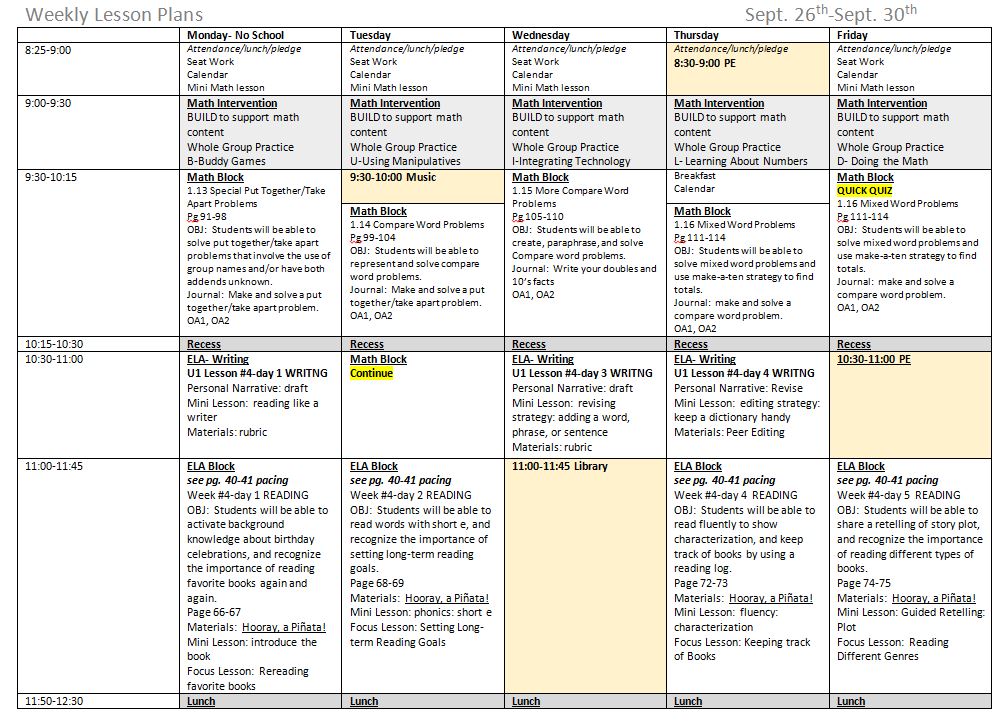
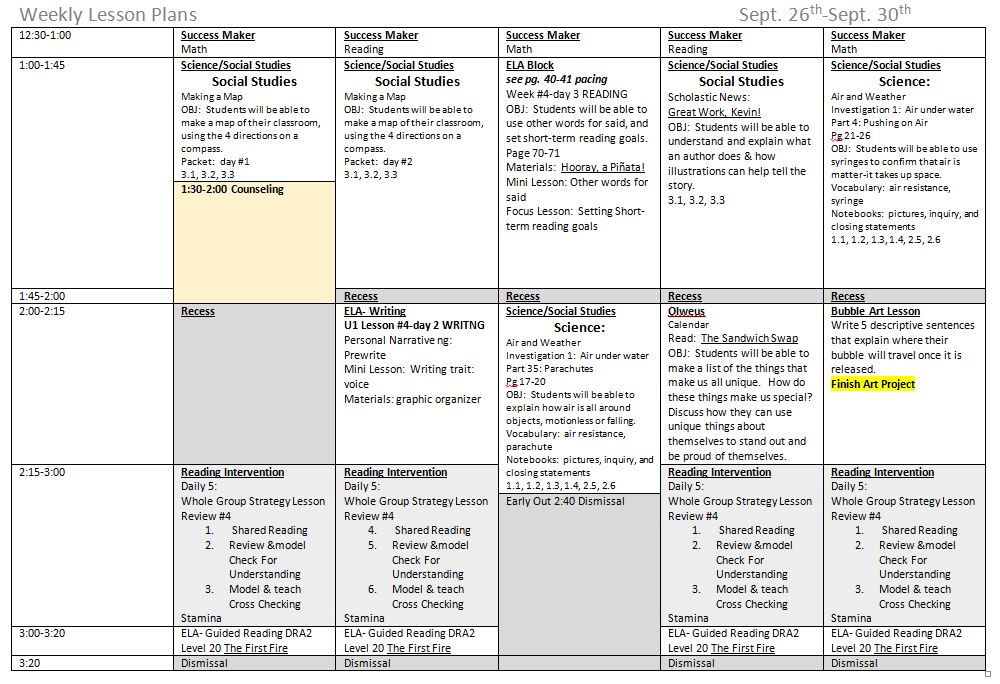
Below is a sample weekly plan built around these five components. You don't need an expensive Web 2.0 template to organize it: a spreadsheet works fine once you trust the five components to carry the structure. Using this approach, a teacher isn't letting a textbook's page numbers dictate the week's instruction, and that shows up in student progress, academically and socially.
Footnote: Madeline Hunter's Lesson Plan Format. See "Madeline Hunter Lesson Plan Model," The Second Principle, thesecondprinciple.com.
Frequently Asked Questions
Is five components enough, or do I need Madeline Hunter's full seven?
A five-component weekly plan can incorporate elements of Hunter's seven-step instructional model without listing each step separately. Many teachers still do the anticipatory set, modeling, and guided or independent practice inside the lesson itself. The five-component plan is a planning document, not a limit on how you teach.
What's the difference between a lesson plan and a weekly plan?
A lesson plan covers a single class period. A weekly plan lays out how each day's lesson connects to the next, so the five components (especially structure and standards) show progression across the week rather than one isolated day.
Do all schools use the same lesson plan format?
No. Individual schools, districts, and states set their own templates and requirements. Some require a specific format tied to teacher evaluation, others leave it to the teacher. Check with your school administration before assuming any single format, including this one, is required.
Where do lesson objectives come from if my textbook doesn't have them?
Write your own, tied directly to the state standard you're addressing. A workable objective names what the student will do (not just "understand") and gives you something concrete to check for by the end of the period.
- One practical framework, not the only one - standards, objective, materials, assessment, and structure is one teacher's way of covering the same ground as Madeline Hunter's seven-step model with less paperwork.
- Standards come first - know what you're responsible for teaching before you pick materials or write the objective.
- Assessment isn't optional - even a quick formative check tells you whether the objective was met and where to go next.
- Structure covers the week, not just the day - a strong weekly plan leaves room for the routines you can predict and the moments you can't.
Building a weekly plan is easier when you're not doing it alone. The programs listed on this page cover instructional design and classroom planning for teachers at every stage, from student teaching through a graduate degree.
As a 5th grade teacher, in 2010 Jon won the Presidential Award for Elementary Math and Science Teaching (PAEMST). As a principal, his school won the 2012 Blue Ribbon Award. In 2018, he won the National Distinguished Principal Award (NDP). In 2019 he won the National No Kid Hungry Breakfast Hero Award.
Jon is the author of three guides published on teacher.org: An Educator's Guide to Combat Bullying & Bully Prevention; Teacher Evaluation: A Transition Guide to Exemplary Performance; and You are the Wild Card: Infusing Fun Back into Curriculum. He has authored a children's picture book that was released January 2019 titled Benjamin’s Visit to Principal Reads Office…again! (available at www.archwaypublishing.com)
- Learning How to Say No and Set Boundaries with Parents - November 21, 2022
- How to Implement a Check-In, Check-Out (CICO) Behavior System - September 26, 2022
- Live Your Code: 7 Strategies That Will Help You Be the Most Effective Educator You Can Be - August 15, 2022