
Why Education Is Slow to Change: Lessons from Atari’s Collapse

Ask why education is slow to change and much of the answer is structural. Bureaucratic rules reward compliance, accountability pressure raises the cost of a failed experiment, and leaders often move on before reforms mature. Structural barriers can play a major role, alongside individual attitudes and habits.


"If I was going to school right now to be a teacher," a colleague said during the COVID-19 lockdown, "I'd be thinking about doing something else."
"Why?" I asked.
"Because this isn't teaching," he said, with no trace of a smile anywhere on his face. "This is hell."
I'd never heard this teacher talk that way. I'd only known him a few years, but he'd been teaching 29 and was deeply respected by everyone in the building. He was a man of sincere hope and positivity, so his honesty surprised me, and it discouraged me. If he's down, I thought, what will everyone else be like?
By the end of that school year, though, he was the steadiest person in our school. He brought hope to the building and encouragement to the students by showing what it looked like to endure. He was our anchor, and his name was Kevin Shaw.
I've thought about that year a lot since. Schools were forced out of their normal patterns almost overnight, and for a few months it looked like the whole profession might come back different. Mostly it didn't. That's the part worth understanding, because it wasn't a failure of will.
Why Education Is Slow to Change
The usual explanation is that teachers resist change. It's a tidy story, and it's at best a partial one.
Look at what actually gets in the way, and a lot of it sits above the classroom rather than inside it. That doesn't let any of us off the hook, but it does change where the conversation should start.
The Hoover Institution has looked hard at this. Its analysis argues that the existing education infrastructure can itself inhibit innovation from emerging, spreading, and lasting, because education bureaucracies are built for control and efficiency, which tends to produce rigid rules and reward compliance. Hoover also argues that decades of emphasis on standardized test scores have conditioned educators to avoid failure, since a failed experiment can stigmatize a school. Whether or not you accept every part of that framework, the incentive it describes will be familiar. Ask a teacher to try something that might not work in a building where scores are public, and you'll often get a polite yes and a quiet no.
Then there's the churn problem, and this one you can see from inside a building without needing a study. Initiatives arrive, get a launch meeting, and are gone before anyone finds out whether they worked. Leadership turns over. Priorities reset. The result isn't a system that refuses new ideas. It's a system that keeps adopting them and finishes almost none of them.
So when people say education hasn't changed, what they usually mean is that the changes haven't stuck. BCG's read on K-12 is that innovation has generally been additive and evolutionary rather than disruptive, and that a number of promising efforts have stayed isolated experiments instead of becoming systemwide shifts. That squares with what I watched happen. In my own building, a handful of teachers came out of 2020 teaching differently. The building itself didn't.
As a whole, education is behind. COVID-19 provided an opportunity to catch up by forcing us to break our educational norms.
Individual habit does play a part, and it's worth naming honestly. The Onion once ran a joke about Americans reaffirming their commitment to things they already recognize, and the reason it lands is that it's half true. People tend to like what's familiar and distrust what isn't, right up until the second or third exposure. Then they like it fine.
Which is what made the lockdown year unusual. It didn't just push teachers into unfamiliar territory. It kept them there long enough to get comfortable, and comfort is what turns a new practice into a normal one.
What Atari's Collapse Teaches Educators

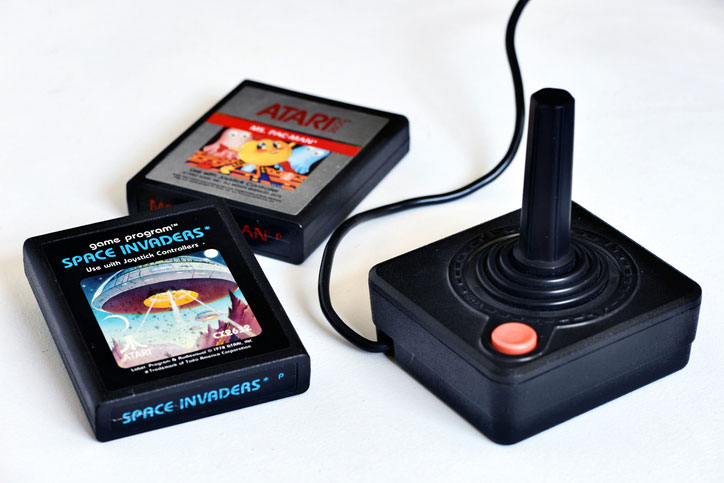
Before Nintendo, Xbox, and PlayStation, home video gaming barely existed outside the arcade. Atari's arcade Pong arrived in 1972 and was a hit, but the shift that mattered came in 1975, when the company put a home version under the television set. As host Lizzie Peabody tells it in The Worst Video Game Ever, Atari brought the arcade into the suburban living room, and it didn't happen by accident. The company hired the best programmers it could find and pointed them at one question: what makes a game fun?
Atari grew fast and dominated the early home console market. So in 1981, when the company went after Hollywood, nobody was surprised. Howard Scott Warshaw spent roughly eight months building a game around Raiders of the Lost Ark, and it sold well. When Spielberg released E.T. in the summer of 1982, a second movie tie-in looked like free money.
It wasn't. Warshaw got about five weeks instead of eight months, because the cartridges had to be on shelves by Christmas. He delivered on time. Atari manufactured the game in enormous quantities. And "E.T. the Video Game" became famous as the worst game ever made, got blamed for the collapse of the American console industry, and ended up buried in a New Mexico landfill. Warshaw has always pushed back on the simple version of that story, and he has a point: one bad cartridge doesn't sink a company that size. But the decision that produced it says something about what had already gone wrong.
What follows is the lesson I draw from that history rather than a business-school post-mortem. Take it as an analogy, because that's what it is.
The collapse is a useful warning for educators, and it comes down to three things.
- Keep the main thing the main thing.
- Innovate, then keep innovating.
- Outwork and outlast.
Keep the Main Thing the Main Thing

My reading is that Atari let a director's prestige and a holiday deadline reorder its priorities. Simon Sinek would call that losing your Why, the argument he makes in Start With Why. Whatever the full story of the company's decline, the rushed game itself wasn't slightly worse than the last one. It was incoherent.
Warshaw himself put his finger on the problem later. A good game should frustrate you, because frustration is what makes getting better feel like something. What it should never do is disorient you. A frustrated player tries again. A disoriented player has no idea what they're supposed to be doing or why it matters, and they put the controller down.
I've found that distinction useful in a classroom, with the caveat that a game and a lesson aren't the same thing. Productive challenge can support learning, but students also need clear goals and appropriate support to get through it. The version that goes wrong is the lesson where a student can't tell what they're aiming at or why it matters, and that's often what you get when the teacher is being pulled in six directions at once.
Most teachers know this. The trouble starts a few months into the year, when the pressure for higher scores arrives, plus a building-wide initiative, plus whatever great idea came out of the last conference, plus parent concerns. By spring, the clear purpose that a teacher started the year with has been sanded down to a schedule. They're on pace, and the whole thing is muddled.
A clear Why is the defense. It settles how you handle a discipline problem, how you set up the room, how you talk to families, and which of the six competing demands you can afford to let slide.
It's also what pulled Mr. Shaw back. The day after schools closed, he was in my office and furious. "This isn't teaching," he told me. "This is hell." Twenty-nine years in, and this was the worst thing he'd been handed.
Two days later he was leading. He was building online lessons his students were forwarding to friends across the state, checking on other teachers, and dancing in staff videos. He was doing what good teachers do in a crisis, which is figure out what still works and do that. His Why hadn't moved, so nothing else needed to.
Atari lost the thread and got remembered for the worst game ever made. Mr. Shaw held onto his and steadied an entire school.
A Failure to Innovate Assures Nothing But Certain Failure

Atari also stopped pushing. By 1983, programmers were bumping against the console's memory and graphics limits, so the games started to look alike, and players got bored. When people returned to E.T., plenty of them didn't swap it for another Atari title. They left the platform. The American home video game market crashed hard in the years that followed, and the industry's revival came from Japan, when Nintendo and Sega brought their consoles over later in the decade.
Adam Grant's Originals gets at why organizations drift into that position. Most people, in most institutions, choose to fit in rather than stand out, because standing out carries risk and fitting in carries a career. Rocking the boat gets you noticed for the wrong reasons. Going with the flow gets you to retirement.
Playing it safe is fatal to innovation, though, because it swaps curiosity for conformity. And curiosity is the thing. Deepak Chopra makes the point in Meta Human that human history is a sequence of boundaries being tested and then moved, and that we're the only species that treats risk as fun.
You couldn't always say the same about classrooms, and the reasons are real ones. Standardized measures are useful, and I'm not arguing for throwing them out. But we have leaned on them because they're countable, and a system that only values what it can count will squeeze out everything it can't. Learning is supposed to involve some risk, some failure, some visible growth. A lot of the time what it involves instead is data.
Mr. Shaw is not a technology person. He doesn't own a cell phone. No Facebook, no TikTok. As far as I could tell, his only device was the desktop in his science room, used for grades, handouts, and projecting notes. Then the shutdown hit, and he had to teach entirely online, which meant a Google Classroom account and daily video posts. Teachers half his age were hesitant about that.
Within days, he was the one setting the pace, and he was having fun with it. He ran a daily "Find Beaker" challenge and had students sending back their own videos. He changed how he taught so he could keep reaching his kids, and in doing it he showed the rest of us what adapting actually looks like when it isn't a slide in a PD deck.
Outwork and Outlast the Naysayers

Our last day of that year was bittersweet. Sweet because we were finally closing the door on it. Bitter because several good teachers were leaving, Kevin Shaw among them.
We sat around sharing memories, some of us crying, and Mr. Shaw mostly listened. At the end, he wiped his eyes with a balled-up napkin and asked if he could leave us with one thing.
"Since the beginning of my teaching career, I've had one guiding truth that's carried me through," he said. There was a pause while he found the words, and a sort of collective leaning in.
"Show up every day, outwork and outlast the naysayers, work hard." Heads nodded.
"Get to work," he said, raising his hands in an it's-just-that-simple gesture. Then they dropped, and he looked around the room. "Get to work."
Education overthinks itself sometimes. It reaches for the complicated framework when what the situation actually calls for is people showing up and caring about the work in front of them.
Kevin Ashton, who wrote How to Fly a Horse, describes creation as mostly unglamorous. First attempts are rarely terrible and almost never good. They tend to be average. Their real virtue is that they break the blank page, and everything after that is revision.
That's what innovation is in a school building. Not a keynote and not a grand redesign, but small improvements that accumulate because somebody kept going after the first draft was mediocre. The teachers who improve their craft are the ones who break the blank page again and again.
COVID-19 cost that school year a great deal. It also handed the profession a rare opening, and openings close. Atari got complacent and distracted. Kevin Shaw got frustrated and stayed focused. One of them ended up buried in a desert.
Where will you be?
Frequently Asked Questions
Why is education slow to change?
Research identifies structural factors as important barriers to sustained innovation, including bureaucracy, accountability pressures, implementation challenges, and leadership continuity. Individual attitudes and habits play a part too. What tends to get missed is that schools adopt new ideas fairly readily, but often can't sustain them long enough to see whether they worked.
Did COVID-19 actually change how schools teach?
Less than it looked like it would at the time. Analysts describe post-pandemic K-12 innovation as additive rather than disruptive, showing up as isolated experiments in individual classrooms instead of systemwide shifts. Plenty of teachers came out of that period teaching differently. Most buildings went back to their prior routines.
What's the difference between innovating and just adopting new tools?
A tool is innovation only if it changes what students actually do. Putting worksheets into a learning management system isn't a new practice, it's the same practice on a screen. The useful test is whether the change alters how students engage with the material or only where the material lives.
How can one teacher innovate when the system around them doesn't?
Start narrow and finish what you start. Pick one unit, change one thing about how students interact with it, and run it long enough to know whether it worked. Small changes that get refined over several years outlast building-wide initiatives that arrive with a launch meeting and disappear by spring.
- Structure matters, not just willpower - Bureaucracy, accountability pressure, and leadership turnover are real barriers, working alongside individual attitudes and habits.
- Adoption isn't the problem - Schools take on new frameworks constantly and finish almost none of them, so change looks like churn rather than progress.
- Challenge needs direction - Appropriate challenge can build capability, while unclear purpose can undermine engagement.
- A clear Why filters the noise - Teachers pulled toward scores, initiatives, and parent demands need a fixed purpose to decide what gets dropped.
- Innovation is incremental - Real change comes from small revisions repeated over years, not from a keynote or a redesign.
Teachers who want to push their practice further often end up back in a program: a master's in curriculum and instruction, a reading or special education endorsement, an administrative credential. The sponsored programs on this page list format, cost, and whether the coursework can run alongside a full teaching load.
You can connect with Brian on Twitter at @miller_brian_
- Five Ways for You and Your School to Thrive This Year - August 30, 2021
- Is a Teaching Degree Worth It? Cost vs. Salary 2026 - July 14, 2021
- Teaching Is Not a Job. It’s a Calling. - January 6, 2021