
When a Student Dies: A Teacher’s Reflection on Grief
There's no single right way to grieve when a student dies. Teachers may experience many common grief reactions, including denial, anger, sadness, bargaining, and eventual acceptance, but grief doesn't follow a fixed set of stages or sequence. Talk to your class honestly, using the words "death" and "died" rather than euphemisms, and lean on colleagues and school counselors.


It was a quiet Sunday afternoon here in N.E. Arkansas. The weather was beautiful. The sky was a clear blue with those fluffy white clouds, letting us know Spring is here and Summer will make its warm presence known very soon. It was a great day to sit outside on the patio and enjoy the sun warmly kissing my pale Northern girl arms, face, and legs.
A text from an unrecognized number popped up on my phone, lying on the bistro table next to me. I read the message. It was so unbelievable that I read it again. And again. And again. "Stevie Mason passed away Friday. Funeral arrangements have been made at…We are so thankful for what you did for him. He shouted ‘Miss Mary' for months after leaving your class."
What. The. Heck?
Disbelief suspended and forgetting about propriety (because I'm old and sometimes doing my best to be proper as frequently as possible still matters to me, although etiquette typically evades me), I replied and asked, "Who is this? I am so sorry to hear of this news." Stevie's stepmother confirmed her identity. She told me that Stevie had passed away from choking. It was accidental and unrelated to his disabilities. The shock began to set in. I've never had a student die before.
Who Was Stevie?
Stevie arrived in my class in late Spring. His records indicated he was a student who was non-verbal, was a child with Cerebral Palsy, had a shunt in his head, very low vision, and was on the Autism Spectrum. Our boy was considered nonverbal but did utter refrains parrot-like. He had come to school the day after a change in his living situation occurred. He was now residing with his father and stepmother.
Stevie also had a few issues with behavior…he was defiant and would scream when he didn't get his way. He would bite and pull hair. He pulled hair A LOT. He was also a runner.
Academically, he was low, but that was okay. Stevie could match letter cards to alphabet cards. He could follow simple directions. He could walk in a line when he felt like it, and Stevie was very loving, and his feisty antics were always done with a cat-who-ate-the-canary grin on his face.
This strawberry-haired lad took quite a shine to our classroom paraprofessional. She would work with him; he would hug her. She would diaper him; he would chatter at her indistinguishably. She would tell him to get beside her and hold his hand to go to lunch; he would run the opposite direction. She would playfully chase him.
The other kids in our class were great with him, demonstrating the kind of patience we Teachers don't always suspect our kids have. But when they showed him loving-kindness every day, they taught me what compassion looks like.
Stevie and I worked tirelessly together with a singular goal: no pulling hair. "Don't pull my hair," was his frequently repeated phrase. "You're right! Don't pull my hair!" His goal was to keep his hands to himself. We started small-two seconds at a time. Then we built to five seconds. Then we grew to thirty, then a minute. Eventually, the hair-pulling subsided, but it never ceased completely.
This fellow was complicated to me as his Teacher. To-date, I'd not had a student with such profound disabilities in my classroom. Because I loved him dearly, it was my mission to learn better ways to support his behavioral needs in addition to his physical and academic needs. Not gonna lie: being his Teacher could be exhausting, but we managed to communicate, and he learned. Me too.
Processing His Passing
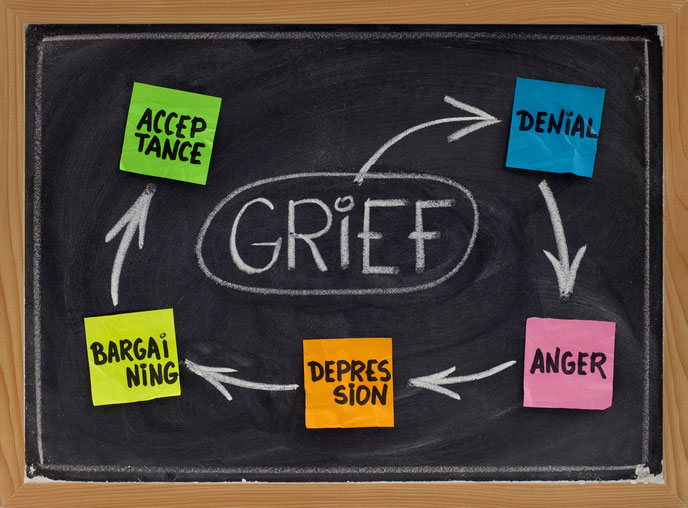
After several days, I realized that I was indeed grieving the loss of my student as one would grieve the loss of anyone close to them. I rotated through the Five Stages of Grief as if I were riding a teacup on the Mad Tea party Ride at Disney World. My head was whirring in wonder, asking myself over and over again if I had done enough to support this child. Had I truly done my best to overcome any personal anxiety I may have had about working with a child with special needs more significantly than I'd ever done before? Was I good enough to him? Was I good enough for him?
Denial
No. This wasn't happening. Children don't die first. We aren't supposed to bury our children. It seems so out of the natural order of life. We are especially not supposed to bury our children who are victims of horrible accidents. I'm sure I'll get another message saying this was all a cruel hoax, and they will tell me their son is just fine, right as rain…
Depression
Inability to travel the distance to attend the funeral. I can't even mourn his passing and give myself closure. What if it had been one of my grandchildren? Wouldn't I want their teacher to move Heaven and Earth to show her respect and sadness at their tragic and too-soon passing? Why is this all so cruel and wrong? His poor family…I felt a deep, intense sadness thinking about other families who've lost their children all too soon. Has anyone from the school stood beside them?
Anger
Why aren't people acting as I feel? Why didn't certain professionals outwardly act more sad? Why didn't peers seem sadder? Do people just not care anymore? Are we turning into a heartless society? Is it because he was a child with disabilities? Did his life just NOT matter as much to others? No offers of t-shirt sales for fundraisers, no coin canisters on the counters at local gas stations to collect change. His memory will have to live on in the hearts of those who knew him best because it seems like those are the only ones who care. Sure, a local favorite restaurant fails a whole community gets behind the effort to keep it open. A child dies-a child with SPECIAL NEEDS dies-and it doesn't even make a corner in the newspaper? Nothing to celebrate him? Yeah, there were days when 3:00 couldn't come quickly enough, but our class always wanted to love him, to educate him, to be friends with him, to give him opportunities to have fun, too. Maybe Special Ed. classrooms really ARE silos-lonely places-where we're left alone to ply our trade with "those kids."
Bargaining
If there really is any justice in this world, Stevie would still be around. I mean, there are so many horrible human beings roaming this planet who could have easily taken Stevie's place and allowed him to remain with us. It's not okay! He should still be alive! He is a child whose only "crime" was being in the wrong place at the wrong time. IT'S JUST NOT FAIR!!!! Trade his life for one of those horrible people who prey on other innocents. PLEASE just bring him back!
Acceptance
Accepting the death of a child is something I'm not sure anyone actually does. Don't tell me he is in a better place. Don't tell me his body is now whole…my faith causes me to already know that. What I am unsure I will ever be able to accept were the circumstances surrounding his death. It was an accident. While accidents do happen, they're not supposed to leave the world with one less child. But no amount of tears flowing, negotiating with God, or offering to trade out other, more sinister souls for that of one young boy is going to cause him to return to us.
Instead, we do what we can to honor his memory. We will speak well of him; we will develop more fully as professionals by choosing to learn more about how to work with kids whose disabilities fall outside the usual box in which we typically work. We will remind our professional community that the kids in my care are the kids in the care of ALL of us…they're not just "your" kids or "my" kids. They're OUR kids. They may talk funny, have physical appearance differences, or smell because of a physical issue over which they have no control. They may make a lot of noise. They might pull "hurr." Every single one deserves to be loved and mourned when they pass.
Pressing Onward
If we've lived any length of time, we know there is so much in life that is just unfair. My heart will never be the same because of Stevie's passing. I hope it will be better, bigger, and broader in my thinking when it comes to better educating children with special needs.
Thanks, Stevie, for assuming the role of Teacher. I hope I have been a good student. I promise I will make you proud. I will work hard to do so until we meet again…
If you have experienced the loss of a child, here are some resources to assist in the grieving process: sharing the experience, what not to say, and helping students grieve loss.
Frequently Asked Questions
What should a teacher do when a student dies?
Be honest with the class using plain language like "died" instead of euphemisms, let students ask questions, and give them room to react differently. Loop in your school counselor early. Expect that some of the heaviest processing happens in the days and weeks after, not just the first one.
Is it normal for a teacher to grieve a student like a family member?
Yes. Teachers spend hours a day with the same kids, often for a full school year, and that closeness doesn't disappear because the relationship was professional. Feelings such as disbelief, anger, and profound sadness can occur during grief, and having them doesn't mean you're overreacting.
Should a teacher attend a former or current student's funeral?
There's no rule that says you have to, and distance, timing, or school obligations sometimes make it impossible. What matters more is finding some way to acknowledge the loss, whether that's reaching out to the family, marking the day with your class, or giving yourself space to grieve on your own timeline.
Where can teachers find support after a student's death?
Your school or district may have a crisis-response or bereavement protocol - check with an administrator, counselor, or employee assistance program. The National Center for School Crisis and Bereavement publishes free guidance specifically for schools responding to a student's death, and grief-specific resources beyond the building can help too.
- Grief isn't linear - feelings such as disbelief, anger, sadness, and acceptance can come and go, and there is no required sequence or timeline.
- The classroom grieves too - students who spent real time with the child who died need honest, age-appropriate conversation about the loss, not silence.
- Some settings create closer bonds - the hands-on and individualized nature of some special education settings can create especially close relationships, so the death of a student may affect educators deeply.
- Grief support isn't in the job description, but it's part of the job - nobody trains you for this in your certification program, yet it's one of the realities a career in education can ask of you.
- Support exists beyond the building - school counselors, grief-specific resources, and other educators who've lived through the same loss are there to lean on.
If moments like this are part of why you're drawn to special education, the certification and training programs listed here focus on preparing teachers for exactly that kind of work, and for the support most first-year special ed teachers say they wish they'd had going in.
- The Pros and Cons of Being a Principal: An Honest Look - July 29, 2021
- Special Needs Prom: How One Student Led His School’s Grand March - April 20, 2021
- Behavior Management Training for Teachers: What to Ask For - October 9, 2020