
Rural STEM Education: Inside Alabama’s Black Belt STEM Institute

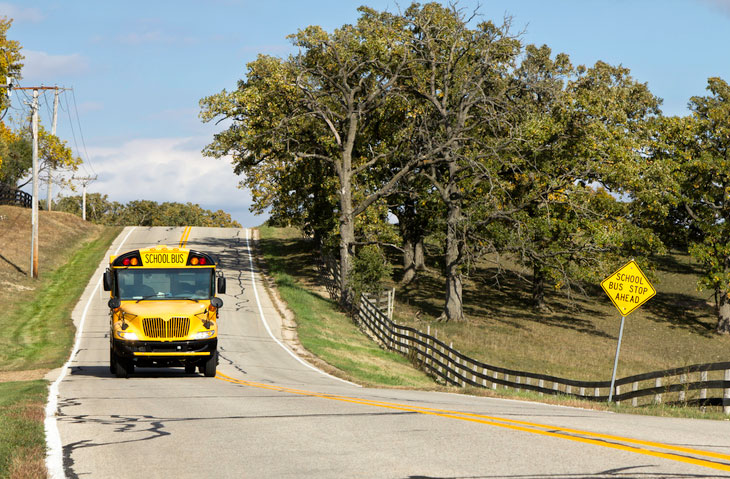


Rural STEM education struggles less from a lack of student interest than from a lack of infrastructure: certified teachers, equipment, and travel budgets. In Alabama's Black Belt, the University of West Alabama's Black Belt STEM Institute answers that with coaching, credentialed training, and loaned equipment, staffed largely by people who grew up in the region.
About one in five U.S. public school students attends a rural school, according to the National Center for Education Statistics. Many rural schools struggle to staff specialized STEM courses. A 2025 Government Accountability Office review of federal STEM initiatives found that districts in Alabama, Maine, Nevada, and South Dakota named the same three barriers: they couldn't attract certified teachers, couldn't get materials, and couldn't afford to bus students to anything worth seeing.
Curriculum redesign doesn't fix that. Neither does a national push toward computer science, if the district has nobody qualified to teach it. Infrastructure can be a major barrier to rural STEM education even where student interest exists.
That gap is visible in the Black Belt region of Alabama. Bureau of Economic Analysis data from 2022 placed many of the roughly 20 counties that make up this stretch of rich, dark land among the poorest in the state and the nation. The figures below come from reporting published between 2019 and 2022 and describe the region as it stood when this interview took place. They have not been refreshed against newer data, so read them as a historical snapshot rather than a current measurement:
- State assessments reported in 2022 found 22% of Black Belt students proficient in science.
- In 2019, 39% of Black Belt residents had no more than a high school education. Only 6% had obtained any sort of professional or graduate certification.
- A 2022 Alabama Commission on the Evaluation of Services (ACES) report placed 4 of the 10 Alabama counties with the highest teacher turnover rates in the Black Belt, with rates in some districts reaching 32%.
For 11 years, Dr. Chet Nicklas worked in secondary STEM education in Meridian, Mississippi, a city adjacent to the Black Belt. He saw many of the region's challenges firsthand:
"Some of these areas have large amounts of land with not very many people. A lot of educators teach elementary all the way through middle school - maybe 3rd, 4th, 5th, and 6th grade all in the same day. So most of the time, nobody's going to transfer in to teach in our schools. The teachers are home-grown talent. They don't come from outside."
That reality led Dr. Nicklas to change careers. But he didn't leave education or the Black Belt. He took a position that put him at the center of the region's effort to improve STEM education. In October 2022, he became the Director of the Black Belt STEM Institute at the University of West Alabama.
The Institute is located on UWA's campus in Livingston, Alabama, on the western side of the Black Belt. It aims to train teachers in STEM education, keep students interested in STEM, and meet the region's demand for skilled STEM workers. None of those are easy goals given the Black Belt's current position. In an interview with Teacher.org, Dr. Nicklas discussed these issues in detail and how he and his colleagues at the Institute are addressing them.
Dr. Chet Nicklas earned a Bachelor of Science in Biology from the University of West Alabama in 2011, followed by a Master of Education in 2012 and an Education Specialist degree in Educational Leadership in 2015, both from Mississippi State University. He spent 11 years teaching biology, chemistry, and physical science at high schools in Meridian, Mississippi, where he also served as a football coach and bus driver. In 2021, he completed a Doctor of Education in Rural Education and Organizational Change at the University of West Alabama, writing his dissertation on inequitable broadband access in rural schools. He returned to UWA in 2022, where he now serves as the Black Belt STEM Institute's Director and as an Adjunct Professor.The Black Belt's Multilayered Teacher Problem
High turnover rates and the stresses Dr. Nicklas saw in his own career are only the start of the Black Belt's educational problems.
According to that same 2022 ACES report, Alabama increased its teaching workforce by 2,000 from 2015 to 2021. That number is less encouraging than it looks. Over half of the teachers Alabama hired in that period held non-traditional or emergency teaching certificates.
Those Alabama categories don't map cleanly onto other states. States offer different alternative, provisional, or emergency pathways to address staffing needs, and requirements, credential names, and issuing agencies vary by state. What the pathways have in common is that they bring in people who already hold a degree in another field. Teachers entering through alternative pathways may have different preparation and support needs, particularly when teaching in hard-to-staff STEM fields.
The barriers stack in a predictable way, and the Institute's programming is built to answer each one:
| Barrier | How it shows up in the Black Belt | Institute response |
|---|---|---|
| Recruitment | Few teachers transfer in, so staff are largely home-grown | Partnerships with UWA faculty, students, and pre-service teachers |
| Retention | 4 of Alabama's 10 highest-turnover counties sit in the region, some districts at 32% | Math and science coaches, plus in-person and virtual mentoring |
| Subject expertise | Over half of Alabama's 2015-2021 hires held non-traditional or emergency certificates | Subject-specific courses that end in a credential |
| Equipment | Districts can't fund robotics kits or lab materials | Purchased robots and Microbits, plus Beta Box residencies |
| Career exposure | Few STEM employers are visible to students locally | Employer visits, mock interviews, and county career tours |
Dr. Nicklas says the Institute is already working on the retention piece for traditional and non-traditional teachers alike:
"We're hiring math and science STEM coaches to help teachers build efficacy. We hope to facilitate the likelihood that they're going to remain in the classroom and remain effective. Those sessions are going to be in-person and virtual. And that also comes with virtual mentoring sessions."
In these sessions, Black Belt Institute partners help teachers craft lesson plans, learn new STEM teaching methods, and find ways to reach their students. The Institute also offers classes on specific areas of STEM, delivered under TEAMS approval and AMSTI affiliation. UWA describes these as professional development sessions for math and science teachers, and what a teacher earns on completion is professional-development recognition rather than a state teaching certificate or endorsement. It does not by itself change a teacher's Alabama certification, which is issued separately by the state's educator-certification agency.

But where do the Institute's coaches, mentors, and STEM experts come from? If Black Belt districts are already stretched, who has time to support professional development? Dr. Nicklas says they largely come from the area:
"We use a collective impact approach - partnerships - to reach these schools. Everybody that can help here has had experience with the Black Belt region."
UWA's own faculty, students, and pre-service teachers from the school's College of Education partner with K-12 schools to address their specific needs. UWA's Cahaba Biodiversity Center recently joined forces with the Institute, and Dr. Nicklas plans to use that partnership to host biology-focused teacher retreats.
Other experts come from local businesses and community organizations. That keeps the material teachers receive aligned with what regional employers actually hire for. Despite the range of backgrounds, everyone at the Institute shares one thing: they're invested in the Black Belt and want to see it succeed.
State Funding and Stipends: Making the Black Belt Institute Accessible for All
Geographically, the Black Belt STEM Institute is within reach of most of the teachers it intends to serve. Dr. Nicklas and his UWA colleagues, all experienced grant writers, work to make it economically accessible too:
"Because Alabama is in the bottom three states in math and science, we were able to get funding for this from the state. A lot of the educational consultants we use are state-funded already."
The same skills that fund the Institute also fund the teachers who attend it:
"One of the things we've started to do is provide teacher stipends. So when we're starting programs, we offer teachers stipends to come to the training and also to be the leaders in their school to get programs rolling."
Fostering Passion for STEM Amongst Students
For even the most experienced educators, getting students interested in STEM can be an uphill battle. Field trips, hands-on projects, and science competitions all help, but Black Belt schools don't always have the resources for them. The Institute does:
"We've purchased some equipment including robots, Microbits, and all the stuff schools need to get STEM off the ground. Then there's our partnership with Beta Box which does Skills on Wheels. They go around to different high schools and middle schools and do hands-on activities like programming cars and working with drones. They usually stay for about a week and then they leave teachers with all of these resources. It's really cool."
The Institute also partners with If I Had A Hammer, an organization that teaches fractions, scaling, and measuring through hands-on construction projects. Dr. Nicklas says Black Belt students often take part in HammerBuilds, constructing houses big enough for a whole group of 20 to 25 students to fit inside.
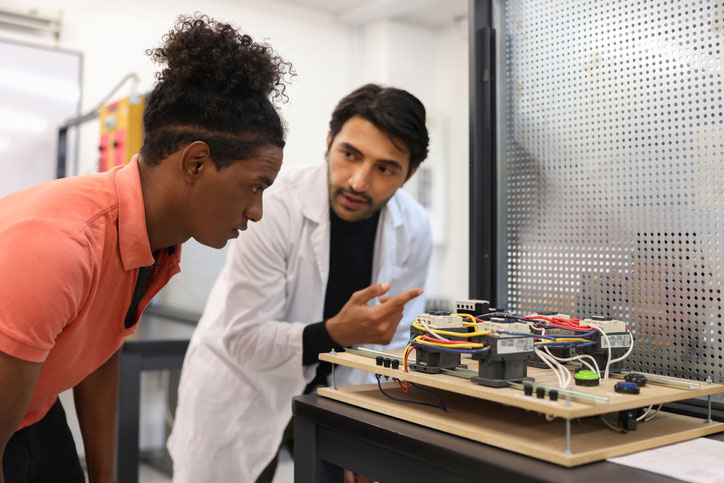
Beyond hammering home fundamentals, Dr. Nicklas said these experiences prepare students to enter STEM careers. Speaking at the time of the 2022 interview, he described what was then on the Institute's calendar:
"We invite companies to tell students what they're looking for. Some even do interviews and all that kind of stuff. That lets students know that if you can measure, you can get a job. Next week, NASA's coming. We're going on a little trip through the counties to present stuff they're offering career-wise."
Those conversations carry weight in a region where students rarely see STEM work happening close to home. They tell students their options aren't capped by where they live, and they make the case that a STEM career doesn't have to mean leaving.
The Cornerstone of It All: Building Community Bonds
The Black Belt STEM Institute is a UWA initiative, but its faculty and partners have made it into something larger: a place where community stakeholders of every kind pool resources and work toward a shared goal. That principle sits at the core of what Dr. Nicklas and his colleagues do:
"What we try to do first of all is create relationships. Relationships go a long way in making a difference. It's really hard to do it all by yourself."
While the Institute is addressing the Alabama Black Belt's specific problems, it's also building a model other communities can adapt. Each place will need its own version. But as Dr. Nicklas shows, students and teachers in even the most strained districts can succeed when a community decides education is the priority.
Frequently Asked Questions
Why is STEM education harder to deliver in rural schools?
The obstacles are largely structural. The Government Accountability Office found that rural districts struggle to recruit certified teachers, obtain lab and technology materials, and fund transportation to field trips. Infrastructure can be a major barrier even where student interest exists. A teacher covering four grade levels in a single day also has little room to build subject depth in science or math.
What does the Black Belt STEM Institute offer teachers?
The Institute provides math and science coaching, in-person and virtual mentoring, and subject-specific professional development delivered under TEAMS approval and AMSTI affiliation. Completing a course earns professional-development recognition, not a state teaching certificate or endorsement. It also supplies equipment schools can't fund on their own, including robots and Microbits, and brings in partner programs that leave materials behind after a residency ends.
Who funds the Institute's training and teacher stipends?
State funding covers much of it. Dr. Nicklas points to Alabama's standing in math and science as the argument that unlocked state support, and notes that many of the educational consultants the Institute works with are already state-funded. Those grants also pay stipends to teachers who attend training and lead programs at their own schools.
Does alternative or emergency certification affect STEM instruction?
It can, though not because these teachers are less capable. Over half of the teachers Alabama hired between 2015 and 2021 held non-traditional or emergency certificates. Teachers entering through alternative pathways may have different preparation and support needs, particularly in hard-to-staff STEM fields, and in districts already short on support, where mentoring isn't always available. Pathway names, requirements, and issuing agencies vary by state, so Alabama's categories don't describe how this works elsewhere.
- Infrastructure is a major barrier - Rural STEM shortfalls trace heavily to staffing, equipment, and travel budgets, and those obstacles bite even where student interest exists, a pattern the GAO documented across four states in 2025.
- Retention is the pressure point - A 2022 ACES report put four of Alabama's ten highest-turnover counties in the Black Belt, with some districts reaching 32%, and the Institute answers that with coaches and mentors rather than recruitment campaigns.
- The staffing model is local - Coaches, mentors, and partners are drawn from people who already have Black Belt experience, because teachers rarely transfer into the region from outside.
- Money removes the attendance barrier - State grants fund both the Institute's programming and stipends that pay teachers to attend training and lead it back at their own schools.
- Career exposure is part of the curriculum - Employer visits, mock interviews, and county tours with organizations like NASA connect classroom skills to jobs students can reach without leaving home.
Small and rural districts may need teachers to cover multiple subjects or pursue additional endorsements, and certification and assignment requirements vary by state. The sponsored programs on this page include online and hybrid options in science and math education, several of them built for teachers who are already working full time.
- Rural STEM Education: Inside Alabama’s Black Belt STEM Institute - June 27, 2023